



Choosing NOSHOK -Massmeasure Measurement Products


A plant outage rarely starts with a major component. More often, it starts with a gauge that was not rated for the service, a transmitter with the wrong connection, or a valve assembly that does not match the instrument manifold layout. That is why NOSHOK measurement products are typically sourced by specification first, not by appearance or price.
For engineers, MRO buyers, and maintenance teams, the value in a NOSHOK-focused catalog is straightforward. You are not sorting through general industrial inventory hoping a part might fit. You are working within a product family built around pressure, temperature, and flow instrumentation, where connection size, wetted material, pressure range, fill type, output signal, and mounting style all matter.
Where NOSHOK measurement products fit
NOSHOK measurement products are used across process control, hydraulic systems, compressor packages, pump skids, panel assemblies, utility systems, OEM builds, and general plant maintenance. The product line covers both local indication and instrument loop components, which means buyers can source a simple replacement gauge or build out a more complete measurement point with transmitters, manifolds, needle valves, diaphragm seals, and accessories.
That breadth matters when the application is specific. A dry utility gauge in a clean indoor setting is one decision. A liquid-filled stainless steel gauge on a vibrating pump discharge is another. A pressure transmitter mounted on corrosive media may require a diaphragm seal and capillary assembly rather than direct mounting. The right product family depends on service conditions, installation constraints, and required output.
Start with application, not product category
Technical buyers often know the instrument type they need, but the faster path is to start with service conditions. Pressure range is only one piece of the selection. Media compatibility, ambient temperature, process temperature, vibration, pulsation, mounting orientation, enclosure exposure, and connection standard are just as important.
For example, a pressure gauge selected only by PSI range can fail early if the case material, socket material, or movement is not appropriate for the environment. A transmitter selected by output signal alone may create installation issues if the electrical connection, pressure port, or turndown does not match the panel or PLC design. In other words, the correct NOSHOK part number is the result of several specification decisions, not a single category choice.
NOSHOK measurement products by major family
Pressure gauges
Pressure gauges remain one of the most common instrument replacements in industrial facilities. Within the NOSHOK range, buyers typically sort by case material, dial size, fill option, accuracy, and application style. General-purpose gauges may fit non-corrosive, low-vibration environments, while stainless steel liquid-filled gauges are better suited to washdown areas, outdoor exposure, and pulsating service.
Accuracy requirements also vary. A utility indication point on auxiliary equipment may not need the same performance level as a test bench or calibration-related application. Overpressure protection, restrictor options, and dual-scale configurations can also affect selection. The practical question is not just whether the gauge fits the pressure range, but whether it will remain readable and stable in the actual service conditions.
Pressure transmitters and transducers
Transmitters are usually selected where remote monitoring, control integration, or continuous signal output is required. Here, the details become more specific. Buyers need to match pressure range, output signal, excitation or loop power requirements, electrical termination, process connection, wetted materials, and enclosure suitability.
A compact transducer for hydraulic equipment has different priorities than a transmitter installed in a chemical process line. One may emphasize shock resistance and packaged equipment integration. The other may require broader material compatibility, tighter accuracy, and long-term stability. When replacing an existing transmitter, exact fit often depends on more than pressure range and signal type. Connection thread, body dimensions, and connector style can determine whether the replacement is truly drop-in.
Instrument manifolds and needle valves
Manifolds and needle valves are often treated as supporting hardware, but in instrumentation service they are central to isolation, equalization, venting, and safe maintenance. NOSHOK product lines in this category are relevant wherever transmitters, gauges, or pressure instruments need controlled isolation and service access.
Here, buyers typically focus on valve pattern, body material, pressure rating, end connection type, and mounting compatibility. A manifold selected for a differential pressure setup will not be interchangeable with a simple block-and-bleed arrangement. The layout has to match the transmitter and the piping configuration. Material selection matters as well, especially in corrosive service or higher-pressure applications where body integrity and packing performance are not negotiable.
Diaphragm seals and accessories
When the media is viscous, corrosive, sanitary, or subject to clogging, direct instrument mounting may not be the best approach. Diaphragm seals create separation between the instrument and the process, helping protect gauges and transmitters while maintaining pressure transmission.
This is where selection becomes application-driven very quickly. Seal type, diaphragm material, fill fluid, process connection, and temperature all affect performance. A poor match can introduce response lag, temperature-related error, or material compatibility issues. Buyers specifying seal assemblies usually need to evaluate the full system, not just the seal itself.
Switches, thermometers, and related instrumentation
Switches and temperature instruments are often purchased alongside pressure products in maintenance and OEM work. Pressure switches may be used for alarm, shutdown, or control logic. Thermometers and temperature-related accessories support local indication where electronic measurement is not necessary. As with the rest of the product line, connection type, material, range, and mounting style determine fit.
How industrial buyers narrow the correct part
A spec-driven buying process usually starts with five checks. First is process media, because material compatibility eliminates the wrong options immediately. Second is range and operating conditions, including expected spikes or cycling. Third is mechanical fit, such as connection size, thread type, orientation, and mounting. Fourth is electrical or signal requirement where applicable. Fifth is environment, including washdown, vibration, ambient conditions, and enclosure needs.
Cross-reference tools can shorten this process, especially when replacing discontinued or legacy part numbers. They are useful, but they should still be verified against the actual service conditions. Equivalent does not always mean identical in every dimensional or performance detail.
Common selection errors with NOSHOK measurement products
Most purchasing mistakes happen in familiar ways. One is choosing by pressure range only and ignoring wetted material. Another is assuming NPT, SAE, and other connection standards are interchangeable when they are not. A third is selecting a dry gauge where vibration calls for liquid fill, or choosing a general-purpose instrument for a corrosive or washdown area.
There is also the issue of over-specifying. A premium configuration is not automatically the best value if the service is simple and stable. On the other hand, under-specifying a transmitter or manifold for a demanding process usually creates higher replacement and maintenance cost later. The right choice depends on service severity, calibration expectations, and lifecycle cost, not just initial price.
Why authorized sourcing matters
For instrumentation buyers, product legitimacy is not a branding detail. It affects traceability, specification accuracy, and confidence that the received part matches the stated series and configuration. With NOSHOK measurement products, authorized sourcing helps reduce the risk of mismatched documentation, incomplete product data, or uncertainty around exact part numbering.
That becomes especially important when procurement teams are ordering replacements against an existing BOM, when OEMs are standardizing around a specific series, or when maintenance departments need consistent components across multiple sites. Buying through a specialist such as Mass Measure also improves the odds of finding an exact series match instead of a loosely comparable substitute.
When exact replacement is not enough
There are times when replacing the same part number is not the best decision. If the previous gauge failed repeatedly, the root cause may be pulsation, overpressure, corrosion, or temperature exposure. If a transmitter has had drift or connection issues, the original selection may not have matched the installation well. In those cases, the smarter move is to review the application and adjust the product family or configuration.
That could mean moving from a dry gauge to a liquid-filled stainless model, changing connection orientation for easier installation, adding a diaphragm seal, or selecting a manifold that better supports calibration and maintenance. Replacement should restore function, but it can also improve reliability if the underlying service conditions are addressed.
A precise instrumentation catalog is most useful when it helps buyers get beyond generic product labels and down to the actual configuration the application requires. With NOSHOK measurement products, the real advantage is not just brand familiarity. It is the ability to match gauges, transmitters, valves, seals, switches, and accessories to the exact service conditions they will face in the field.
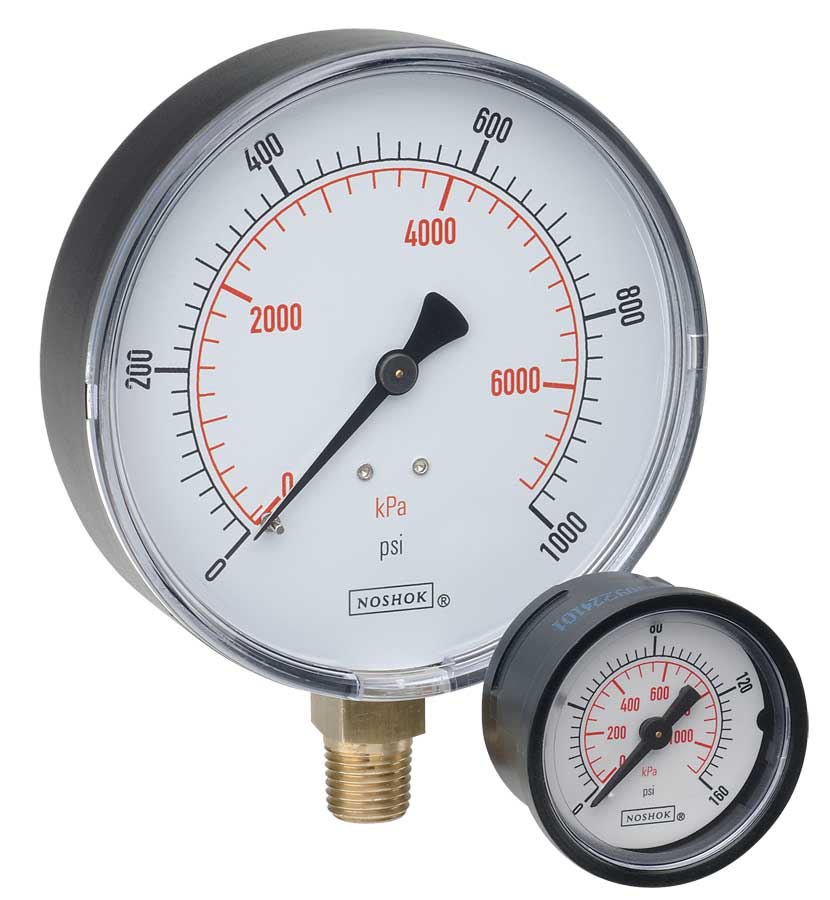 NOSHOK ABS & Steel Dry Pressure Gauges 100 series
 NOSHOK Low Pressure Dry Pressure Gauges-( 200 series)
 NOSHOK PT40 Series High Accuracy Transmitters-Replaces 100,200,615 series