



NOSHOK Transmitter Series Review for Industrial Use


A transmitter replacement can look straightforward until the new device reaches the plant and the electrical output, wetted material, pressure connection, or approval requirement does not match the existing installation. This NOSHOK transmitter series review is intended for industrial buyers who need to evaluate transmitter families by application requirements rather than by a generic product description.
NOSHOK transmitters are specified across process measurement, OEM, hydraulic, pneumatic, utility, and general industrial service. The practical value of the line is not simply that it measures pressure or temperature. It is the ability to select a configuration that aligns with the process connection, measurement range, output signal, media compatibility, installation environment, and control system already in place.
NOSHOK Transmitter Series Review: What Buyers Should Evaluate
A useful review of any transmitter series begins with the measurement task. Pressure transmitters, differential pressure transmitters, and temperature transmitters may appear in the same instrument schedule, but they solve different problems and require different selection criteria.
For pressure measurement, the first decision is whether the application needs gauge, absolute, vacuum, compound, or sealed gauge reference. A standard gauge pressure transmitter may be appropriate for pump discharge, compressed air, hydraulic systems, and many utility lines. Absolute pressure is more appropriate where atmospheric pressure variation affects the result, while compound ranges are commonly used where a process moves between vacuum and positive pressure.
Differential pressure measurement requires an additional level of discipline. The transmitter range must match the expected differential, but the unit must also tolerate the static line pressure on both sides of the sensing element. This distinction matters in filter monitoring, flow measurement across primary elements, tank level measurement, and other installations where a relatively low differential exists within a much higher-pressure process.
Temperature transmitter selection is similarly more than a question of operating temperature. Buyers must confirm sensor type, probe construction, insertion length, connection style, and the signal required by the receiving device. A transmitter that is correct electrically but poorly suited to the thermowell or installation geometry will not provide a reliable process measurement.
Pressure Transmitter Strengths and Trade-Offs
NOSHOK pressure transmitter series are commonly evaluated for their combination of industrial construction, standard analog outputs, broad range availability, and process connection options. For maintenance teams, this makes them practical candidates for replacing installed transmitters where the original part number is obsolete, unavailable, or no longer preferred.
The most common output requirement remains 4-20 mA, particularly in plants using conventional PLC, DCS, and remote I/O architectures. This signal is well suited to longer cable runs and provides a recognizable fault indication when loop current falls outside the normal operating range. Voltage-output models can be appropriate for OEM equipment and shorter-run machine control, but they require closer attention to power supply stability, input compatibility, and electrical noise.
Accuracy should be evaluated against the actual control or monitoring requirement. A highly precise transmitter is not automatically the best choice if the process connection, installation location, impulse line condition, or pressure range introduces larger sources of error. Conversely, a low-cost general-purpose transmitter may be a poor fit for calibration-critical systems, narrow-range measurement, or applications where repeatability affects product quality.
Range selection is one of the most consequential decisions. A transmitter should not be sized only to the maximum process pressure. If normal operating pressure occupies a very small portion of the selected span, the usable resolution of the measurement may be reduced. At the same time, selecting an excessively narrow range can expose the transmitter to overpressure conditions during startup, deadhead operation, pressure spikes, or maintenance events. The correct choice depends on normal operating conditions, maximum credible pressure, and the device’s published overpressure capability.
Material compatibility remains equally important. Stainless steel wetted components are suitable for many industrial fluids and gases, but not every chemical process. Corrosive media, high-purity applications, sanitary systems, and services prone to plugging may require a different wetted material, a diaphragm seal, or a modified process connection. A transmitter cannot correct for an unsuitable interface with the process.
Process Connections Are Not Interchangeable by Assumption
Thread size alone does not confirm compatibility. Buyers should verify the connection standard, thread form, sealing method, and available installation depth. NPT, SAE, DIN-style, tri-clamp sanitary, and other process connections are not substitutes for one another.
This is especially relevant when replacing pressure sensors on OEM machinery. A unit may have the same nominal thread size as the original device but differ in port geometry or sealing surface. In hydraulic equipment, that difference can create leakage, damage threads, or produce an unreliable pressure reading.
Differential Pressure Transmitters for Process Visibility
Differential pressure transmitters deserve separate consideration because installation quality has a direct effect on measurement quality. A correctly specified unit can still perform poorly if high- and low-side connections are reversed, impulse lines are plugged, condensate legs are inconsistent, or the transmitter is mounted without considering fluid phase and elevation.
For filter monitoring, the key measurement is often a rising pressure drop that signals loading or fouling. The selected differential range should provide meaningful indication during normal clean-filter operation while still accommodating the expected dirty-filter condition. Selecting too broad a span may make early restriction difficult to detect. Selecting too narrow a span can lead to frequent overrange conditions or false alarms.
In flow applications, differential pressure is frequently used with an orifice plate, venturi, pitot-style element, or other primary flow device. The transmitter itself is only one part of the measurement loop. Engineering teams should confirm the primary element sizing, fluid properties, operating pressure, temperature, turndown, and required square-root extraction method before selecting the transmitter range and output configuration.
For level applications on closed vessels, static pressure rating, wet-leg or dry-leg arrangement, remote seal requirements, and process temperature all influence the selection. A general differential pressure transmitter may be appropriate for clean, stable service. Viscous, corrosive, high-temperature, or crystallizing media often justify a diaphragm seal arrangement to protect the sensing element and reduce maintenance exposure.
Electrical and Environmental Fit
Industrial transmitters are often selected under time pressure, particularly during unplanned maintenance. That makes it easy to overlook power requirements, connector type, enclosure rating, cable entry, and hazardous-location needs. These details should be verified before ordering, not after the instrument is on site.
Confirm the supply voltage and output type against the existing panel input. Verify whether the transmitter uses a molded cable, DIN connector, M12 connection, conduit connection, or another termination method. Check the environmental rating against washdown, outdoor exposure, vibration, dust, and temperature conditions at the mounting location.
Hazardous-area requirements require particular caution. A transmitter suitable for general-purpose industrial service is not automatically approved for classified locations. When the installation requires specific protection methods or agency approvals, the exact model configuration and documentation must be reviewed against the site standard and applicable code requirements.
When a NOSHOK Transmitter Is the Right Fit
NOSHOK transmitter series are a strong fit when an application requires industrial-grade measurement with clear configuration control. They are particularly practical for buyers replacing common pressure and temperature instruments, specifying components for new equipment, or standardizing measurement hardware across multiple facilities.
The trade-off is that proper selection requires more than matching a pressure range. Buyers should identify the complete requirement: measured variable, range and reference type, output, power, wetted materials, process connection, electrical connection, accuracy, environmental conditions, and applicable approvals. For differential pressure service, include static pressure, line configuration, and the expected operating differential.
Mass Measure can assist buyers who need to identify an appropriate NOSHOK transmitter family, cross-reference a prior configuration, or confirm companion components such as manifolds, valves, gauges, and diaphragm seals. The best transmitter choice is the one that matches the process and the installation as a complete measurement point, not merely the one that fits the connection.
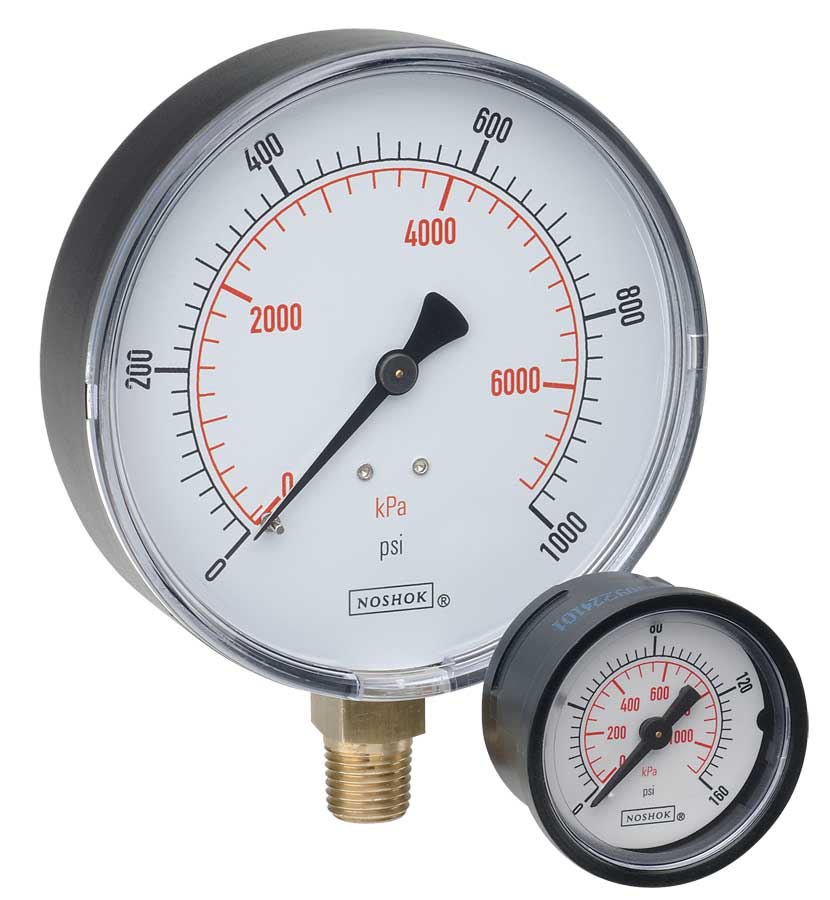 NOSHOK ABS & Steel Dry Pressure Gauges 100 series
 NOSHOK Low Pressure Dry Pressure Gauges-( 200 series)
 NOSHOK PT40 Series High Accuracy Transmitters-Replaces 100,200,615 series