



Pressure Switch Hysteresis and Deadband Control

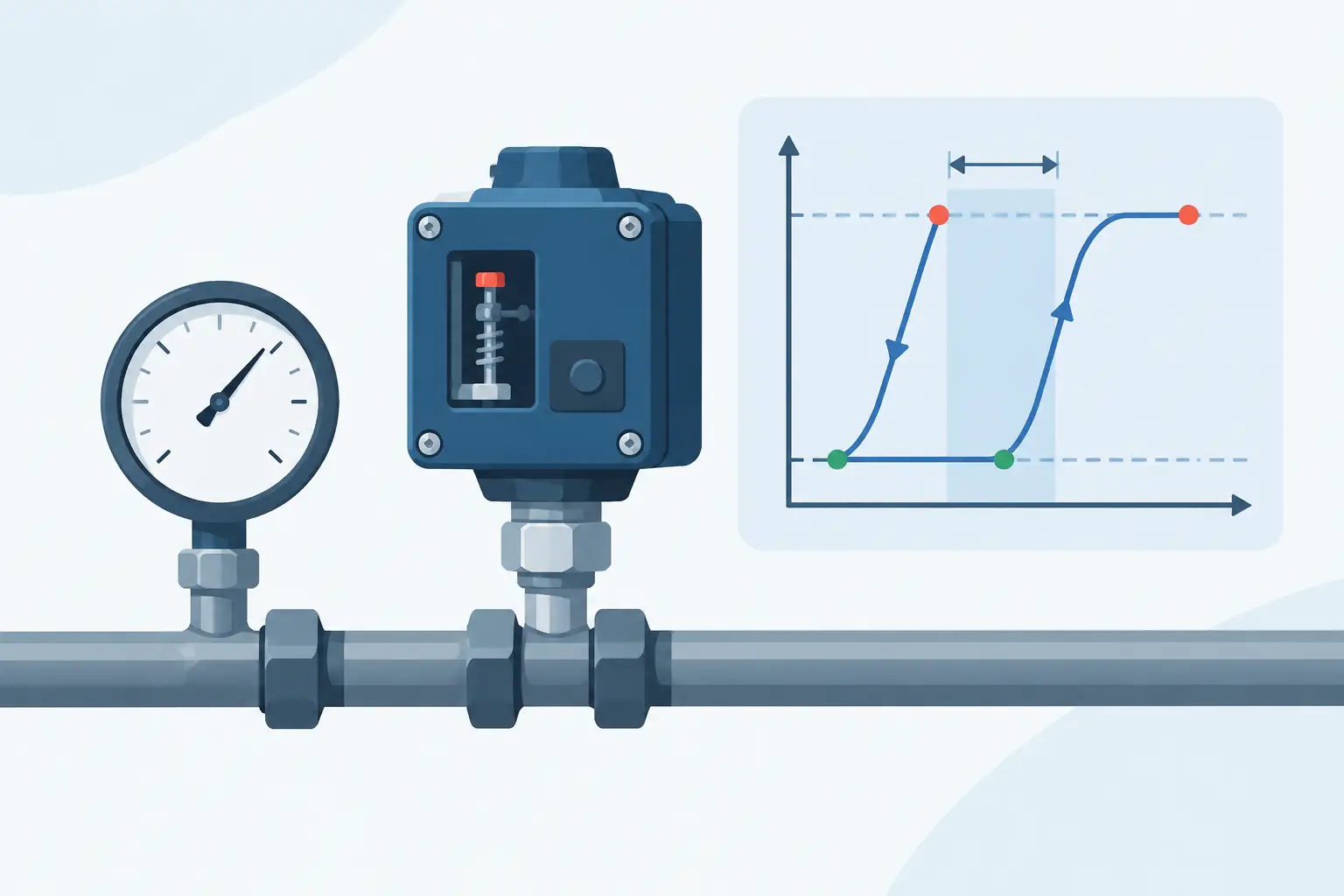
A pressure switch that cycles a pump contactor repeatedly within a few psi is not necessarily failed. The issue may be pressure switch hysteresis – the designed difference between the pressure at which the switch changes state and the pressure at which it resets. For industrial control circuits, that difference is what keeps normal pressure fluctuation from becoming relay chatter, short cycling, or nuisance alarms.
Pressure switches are often selected by pressure range and process connection alone. Those specifications matter, but hysteresis can determine whether the installed switch performs acceptably in the actual process. A switch with the right set point and the wrong differential may cycle equipment too frequently, delay a protective response, or fail to maintain the operating band required by the system.
What Pressure Switch Hysteresis Means
Pressure switch hysteresis is the separation between the actuation point and the reset point. It is also commonly called differential, deadband, or switch differential. Manufacturers may use these terms differently in product literature, so the stated operating values should always be reviewed rather than assuming the terminology is identical.
For a switch that actuates on rising pressure, the rising set point is the trip point and the lower pressure is the reset point. If a high-pressure alarm switch trips at 100 psi and resets at 90 psi, its hysteresis is 10 psi.
For a switch that actuates on falling pressure, the sequence is reversed. A low-pressure switch might close at 40 psi to start a compressor and open at 55 psi after system pressure recovers. In that example, the operating differential is 15 psi. The practical function is the same: the switch does not change state again until pressure moves far enough in the opposite direction.
The basic relationship is:
Hysteresis = actuation pressure – reset pressure
The sign and wording depend on whether the application uses rising or falling pressure actuation. For procurement, maintenance, and panel design, document both actual switching points. Listing only a nominal set point leaves too much open to interpretation.
Why Deadband Is Necessary in Industrial Systems
Pressure in a working process is rarely perfectly stable. Pump pulsation, compressor loading, valve movement, pressure regulator behavior, flow demand, and sensor location can all create momentary changes around a desired control point. Without a sufficient deadband, a switch can alternate between open and closed states as pressure moves only slightly.
That rapid cycling has consequences beyond an annoying indicator light. It can wear relay contacts, overload contactors, shorten motor life, create unstable pneumatic control, and generate repeated events in a PLC or building management system. In a shutdown circuit, repeated switching can also make fault diagnosis more difficult because the process condition and the electrical symptom no longer line up cleanly.
A wider hysteresis band provides greater immunity to these fluctuations. The trade-off is control precision. A pump controlled across a 20 psi band will operate less frequently than one controlled across a 5 psi band, but system pressure will vary more. Neither approach is automatically correct. The required band depends on process tolerance, equipment cycle limits, available storage volume, and the consequences of pressure excursion.
Fixed vs. Adjustable Pressure Switch Hysteresis
Many mechanical pressure switches have a fixed differential or a differential that changes as a percentage of the set point. This is common where a simple, repeatable on-off function is more important than a tightly controlled operating band. A catalog specification may state a nominal differential, a percentage of set point, or a minimum and maximum reset range.
Adjustable differential models allow the set point and deadband to be configured independently, within defined limits. They are useful when the process must start and stop equipment within a specific band, such as pump control, compressor control, or staged alarm logic. Adjustment does not eliminate the need for specification review. The achievable differential can be affected by pressure range, switch design, sensing element, and direction of operation.
Electronic pressure switches may offer programmable set points and reset points, sometimes with additional functions such as time delay, window switching, or configurable output logic. These features can improve control flexibility, but they introduce setup requirements. A programmed deadband should be verified during commissioning with a calibrated pressure source, not assumed from the display configuration alone.
Specifying the Correct Switching Band
A useful pressure switch specification begins with the actual process behavior, not just the desired trip value. Establish whether the switch is intended for high-pressure protection, low-pressure protection, pump or compressor control, filter monitoring, proof-of-flow confirmation, or alarm indication. Each duty has a different tolerance for cycling and pressure variation.
For a high-pressure alarm, a relatively narrow hysteresis may be acceptable if the alarm must clear soon after pressure returns to normal. For a motor-driven pump, a wider differential may be preferred to limit starts per hour. For a hydraulic system with substantial pressure pulsation, the switch may need enough deadband to avoid responding to normal transient peaks, while still reacting to a sustained overpressure condition.
The pressure range should be selected so the intended set point falls within a practical portion of the switch’s adjustment range. Specifying a 10 psi switch point on an excessively high-range device can reduce adjustment resolution and make field calibration difficult. Conversely, selecting a range that leaves little margin above normal system pressure can expose the sensing element to overload.
The complete specification should identify the following operating conditions in the purchasing record or instrument datasheet:
- Rising or falling pressure actuation direction
- Required set point and reset point in psi
- Acceptable hysteresis or differential range
- Normal operating pressure and maximum pressure exposure
- Process media, wetted materials, and ambient conditions
- Electrical load, output type, enclosure requirements, and connection style
These details prevent a common replacement error: installing a physically similar switch that has the opposite switching action or an unsuitable reset differential.
Factors That Affect Actual Switch Performance
Published hysteresis is not the only influence on field operation. Mechanical switches have repeatability and calibration tolerances. The switch may actuate within a stated tolerance around the adjusted value, and reset performance may vary slightly over repeated cycles. Temperature changes, vibration, mounting orientation, and pressure spikes can also affect apparent switching behavior.
System dynamics matter just as much. A switch mounted near a reciprocating pump or compressor discharge may see much sharper pressure fluctuation than a gauge located farther downstream. A restriction, snubber, or remote sensing line can reduce pulsation at the switch, but it can also slow the pressure signal. That delay may be unacceptable in a fast protective function.
Electrical behavior deserves attention as well. Contact bounce occurs at the moment a mechanical switch changes state and is distinct from hysteresis. Hysteresis controls the pressure difference between cycles; it does not eliminate millisecond-level contact bounce. PLC inputs, relay circuits, and sensitive electronic loads may require suitable suppression, debounce logic, or interface relays based on the control design.
Troubleshooting Frequent Cycling and Unstable Switching
When a pressure switch appears to chatter, start by confirming the actual pressure at the sensing point with a calibrated reference gauge or test instrument. Observe both increasing and decreasing pressure. Record the pressure where the switch changes state and where it resets, then compare those values with the required operating band and manufacturer tolerance.
If the switch changes state at the correct points but equipment still short cycles, the problem may be system capacity, inadequate receiver volume, control logic, a leaking check valve, or a process demand that changes faster than the equipment can respond. Replacing the switch without checking these conditions can mask the real cause.
If the observed differential is substantially different from specification, inspect for improper adjustment, damaged sensing components, blocked process ports, contaminated media, excessive vibration, or an incorrectly selected pressure range. Verify wiring before condemning the instrument. A normally open or normally closed contact connected contrary to the intended logic can resemble a switching fault.
For an exact replacement or a new design, Mass Measure can help industrial buyers align pressure range, connection, wetted material, electrical configuration, and required switching characteristics within the applicable NOSHOK product family.
Treat Hysteresis as a Control Requirement
Pressure switch hysteresis should be specified with the same care as pressure range, process connection, and electrical rating. A stated trip point tells only half the story. The reset point determines how the control system behaves after the first change of state.
Before releasing a purchase order or replacing a failed switch, write down the required rising and falling pressures and compare them with actual system fluctuation. That small step helps ensure the pressure switch supports stable equipment operation rather than becoming the next source of downtime.