



Soft Seat vs Hard Seat for Instrument Valves

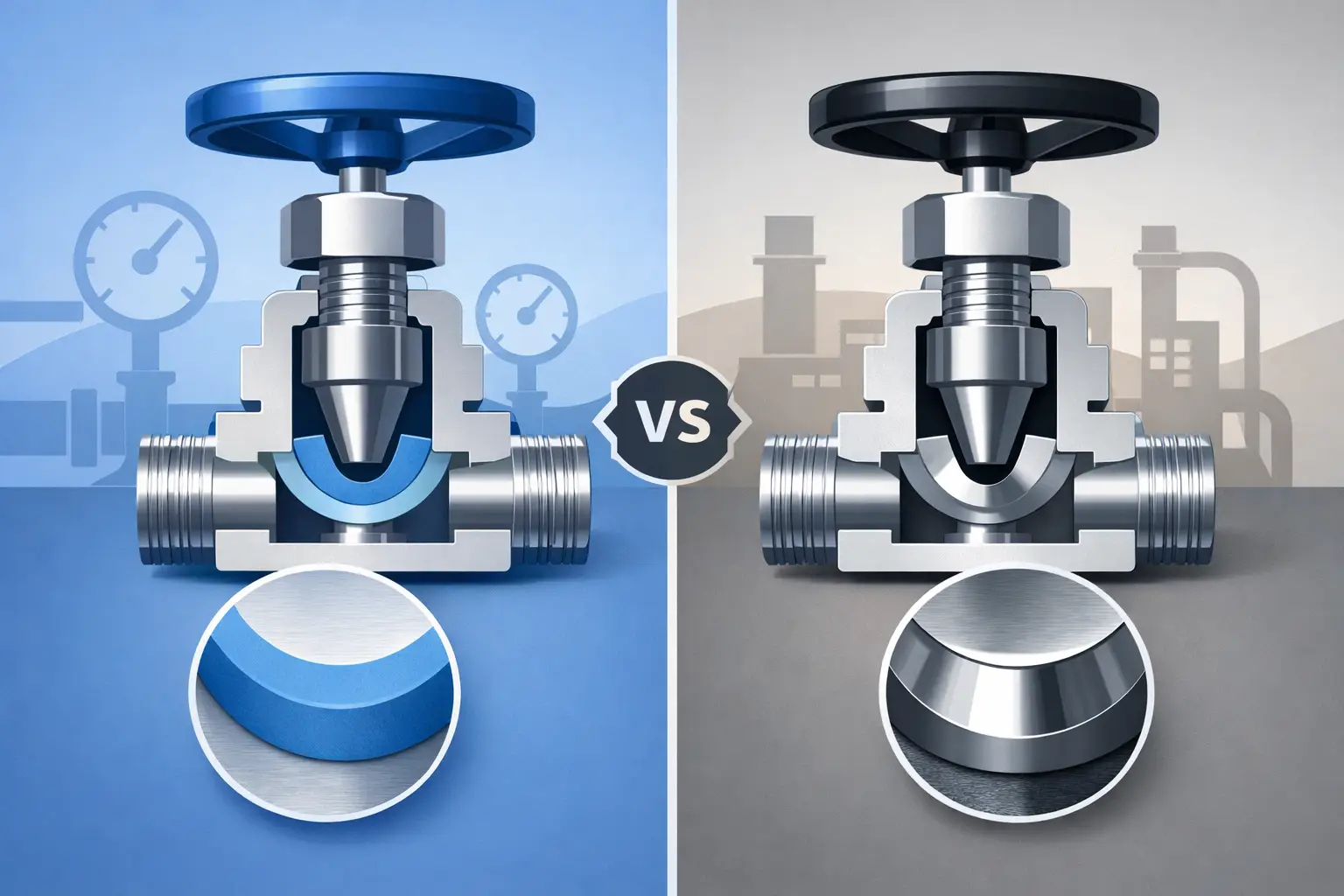
A valve seat is a small component with a direct effect on leakage control, maintenance intervals, and instrument isolation. In the soft seat vs hard seat decision, the correct choice is not determined by one specification alone. Process media, operating temperature, pressure differential, cycle frequency, cleanliness, and required shutoff performance all affect seat selection.
For pressure gauges, transmitters, manifolds, root valves, and other instrumentation assemblies, the seat must be considered alongside body material, stem design, packing, end connection, and pressure rating. A valve that seals effectively in a clean, moderate-temperature utility service may be unsuitable for a hot process line, abrasive fluid, or high-cycle isolation point.
What the Valve Seat Does
The seat is the sealing interface that closes when the valve stem, tip, plug, ball, or other closure member contacts its mating surface. In instrument needle valves and manifold isolation valves, this contact area controls flow to or from the pressure instrument. It is not the same as stem packing, which limits leakage around the moving stem, and it is not the same as a gasket or O-ring installed at a process connection.
A seat must hold against the actual pressure differential across the closed valve. It also has to tolerate the chemical and thermal conditions of the fluid contacting it. Even when a catalog describes a valve as suitable for a stated system pressure, the seat configuration can establish practical limits for temperature, media exposure, shutoff class, and service life.
The terms soft seat and hard seat describe the material behavior at this sealing interface. A soft seat uses a compliant material, often a polymer or elastomeric component, to conform to minor imperfections. A hard seat relies on metal-to-metal contact or another rigid seating arrangement. Exact construction varies by product series, so the manufacturer data sheet and ordering configuration remain controlling.
Soft Seat vs Hard Seat: Core Differences
A soft-seated valve typically requires less seating force to establish a tight seal. The compliant seat material can fill small surface irregularities and compensate for normal manufacturing variation. This makes soft seating useful where low leakage is a primary requirement and the process conditions remain within the material limits of the seat.
The trade-off is that soft materials have finite limits for temperature, chemical exposure, pressure differential, and mechanical wear. A seat may deform under excessive loading, swell when exposed to incompatible media, lose resilience after thermal exposure, or be damaged by particles carried through the valve. Repeated operation can also leave a compression set, reducing the seat’s ability to recover and seal.
A hard-seated valve uses a rigid sealing surface, commonly a metal tip engaging a metal seat. The construction is generally better suited to elevated temperatures, aggressive service conditions, and applications where a soft material would not remain stable. Hard seats can also offer greater resistance to extrusion and some forms of mechanical damage.
However, hard seating normally depends more heavily on the condition of the mating surfaces and proper operating technique. It may require higher closing torque, and it can be more sensitive to scratches, galling, misalignment, or solid contamination. Metal-to-metal seating should not be assumed to provide the same leakage performance as every soft-seat design. Required shutoff performance must be checked against the valve’s published specification.
Select by Process Conditions, Not Preference
A soft seat is not automatically the better sealing option, and a hard seat is not automatically the more durable option. The service defines the appropriate construction.
For a clean, compatible fluid or gas at moderate temperatures, a soft seat may provide the practical sealing performance needed to isolate a gauge or transmitter for service. This is often valuable where minor leakage would affect calibration work, troubleshooting, or safe instrument removal. The selected seat material still needs to be compatible with the process and any cleaning agents, flushing fluids, or condensate that may contact it.
For high-temperature steam, hot hydrocarbons, severe chemical exposure, or process conditions beyond the ratings of polymeric materials, a hard seat may be the better fit. The valve body and wetted trim must also be evaluated. Selecting a hard seat in 316 stainless steel does not resolve a compatibility concern if other wetted components, including packing or seals, are unsuitable for the application.
Pressure requires the same disciplined review. System pressure and differential pressure are related but not identical. A valve may be installed in a high-pressure system while experiencing a lower differential during normal operation. During isolation, depressurization, startup, or upset conditions, the differential across the closed seat can change substantially. The valve must be rated for the actual conditions it will see, not only for the normal line pressure shown on a process diagram.
Temperature, Media, and Cleanliness
Seat material selection often fails because the application review stops at pressure and connection size. Temperature can change both the sealing behavior and the mechanical strength of a soft seat. A material that performs acceptably at ambient temperature may soften, creep, or lose recovery at sustained elevated temperature. Low temperatures can create a different risk by reducing flexibility and increasing brittleness.
Media compatibility is equally specific. Hydrocarbons, solvents, acids, caustics, oxygen service, wet gas, and sanitary fluids can each impose different material requirements. Chemical compatibility references are useful starting points, but they do not replace the valve manufacturer’s rating for the exact seat material, concentration, temperature, and pressure conditions.
Cleanliness should be treated as a seat-life issue. Fine particulate can cut or embed in soft material. Larger particles can damage either style of seat, particularly if a valve is forced closed against debris. Instrument isolation valves are intended to control flow, not to correct a contaminated line. Where solids are expected, consider the overall installation arrangement, flushing practices, filtration, and the likelihood of debris reaching the valve.
Cycling and Operator Practice Matter
A valve that remains open or closed for long periods faces a different duty cycle than one operated every shift or used repeatedly during calibration. Soft seats can wear from repeated compression and reopening. Hard seats can wear from repeated metal contact, high torque, or galling. Neither design is maintenance-free when used frequently.
Operator practice has a measurable impact. Excessive closing force may damage a soft seat or distort the closure geometry. With hard-seated needle valves, overtightening can score the tip and seat, making future sealing less reliable. Use the valve as designed, avoid using it as a substitute for a flow-control device unless its specification permits that service, and do not use handwheel force to compensate for a damaged seating surface.
Thermal cycling also deserves attention in instrumentation installations. A valve body, stem, seat, packing, and connected tubing can expand at different rates. Repeated heating and cooling may change preload at the seat or packing. This is especially relevant for steam tracing, outdoor installations, heated process lines, and equipment that cycles between operating and washdown temperatures.
Seat Choice in Pressure Instrument Assemblies
When selecting a root valve, two-valve manifold, five-valve manifold, or isolation valve for a pressure measurement point, start with the function of the assembly. Determine whether the valve is used only for instrument isolation, for calibration and venting, for equalization across a differential pressure transmitter, or for controlled depressurization. The seat decision should support that function without creating a weak point elsewhere in the assembly.
For example, a pressure gauge installation may require dependable isolation so the gauge can be replaced without shutting down a larger section of the process. A soft seat can be appropriate when its pressure, temperature, and media limits match the process. A high-temperature process connection may instead call for a hard-seat configuration and a gauge protection strategy that addresses heat transfer, vibration, pulsation, and overpressure.
For differential pressure transmitters, manifold valve selection requires equal attention to isolation, equalization, venting, connection type, and pressure rating. A seat that performs well on an isolation valve may not be the only consideration. Correct manifold configuration, impulse line arrangement, and operating sequence are necessary to protect the transmitter and maintain measurement accuracy.
Verify the Exact Valve Configuration
Do not select a valve based only on a general description such as “soft seated” or “metal seated.” Confirm the exact series, model, seat material, body material, stem and packing materials, end connections, pressure rating, temperature range, and published leakage specification. Options within the same valve family can change the application limits.
The specification review should also confirm whether the listed ratings apply to liquid, gas, steam, or a particular temperature range. If the application involves oxygen, hydrogen, sour service, vacuum, high purity media, or a regulated sanitary process, additional cleaning, material, certification, or construction requirements may apply.
Mass Measure can help industrial buyers identify NOSHOK instrumentation components by series and configuration when an existing valve must be replaced or a new measurement point is being specified. Providing the current part number, process media, operating pressure and temperature, connection details, and required function will produce a more reliable selection than choosing by seat type alone.
The best seat is the one that remains compatible with the process, delivers the required shutoff performance, and fits the complete instrument assembly. Treat the valve seat as a specification decision at the design or replacement stage, before a small leakage issue becomes a process reliability problem.
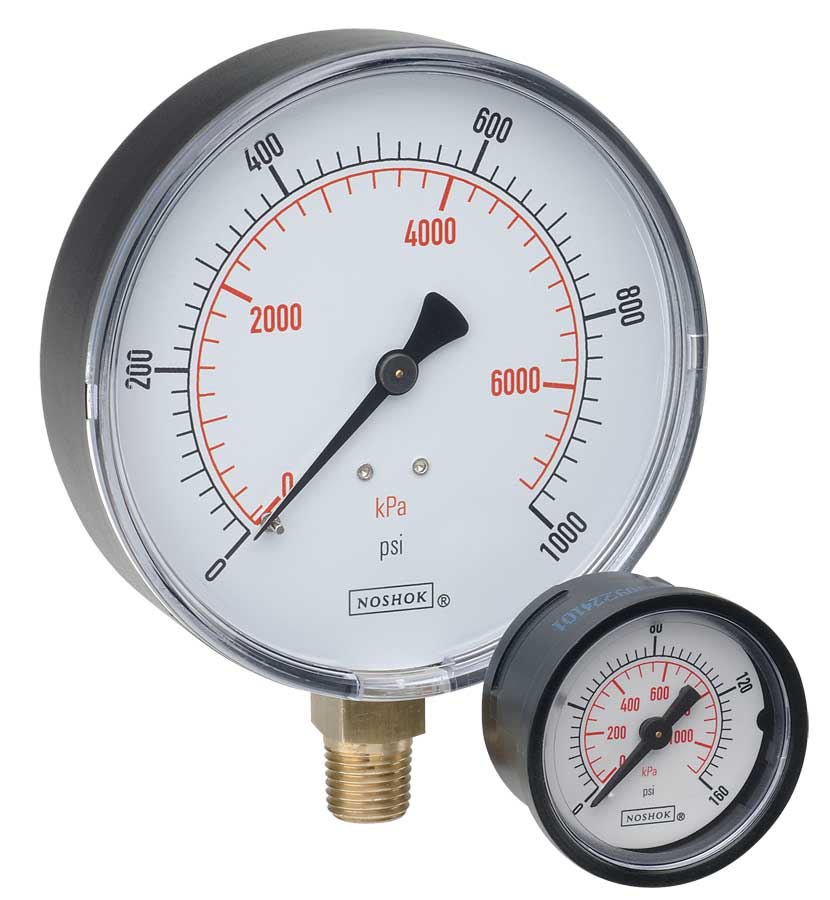 NOSHOK ABS & Steel Dry Pressure Gauges 100 series
 NOSHOK Low Pressure Dry Pressure Gauges-( 200 series)
 NOSHOK PT40 Series High Accuracy Transmitters-Replaces 100,200,615 series