



Best Industrial Pressure Switches for Specified Duty

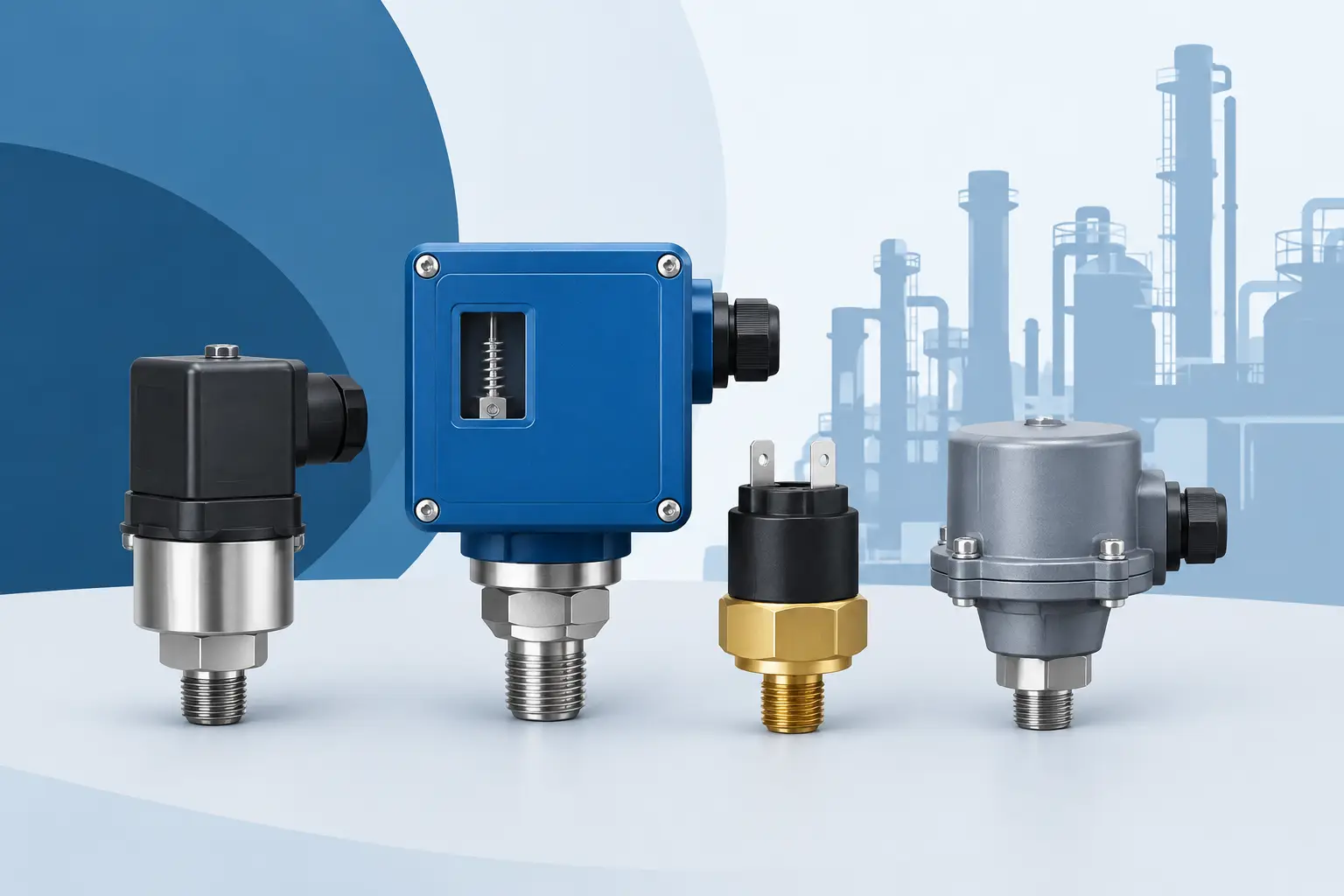
A pressure switch may be a small component in a control loop, but selecting the wrong one can create nuisance shutdowns, pump short-cycling, missed alarms, or premature failure. The best industrial pressure switches are not defined by a single brand feature or pressure rating. They are the switches that match the process medium, operating range, electrical circuit, enclosure requirements, and required switching behavior of the installation.
For maintenance teams, OEMs, and plant engineers, pressure switch selection should begin with the application specification rather than the part number. An exact replacement may be appropriate when the existing switch performed correctly. When failures are recurring or process conditions have changed, the replacement should be evaluated as a system component, not simply matched by connection size.
What Makes a Pressure Switch Suitable for Industrial Service
An industrial pressure switch converts a measured pressure condition into an electrical contact action. The switch may start or stop a pump, actuate an alarm, protect a compressor, prove system pressure, or provide an interlock to a PLC or relay circuit. The relevant question is whether its sensing element and contacts will operate predictably at the required setpoint over the expected service life.
Pressure range is the starting point, but it is not the whole specification. A 0-100 psi switch may physically survive a 60 psi system while providing poor setpoint resolution if the desired trip point is only 5 psi. Conversely, a narrow-range switch can offer better adjustment sensitivity but may be damaged by startup spikes or an overpressure event. Select a range that places the normal operating and switching pressures in the useful portion of the adjustment range while preserving a practical safety margin.
The best industrial pressure switches also provide the right differential, sometimes called deadband. Differential is the pressure change required for the switch to reset after it changes state. A fixed differential can be well suited to straightforward alarm or compressor duty. An adjustable differential is often preferred where cycling frequency, process stability, or separate cut-in and cut-out points need to be controlled more closely.
Start With the Required Switching Function
Before comparing materials or enclosures, define exactly what the switch must do. Determine whether the contact must close or open on rising pressure, falling pressure, or either condition through a changeover contact. This detail prevents a common replacement error: selecting a switch with an acceptable pressure range but the opposite contact action.
For pump control, the cut-in and cut-out points are typically the central requirements. For high-pressure protection, the switch may only need to open a circuit when pressure rises above a defined limit. Low-pressure proof applications can require an alarm contact that changes state when pressure drops below the acceptable threshold. Vacuum and compound-pressure systems require the same discipline, but the reference range must include the expected vacuum level rather than assuming a standard positive-pressure scale.
Contact form matters as much as pressure action. SPDT contacts are common where a single common terminal must transfer between normally open and normally closed circuits. DPDT contacts may be needed when two isolated circuits must switch together. If a PLC input is being switched, the electrical demand is usually modest. If the switch directly controls a motor starter coil, solenoid, or alarm load, confirm the applicable AC or DC contact rating and the nature of the load.
Inductive loads deserve particular attention. Coils, relays, contactors, and solenoids can produce electrical arcing that reduces contact life. A switch rated for a resistive load may not provide equivalent life in an inductive circuit. When the application requires frequent cycling or higher loads, use the switch to operate an appropriately rated relay or control device where practical.
Match the Pressure Range to the Setpoint and Upset Conditions
A correct pressure range must account for normal operation, setpoint tolerance, and abnormal conditions. Record the normal pressure, the required rising or falling setpoint, the maximum expected system pressure, and any transient pressure spikes. Do not treat proof pressure and burst pressure as operating limits. Those values indicate the device’s resistance to abnormal exposure, not a recommendation for continuous service.
Pulsation can complicate this decision. Reciprocating compressors, positive displacement pumps, and rapidly cycling hydraulic circuits can impose pressure fluctuations that cause contact chatter or repeated switching. A pressure snubber, restrictor, or remote-mounted switch may reduce the effect, but it should not be used to hide an incorrectly specified range or differential. The final arrangement must still respond quickly enough for the protective function.
Setpoint accuracy and repeatability should be evaluated separately. Accuracy describes how close the actual switch point is to the intended setting. Repeatability describes how consistently the switch returns to that point across repeated cycles. A general-purpose mechanical switch may be appropriate for equipment control where a modest tolerance is acceptable. Tighter process protection or instrumented control may require more stable switching performance and documented calibration practices.
Specify Wetted Materials and Process Connections Carefully
Material compatibility is a process requirement, not a secondary option. The pressure port, diaphragm, O-rings, seals, and any wetted sensor components must withstand the chemical, temperature, and cleanliness demands of the media. Brass can be a practical choice for compatible air, water, and certain hydraulic services. Stainless steel is commonly selected for more demanding industrial fluids, corrosive environments, and applications where durability or cleanliness is required.
Do not assume that a stainless steel housing means all wetted components are suitable for the process. Verify the actual wetted-material construction and sealing materials. Chemical processing, sour service, sanitary systems, oxygen-related service, and high-purity applications may introduce requirements that go well beyond the basic body material.
Connection type must match the existing process port and installation practice. Common industrial options include male or female NPT connections, but thread size, orientation, and sealing method must all be confirmed. A switch may be mechanically compatible with an adapter yet become difficult to service, poorly supported, or exposed to vibration after installation. When replacing a switch in a crowded manifold or panel assembly, account for cable entry direction, terminal access, and wrench clearance.
Select an Enclosure for the Actual Environment
The pressure side is only half of the selection. The electrical enclosure must protect the terminal compartment and switching mechanism from the environment where it will operate. Indoor dry locations, washdown areas, outdoor installations, dusty facilities, and corrosive atmospheres have materially different requirements.
Review the required NEMA or IP protection level against the site conditions. A basic enclosure may be sufficient inside a protected control cabinet. Outdoor or washdown service may require greater resistance to water ingress and corrosion. If the location is classified as hazardous, the pressure switch and its installation method must meet the applicable area classification requirements. Never infer hazardous-location suitability from enclosure appearance or a general industrial rating.
Ambient temperature also affects performance. A switch may see process temperatures well above the temperature at its electrical housing. Steam tracing, hot manifolds, direct sunlight, freezing weather, and heat from nearby equipment can all move the device outside its rated ambient range. A remote connection, cooling element, or alternate mounting arrangement may be required when process heat cannot be isolated from the switch.
Mechanical or Electronic: Choose for the Control Requirement
Mechanical pressure switches remain a practical choice for many industrial applications. They offer direct on-off control, straightforward field adjustment, and independent operation without a transmitter or external logic. They are commonly used for pump control, compressor control, alarm functions, and equipment interlocks.
Electronic pressure switches can provide a digital display, programmable setpoints, adjustable hysteresis, and diagnostic features. These capabilities are useful where operators need local visibility or where multiple switching functions must be configured from one device. The trade-off is greater configuration complexity and, depending on the model, a need for suitable power and signal integration. A mechanical switch is often the better fit for a simple, dependable discrete control function. An electronic unit can be the better fit when flexibility, indication, or communication adds real value.
Verify the Installation Before Calling It a Replacement
An exact replacement process should capture the existing series, full model number, pressure range, electrical rating, process connection, enclosure type, and setpoint configuration. Photographs of the label, terminal layout, and process connection can prevent incorrect substitutions. If the original part number is incomplete or obsolete, use the available specifications to identify the required functional equivalent rather than relying on appearance.
After installation, set and test the switch using a calibrated pressure source whenever the application is safety-related, process-critical, or subject to quality documentation. Confirm both the actuation point and reset point. Verify the connected circuit performs the intended action, particularly where normally open and normally closed terminology can be interpreted differently across wiring diagrams.
Mass Measure supports industrial buyers who need NOSHOK instrumentation components matched by series, configuration, and application requirements. For a pressure switch purchase, the most useful information to have ready is the pressure range, required setpoint and differential, media, wetted-material requirement, connection type, electrical load, and environmental rating.
The right pressure switch should disappear into the process: it changes state when required, withstands the conditions around it, and gives maintenance personnel a clear path for future replacement. That outcome comes from a complete specification, not from selecting on pressure range alone.