



Dry Gauge vs Filled Gauge: Which One Fits?


A pressure gauge that reads correctly on a bench can become unreliable quickly when installed on a vibrating pump skid, near a compressor, or in an outdoor process area. The dry gauge vs filled gauge decision is therefore more than a preference between two case styles. It affects pointer stability, service life, readability, maintenance intervals, and the suitability of the instrument for the operating environment.
For industrial buyers, the correct choice starts with the process and installation conditions. Vibration, pressure pulsation, ambient temperature, required accuracy, media compatibility, mounting orientation, and safety requirements all need to be evaluated alongside pressure range and connection size.
What Is a Dry Pressure Gauge?
A dry pressure gauge has an air-filled case. Its Bourdon tube, movement, and pointer operate without a liquid filling the enclosure. This is the conventional configuration for general-purpose pressure indication in stable applications.
Dry gauges are commonly selected for stationary equipment with low vibration and relatively steady pressure. They are generally easier to read at a glance because there is no fill fluid surface, and they are often the more economical option when the installation does not impose demanding mechanical conditions.
A dry gauge is not automatically a lower-quality gauge. Case material, movement design, dial size, accuracy grade, pressure range, connection material, and wetted-part compatibility remain central selection criteria. A stainless steel dry gauge can be an appropriate instrument for many industrial duties when pulsation and vibration are limited.
Dry gauges are also useful where the ambient temperature may exceed the recommended range for glycerin or silicone fill. At elevated temperatures, fill fluid can expand and create internal case pressure that influences pointer response. A dry case avoids that specific concern, although the gauge itself must still be rated for the actual ambient and process temperatures.
What Is a Filled Pressure Gauge?
A filled gauge contains liquid, most commonly glycerin or silicone oil, within the case. The fluid dampens movement of the internal components and pointer. In practical terms, it reduces the visible effects of vibration and pressure pulsation that can make a dry gauge difficult to read or accelerate wear in the movement.
On a reciprocating pump, compressor discharge line, hydraulic power unit, mobile equipment installation, or vibrating process skid, a filled gauge often provides a steadier indication. The damping fluid helps prevent pointer flutter and reduces the repeated shock loading that can shorten the life of gears, linkages, and other movement components.
Filled gauges may also provide added protection against moisture entering the case. That benefit applies to the internal mechanism, not the process-wetted components. The Bourdon tube, socket, and process connection must still be selected for compatibility with the measured media. Case fill cannot make an incompatible brass, stainless steel, or specialty alloy wetted system suitable for a corrosive process.
Dry Gauge vs Filled Gauge in Vibrating Service
Vibration is usually the clearest dividing line between dry and filled gauge selection. If the pointer on an installed dry gauge visibly oscillates, the operator may not be able to determine the actual pressure. More importantly, continuous vibration can cause premature mechanical wear, loosened components, and calibration drift.
A filled gauge is normally the first choice for sustained vibration. Glycerin-filled models are widely used in moderate industrial conditions. Silicone-filled gauges may be better suited to broader temperature ranges or applications where glycerin is not the preferred fill medium. The manufacturer’s published temperature limits should govern the final selection.
However, liquid fill is not a substitute for correcting an installation problem. Excessive piping vibration should be addressed with proper support and mounting practices. Severe process pulsation may require a pulsation dampener, pressure snubber, restrictor, or other system-level solution. A fill fluid can calm the pointer, but it does not eliminate damaging pressure spikes or resolve an improperly sized pressure range.
Pressure Pulsation and Pointer Stability
Pressure pulsation differs from external vibration, although the symptoms at the gauge can look similar. Pulsation originates in the pressure system itself. Reciprocating pumps, compressors, hydraulic circuits, and rapidly cycling equipment can create pressure fluctuations that make the pointer sweep continuously.
For moderate pulsation, a filled gauge can produce a more usable indication. It adds damping to the movement and can improve readability without adding another component to the pressure connection. Where pulsation is severe, a snubber or restrictor may be necessary to protect the gauge and obtain a representative reading.
Selection also depends on what the gauge is intended to show. A maintenance technician may need to observe rapid changes in pressure during troubleshooting. Too much restriction can mask those changes. For routine operating indication, a stable average reading is often more valuable. The required response time should be considered before adding a snubber or selecting a heavily damped configuration.
Temperature, Orientation, and Case Filling
Ambient temperature has a meaningful effect on filled pressure gauges. As fill fluid heats or cools, its volume changes. Many filled gauges use a compensating device, vent plug, or fill plug arrangement to manage case pressure. Installation instructions should be followed carefully, particularly when the gauge is shipped with the compensating feature closed.
Temperature also affects fluid viscosity. In cold conditions, glycerin becomes more viscous and may slow pointer movement. Silicone generally offers stronger low-temperature performance in appropriate configurations, but the specified operating range remains the controlling factor. Do not select fill fluid by convention alone when the gauge will be exposed to extreme seasonal or process-area temperatures.
Mounting orientation matters as well. A gauge designed for upright mounting should be installed as specified unless the manufacturer permits another orientation. Fill level, venting arrangement, dial visibility, and the application’s vibration pattern can all influence installed performance. Outdoor service may also require attention to ultraviolet exposure, weather protection, condensation, and enclosure material.
Accuracy and Range Selection Still Come First
A filled gauge does not inherently provide better accuracy than a dry gauge. Accuracy is determined by the gauge design and its stated accuracy grade. Filling primarily improves pointer stability and movement protection under difficult installation conditions.
Pressure range selection is equally important. A gauge should be selected so the normal operating pressure falls in a useful portion of the dial, while allowing adequate margin for expected pressure changes. A gauge that operates continuously at or near full scale is more likely to experience stress and may not provide the resolution required for meaningful observation.
For systems with pressure spikes, evaluate the maximum transient pressure, not only the normal operating pressure. Overpressure protection may be required, especially when selecting lower-range gauges for precise process control or equipment diagnostics. The connection type, thread standard, and connection location must match the existing system to prevent installation delays or leakage issues.
Safety and Material Requirements
Gauge safety design should be selected according to the hazards of the service. High-pressure systems, oxygen service, flammable media, corrosive chemicals, and applications where personnel are regularly near the instrument may require specific safety features. Depending on the duty, buyers may need a solid-front design, blowout back, safety case, or other manufacturer-specified construction.
The gauge case and filling are only part of the selection. Confirm the wetted material of the socket and pressure element, along with compatibility of any diaphragm seal, valve, or isolator used upstream. For hot, corrosive, viscous, sanitary, or solids-bearing media, a diaphragm seal assembly may be more appropriate than connecting a standard gauge directly to the process.
For oxygen or other specialized services, cleanliness and material requirements can be as important as the pressure rating. A general-purpose filled gauge should not be assumed suitable without confirmation of the required service preparation and manufacturer approval.
When to Specify Each Gauge Type
A dry gauge is typically appropriate for stable indoor equipment, low-vibration utility lines, stationary panels, and general plant service where ambient conditions are moderate. It is often the practical choice when the installation is clean, accessible, and not subject to continuous movement or pulsation.
A filled gauge is typically appropriate for pump and compressor systems, hydraulic equipment, mobile machinery, outdoor installations, vibrating skids, and other services where pointer flutter or mechanical shock is expected. It may cost more initially, but that cost can be justified when it reduces premature gauge replacement and provides a readable operating indication.
For replacement work, do not assume that an existing filled or dry configuration was selected correctly. Verify the pressure range, connection size and location, wetted materials, accuracy requirement, case construction, environmental exposure, and reason for the previous gauge’s failure. A gauge that repeatedly loses calibration may indicate vibration, pulsation, overpressure, temperature exposure, or incompatible media rather than a defective instrument.
Mass Measure supports specification-driven gauge selection with NOSHOK instrumentation options for industrial maintenance, replacement, and process applications. Matching the exact configuration to the service conditions is the most reliable way to avoid unnecessary downtime and repeat purchases.
Before placing a gauge order, inspect the installation rather than only the old part number. A clear view of the process conditions will determine whether a dry gauge is sufficient or whether a filled gauge, pressure accessory, diaphragm seal, or higher-duty construction is the better long-term solution.
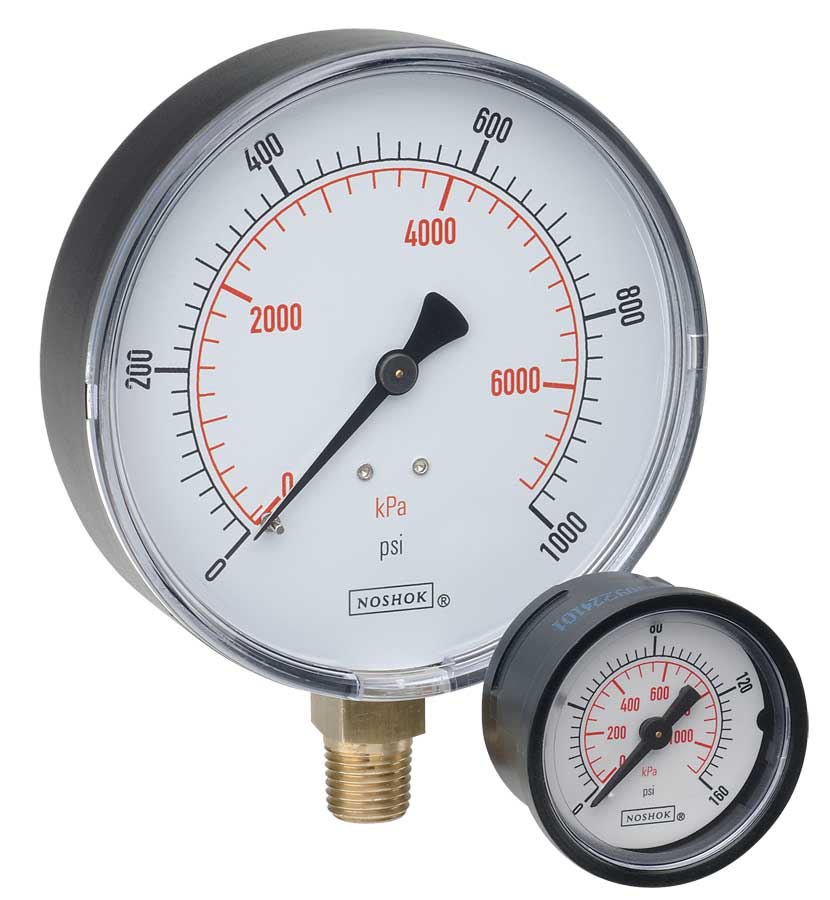 NOSHOK ABS & Steel Dry Pressure Gauges 100 series
 NOSHOK Low Pressure Dry Pressure Gauges-( 200 series)
 NOSHOK PT40 Series High Accuracy Transmitters-Replaces 100,200,615 series