


Authorized Instrumentation Distributor Benefits


A pressure gauge that fits the process connection but carries the wrong wetted material, pressure range, or accuracy class is not a replacement. It is a new failure point. That is where authorized instrumentation distributor benefits become operational rather than administrative: they help industrial buyers obtain legitimate, correctly specified components for systems where measurement accuracy affects safety, uptime, and product quality.
For plant maintenance, OEM production, and process engineering teams, the value is not limited to buying a branded gauge, transmitter, valve, or thermometer. The value is confidence that the product series, configuration, documentation, and manufacturer relationship support the application in front of them.
What Authorization Means in Instrumentation Supply
An authorized distributor has a formal commercial relationship with the manufacturer. That relationship gives the distributor access to approved product lines, current product information, manufacturer-supported documentation, and established channels for technical or order-related questions. In instrumentation, those details matter because a product name alone rarely defines a usable component.
A pressure transmitter may require a specific pressure range, output signal, electrical connection, process connection, wetted material, enclosure rating, and approval package. A differential pressure gauge installation may require compatible manifolds, fittings, and isolation valves. A diaphragm seal selection depends on process media, temperature, mounting arrangement, fill fluid, and connection geometry. An authorized source is positioned to work from those exact requirements rather than treating all products in a broad category as interchangeable.
Authorization does not mean every item is stocked at every moment, nor does it eliminate the need to verify specifications. It does mean the supplier operates within the manufacturer’s intended product and support structure. For buyers responsible for critical maintenance or production schedules, that distinction reduces avoidable uncertainty.
Authorized Instrumentation Distributor Benefits for Industrial Buyers
The most practical benefit is product legitimacy. Industrial buyers need confidence that the item received is the manufacturer’s intended product, not an unverified substitute, a mislabeled unit, or inventory with unclear storage and handling history. This is especially relevant for pressure and temperature instruments that may be exposed to vibration, corrosive media, pulsation, washdown, elevated temperatures, or hazardous locations.
An authorized channel also improves traceability during procurement. Purchase orders can be matched to recognized manufacturer part numbers, approved series, and documented configurations. That helps maintenance teams retain a consistent equipment record and gives procurement a clearer basis for supplier approval, quality documentation, and replacement planning.
For organizations with standardized instrumentation, repeatability is equally valuable. If a facility has specified NOSHOK gauges, transmitters, manifolds, needle valves, or diaphragm seals for a process area, buying through an authorized specialist helps preserve that standard. The team can source the same product family instead of introducing a near-match that changes connection dimensions, response characteristics, material compatibility, or service procedures.
Better Part-Number Accuracy
Instrumentation part numbers often encode the details that determine fit and performance. A few characters may identify a 1/4 in. NPT connection instead of 1/2 in. NPT, 316 stainless steel rather than brass, a bottom mount rather than back mount, glycerin fill, a 4-20 mA output, or a different pressure range.
General industrial catalogs can make it easy to find a category but difficult to confirm a configuration. A specialist distributor is more likely to organize products by series and application-relevant attributes. That supports faster selection when the buyer has a complete manufacturer part number and provides a better starting point when only the installed instrument details are available.
This is particularly useful when replacing aging equipment. Labels may be damaged, old part numbers may have been revised, or the original configuration may no longer be readily available. A crossover process can help identify the current equivalent, but equivalency should be checked line by line. Pressure range, connection type, wetted materials, accuracy, and environmental requirements still need confirmation before ordering.
Access to Product-Family Knowledge
A distributor with concentrated experience in a manufacturer’s instrumentation lines can help distinguish among products that appear similar at first glance. A dry utility gauge, liquid-filled process gauge, sanitary pressure gauge, and heavy-duty gauge may all display pressure, but they are not designed for the same operating conditions.
The same principle applies across the system. Choosing a pressure gauge without considering the needle valve, snubber, siphon, manifold, diaphragm seal, or mounting hardware can leave the installation exposed to pulsation, excessive temperature, vibration, or maintenance difficulty. Product-family knowledge is valuable because instruments work within an assembly, not in isolation.
Mass Measure’s focus on NOSHOK instrumentation gives buyers access to that type of line-specific product discovery. For a maintenance buyer, it can mean locating an exact replacement. For an engineer, it can mean narrowing a new design to compatible components from a defined manufacturer catalog.
The Cost of Buying Only on Unit Price
A lower unit price can be appropriate when the specification is simple, the application is noncritical, and the supplier can verify the exact item. But instrumentation purchases should not be evaluated only by the number on the line item. The cost of an incorrect component may include expedited freight, additional labor, process interruption, return processing, and a second purchase order.
The risk increases where the instrument has a direct process role. A pressure measurement error can affect pump protection, filter monitoring, hydraulic performance, or control logic. An incompatible material can shorten service life in chemical or corrosive applications. A poorly matched diaphragm seal can create response issues or introduce process compatibility concerns. In sanitary service, the wrong connection or surface requirement can complicate cleaning and validation.
Authorized distribution does not replace an engineering review. It supports that review by making reliable product data and manufacturer-aligned options easier to obtain. Buyers still need to define the process media, pressure and temperature limits, connection standards, electrical requirements, accuracy needs, and applicable codes or approvals.
When an Authorized Source Matters Most
The case for authorized sourcing is strongest when the component is specified by brand or series, required for an exact replacement, or used in a demanding process environment. It is also valuable when a buyer needs multiple related components and wants to avoid mixing incompatible thread forms, pressure ratings, or material grades.
Consider a plant replacing a failed pressure transmitter on a skid. The team may know the output is 4-20 mA, but that is only one selection point. They must also confirm the pressure range, process connection, electrical entry, supply voltage, wetted material, installation environment, and whether the existing control system requires a particular signal behavior. Selecting from the correct manufacturer family helps ensure the replacement is evaluated against the full configuration, not just the most visible attribute.
For OEMs, authorization supports production consistency. A repeatable source for a defined product series can simplify bills of material, incoming inspection, technical documentation, and future service parts. For MRO teams, it supports standardization across equipment areas and makes it easier to maintain an approved inventory of commonly used configurations.
Questions to Resolve Before Ordering
Before placing an order, confirm the installed or required part number when available. If a full part number is not available, identify the instrument type, measurement range, process and electrical connections, mounting orientation, wetted materials, accuracy requirement, and operating environment. For pressure instruments, determine whether pulsation, vibration, temperature, or overpressure conditions require accessories or a different product construction.
For valves and manifolds, verify pressure rating, thread standard, material, seal material, number of ports, and intended function. For thermometers, confirm stem length, insertion length, connection type, temperature range, and whether the installation requires a thermowell. These checks take less time than correcting an unsuitable order after the equipment is opened or installed.
The right distributor should be able to support a precise buying process without oversimplifying the application. That means using manufacturer nomenclature, checking critical configuration details, and recognizing when a request needs engineering confirmation rather than a quick substitute.
When an instrument is tied to process reliability, order from a source that treats the specification as part of the product. Start with the exact series and configuration, verify the conditions it will face, and keep the resulting part information available for the next maintenance event.
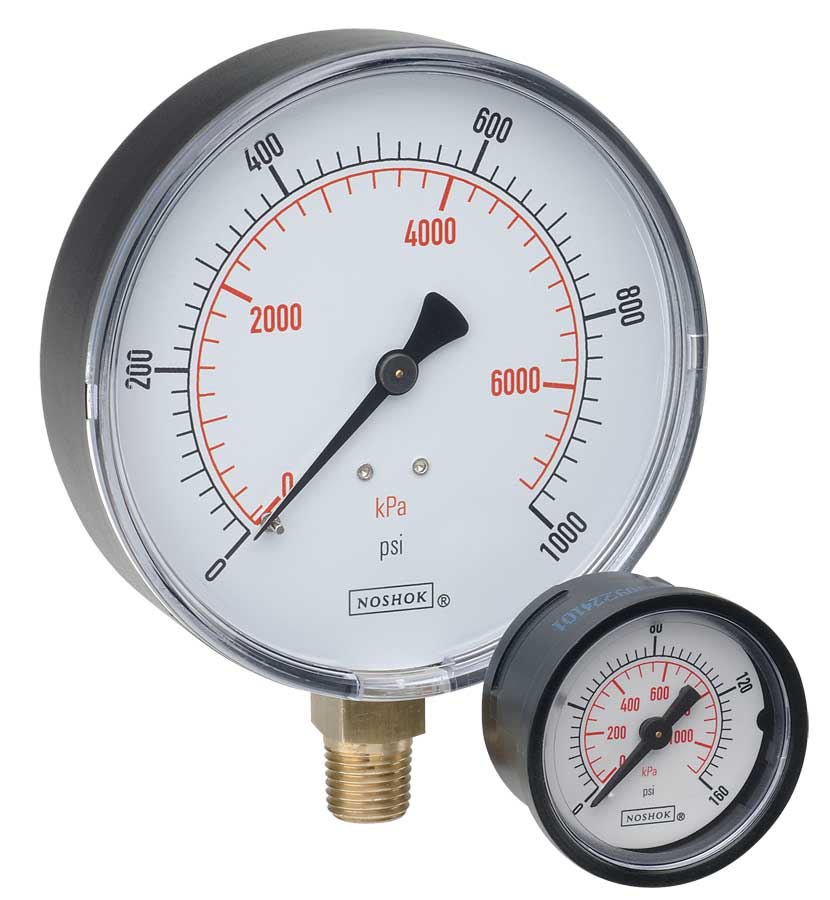 NOSHOK ABS & Steel Dry Pressure Gauges 100 series
 NOSHOK Low Pressure Dry Pressure Gauges-( 200 series)
 NOSHOK PT40 Series High Accuracy Transmitters-Replaces 100,200,615 series