



Pressure Gauge Connection Types Guide for Buyers


A pressure gauge can have the correct pressure range, accuracy class, and wetted material yet still be unusable if its process connection does not match the system. This pressure gauge connection types guide separates thread form, connection location, sealing method, and application requirements so buyers can specify a compatible gauge before it reaches the job site.
For replacement work, do not assume that a fitting that appears to be 1/4 inch is automatically interchangeable with another 1/4 inch fitting. Nominal pipe size, thread profile, taper, pitch, and sealing method all determine whether the connection will assemble correctly and hold pressure.
Start With the Process Connection, Not the Dial Size
The process connection is the threaded or sanitary interface between the gauge and the pressure source. It is typically described by nominal size, thread standard, gender, and location. A typical catalog description might call out a 1/4 inch NPT lower connection, a 1/2 inch NPT back connection, or a G 1/4 BSPP stem.
Gauge connection selection should begin with the mating port or adapter already installed in the system. Identify the port thread from equipment drawings, maintenance records, or direct measurement. A thread gauge and caliper are more reliable than visual comparison, particularly where NPT and BSP threads have similar outside diameters.
Connection location is a separate specification. Lower mount gauges have the connection at the bottom of the case. Center back and lower back configurations place the connection behind the dial and are commonly used for panels, control cabinets, and equipment skids. A gauge can have the correct thread but still be unsuitable if its connection location does not align with the mounting arrangement.
NPT: Common for US Industrial Service
National Pipe Taper, or NPT, is the standard most frequently encountered in US industrial pressure instrumentation. NPT male connections are tapered. As the male stem tightens into a female NPT port, the threads interfere and form the primary seal. Thread sealant, tape, or a compatible paste is generally used according to site procedure and media requirements.
Common pressure gauge sizes include 1/8 inch, 1/4 inch, 3/8 inch, and 1/2 inch NPT. The 1/4 inch NPT male connection is widely used on general-purpose gauges, while 1/2 inch NPT is common where a larger process port or a heavier-duty installation is specified.
NPT is practical for steam, compressed air, hydraulic, water, oil, and many process applications when the gauge material and pressure rating are suitable. It is not a universal answer. Repeated removal can wear threads, excessive tightening can damage the gauge socket, and thread sealant must not enter the pressure passage. For pulsating systems, the connection also needs support from a snubber, restrictor, or gauge protection device when required.
NPT Is Not the Same as BSPT
BSPT, also called R thread in many specifications, is a tapered British Standard Pipe thread. Both NPT and BSPT tighten on a taper, but their thread angles and pitch relationships differ. They should not be treated as interchangeable. Forcing one into the other may initially appear to work, but it can produce leakage, damaged threads, or an unreliable installation.
This distinction matters on imported equipment, packaged OEM systems, and facilities that operate with mixed US and international standards. Confirm the thread callout before ordering a replacement gauge or an adapter.
BSPP: A Parallel Thread That Needs a Seal
BSPP, often designated G thread, is a parallel pipe thread. Unlike NPT, its threads do not create the intended pressure seal by interference. The seal is normally made at a face, shoulder, bonded washer, O-ring, or other mating feature in the port design.
A G 1/4 male gauge connection may look close to a 1/4 inch NPT stem, but the two are not equivalent. The mating component must be designed for the BSPP sealing arrangement. Installing a BSPP gauge into an NPT port is not an acceptable workaround, even if the first few threads engage.
When evaluating BSPP connections, inspect the port as well as the gauge. A flat sealing face may require a gasket or bonded seal. A port with a recessed sealing surface may require a specific O-ring arrangement. The thread designation alone does not tell the entire sealing story.
Metric and DIN-Style Connections
Metric threaded pressure connections are common on European machinery, hydraulic power units, test equipment, and OEM assemblies. They are normally designated by outside diameter and pitch, such as M10 x 1 or M20 x 1.5. These connections may seal on a washer, O-ring, cone, or DIN-style port geometry rather than on the threads themselves.
DIN 3852-related port configurations are a frequent source of ordering errors because the gauge stem and port must be evaluated as a system. A thread may fit mechanically while the sealing shoulder or O-ring location does not match. If the existing gauge has a seal under its hex or a machined sealing nose, document that feature before selecting a replacement.
For metric and DIN applications, record the thread diameter, pitch, sealing feature, and available installation depth. A standard parallel-thread gauge with no correct seal arrangement is not a substitute for a purpose-designed connection.
Sanitary Connections and Diaphragm Seals
Food, beverage, pharmaceutical, biotechnology, and high-purity applications often avoid direct threaded gauge connections at the process boundary. Sanitary clamp connections, including Tri-Clamp-compatible arrangements, provide a cleanable interface using a clamp, gasket, and ferrules.
In most sanitary pressure installations, the gauge is mounted to a diaphragm seal rather than exposed directly to the process. The diaphragm isolates the gauge from viscous product, cleaning chemicals, elevated temperatures, and contamination-sensitive media. The process-side connection may be a sanitary clamp, while the gauge-side connection may still be a threaded instrument connection selected to match the seal assembly.
This is a useful reminder that the gauge connection and the process connection may not be the same component. When specifying a diaphragm seal system, verify the sanitary connection size, gasket material, clamp rating, fill fluid, gauge connection, operating temperature, and pressure range together.
Connection Materials and Media Compatibility
Thread type answers only one part of the compatibility question. The wetted socket, Bourdon tube, diaphragm seal, and any adapter must withstand the process media. Brass is commonly used for noncorrosive air, water, and oil service. Stainless steel is generally selected for broader chemical resistance, outdoor exposure, and more demanding process conditions, subject to the actual media and concentration.
Avoid treating stainless steel as a blanket solution. Chlorides, strong acids, sour service, high temperatures, and abrasive slurries may require a specific alloy, diaphragm material, or isolation method. The connection material must also be compatible with the mating fitting to reduce galling and avoid an unintended weak point in the assembly.
Pressure rating is equally important. A small threaded connection is not automatically suitable for every high-pressure application. Confirm the gauge working pressure, connection design, instrument category, and any applicable system rating. If pressure spikes are expected, choose protection based on the transient condition rather than the normal operating pressure alone.
A Practical Pressure Gauge Connection Types Guide for Ordering
Before submitting a part number or requesting a crossover, capture the existing configuration in complete terms: pressure range, dial size, accuracy requirement, connection size, thread standard, connection location, wetted material, and service media. Add whether the gauge is direct-mounted, panel-mounted, attached to a manifold, or installed on a diaphragm seal.
Photographs can help, but dimensions and markings are more dependable. Measure the thread outside diameter without assuming nominal size. Count pitch with the proper thread gauge when possible. Note whether the old connection used tape, a washer, an O-ring, or a gasket. These details often reveal whether the original connection was tapered or parallel.
Do not use an adapter as the default solution. An adapter can be appropriate when it is pressure-rated, material-compatible, and does not create clearance or vibration issues. It can also add another leak path, increase moment load on the gauge socket, and complicate panel alignment. A gauge with the correct native connection is usually the cleaner specification.
For exact NOSHOK replacements and new installations, Mass Measure can help buyers align the gauge series and configuration with the required process connection. Providing the current part number, port standard, application media, and mounting details reduces rework and helps prevent thread mismatches.
A correct connection is not merely the fitting that screws in. It is the connection that mates to the port standard, seals by the intended method, supports the installation geometry, and remains compatible with the pressure and media throughout service.
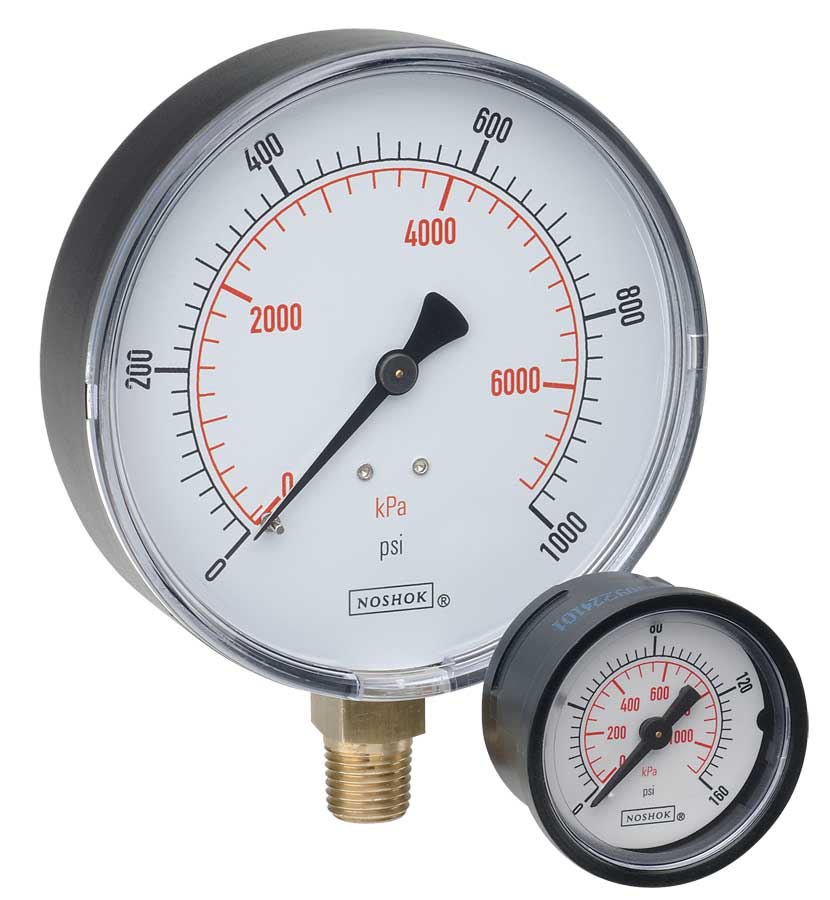 NOSHOK ABS & Steel Dry Pressure Gauges 100 series
 NOSHOK Low Pressure Dry Pressure Gauges-( 200 series)
 NOSHOK PT40 Series High Accuracy Transmitters-Replaces 100,200,615 series