



Choosing a Stainless Steel Pressure Gauge From NOSHOK


A stainless steel pressure gauge is rarely selected on material alone. In most plants, the real question is whether the gauge will hold up to the media, vibration, pressure cycling, washdown exposure, and mounting constraints of the job without creating a replacement problem six months later. For engineers, MRO buyers, and maintenance teams, that means specification discipline matters more than broad product labels.
What a stainless steel pressure gauge actually solves
In industrial service, stainless steel construction is usually tied to durability, corrosion resistance, and cleaner compatibility with aggressive or wet environments. That can mean chemical processing skid instrumentation, outdoor utility installations, compressor packages, food and sanitary equipment, or general OEM builds where painted steel or plastic case gauges are not a good fit.
The term itself can also be misleading if it is not tied to actual construction details. Some gauges use a stainless steel case with brass wetted parts. Others use stainless steel for both the case and the wetted components, which is often the better fit when media compatibility is the main concern. If the process fluid is corrosive, if there is concern about contamination, or if the application standard calls for all stainless wetted parts, the distinction is not optional.
That is why experienced buyers usually move past the phrase stainless steel pressure gauge very quickly and start verifying the exact materials, pressure element type, connection location, pressure range, and environmental protection level.
How to specify a stainless steel pressure gauge
The starting point is the process media. If the gauge will see water, steam, hydraulic fluid, inert gas, or common industrial fluids, a standard all-welded stainless design may be sufficient. If the media is more aggressive, viscous, crystallizing, or prone to clogging, a basic direct-mount gauge may not last, even if the case and socket are stainless. In that situation, diaphragm seals, capillaries, or isolation accessories may be required.
Pressure range selection is the next decision, and this is where over-specifying can be just as problematic as under-specifying. A gauge that operates continuously near full scale will have a shorter service life, especially in pulsating applications. A gauge with too wide a range, however, can make normal operating pressure harder to read and reduce useful resolution for operators. In many installations, the best choice places normal operating pressure somewhere in the middle portion of the dial rather than at the low end or near maximum.
Accuracy also depends on the job. For simple indication, a standard commercial or industrial accuracy may be enough. For calibration checks, critical process verification, or OEM packages where repeatability matters, a tighter accuracy class may be justified. The practical point is that higher accuracy adds value only when the rest of the installation supports it. A high-accuracy gauge on a vibrating line with pressure spikes and poor mounting conditions will not perform like its datasheet suggests.
Connection size and location matter more than many buyers expect. Bottom mount and back mount configurations are not interchangeable once panel cutouts, tubing orientation, and clearance are fixed. Thread type must also match the system standard. NPT remains common across US industrial applications, but exact size still needs to be confirmed. A mismatch here delays installation and turns a routine replacement into a sourcing issue.
Stainless steel pressure gauge construction details that matter
Case size affects readability, available mounting options, and operator use. A compact gauge may fit a crowded manifold assembly or small equipment enclosure, but it can be difficult to read from a distance. A larger dial improves visibility and often makes setpoint monitoring easier in the field, though it takes more space and may not suit every OEM package.
Lens material is another application-driven choice. Standard designs work well in many indoor environments, but impact resistance, chemical exposure, and washdown requirements can change what is appropriate. For outdoor service or frequent cleanup cycles, the entire front assembly deserves review rather than just the case material callout.
Liquid fill is often specified for vibration and pulsation control. A filled gauge can steady the pointer and reduce wear in demanding service, particularly around pumps, compressors, or mobile equipment. The trade-off is that fill fluid behavior can change with temperature, and some applications are better served by a dry gauge with a movement designed for vibration resistance. There is no universal answer here. The service environment should drive the decision.
Pressure element design also affects performance. Bourdon tube gauges remain standard across a wide range of applications, but media condition and pressure profile still need to be considered. Repeated cycling, shock loading, and rapid fluctuations all shorten gauge life if they are not accounted for. In those cases, a snubber, restrictor, or gauge saver may be part of the correct specification rather than an accessory added later.
Where stainless steel gauges are commonly used
A stainless steel pressure gauge is frequently selected for oil and gas production equipment, chemical feed systems, water and wastewater skids, food process equipment, washdown zones, and general industrial service where corrosion resistance and mechanical durability are expected. The appeal is straightforward: stainless construction typically performs better in wet, dirty, or chemically exposed environments than lower-grade alternatives.
Even so, application fit still depends on the full assembly. For example, a gauge mounted directly on a line carrying hot media may need a siphon or cooling element. A gauge exposed to corrosive vapors may require more than a stainless case if the internals or connection hardware are vulnerable. And in sanitary or flush-process service, the better answer may be a diaphragm seal assembly rather than a standard threaded gauge connection.
This is one reason industrial buyers often source from instrumentation-focused suppliers rather than general catalogs. Exact series selection tends to depend on the kind of details that only show up after installation conditions are reviewed.
Common mistakes when buying replacement gauges
The most common error is ordering by dial range alone. A failed 0-160 psi gauge may look easy to replace, but range matching by itself does not confirm wetted materials, connection size, mount style, accuracy, fill, or environmental rating. In practice, many replacement issues come from assuming the old gauge was correct in the first place.
Another frequent problem is treating all stainless gauges as chemically equivalent. Stainless steel is not a blanket answer for every process fluid. Specific grades, seal materials, and isolation methods still matter. If the previous gauge failed due to corrosion, plugging, or pointer instability, replacing it with the same basic configuration usually repeats the same maintenance cycle.
Buyers also run into trouble when panel mount and direct mount styles are confused. A center back connection gauge with panel hardware serves a different installation than a lower mount field gauge, even if the dial size and range match. For MRO teams, this is where exact part-family knowledge saves time.
Why exact series selection matters
For technical buyers, a stainless steel pressure gauge is not one product. It is a category that includes multiple case sizes, mounting styles, pressure ranges, connection standards, accuracy options, liquid fill configurations, and application-specific variants. The right selection is driven by system requirements, not by a broad material description.
That is especially true when standardizing across equipment fleets or matching an installed NOSHOK configuration. Series-level continuity helps with maintenance planning, parts stocking, and replacement speed. It also reduces the risk of subtle mismatches that only show up after startup, such as poor pointer stability, incompatible fittings, or mounting interference.
Mass Measure supports this kind of specification-driven sourcing because industrial instrumentation buyers typically need more than a generic gauge listing. They need to confirm exact product family, construction details, and compatibility with the existing process connection or panel design.
When to move beyond a standard gauge
Sometimes the correct answer is not a standard stainless steel gauge at all. If the process is highly corrosive, sanitary, high temperature, or prone to clogging, the better solution may include a diaphragm seal, manifold, or pressure transmitter instead of direct indication alone. If the application requires remote monitoring or control integration, a mechanical gauge may still be useful locally, but it may not be the primary measurement device.
That does not reduce the value of the gauge. It puts it in the right role within the measurement system. Good instrumentation selection is rarely about choosing the toughest-looking component. It is about choosing the component that fits the pressure profile, media condition, operating environment, and maintenance expectation of the application.
If you are specifying or replacing a stainless steel pressure gauge, slow down long enough to verify the construction behind the label. The part number should answer the application, not just the purchase request.
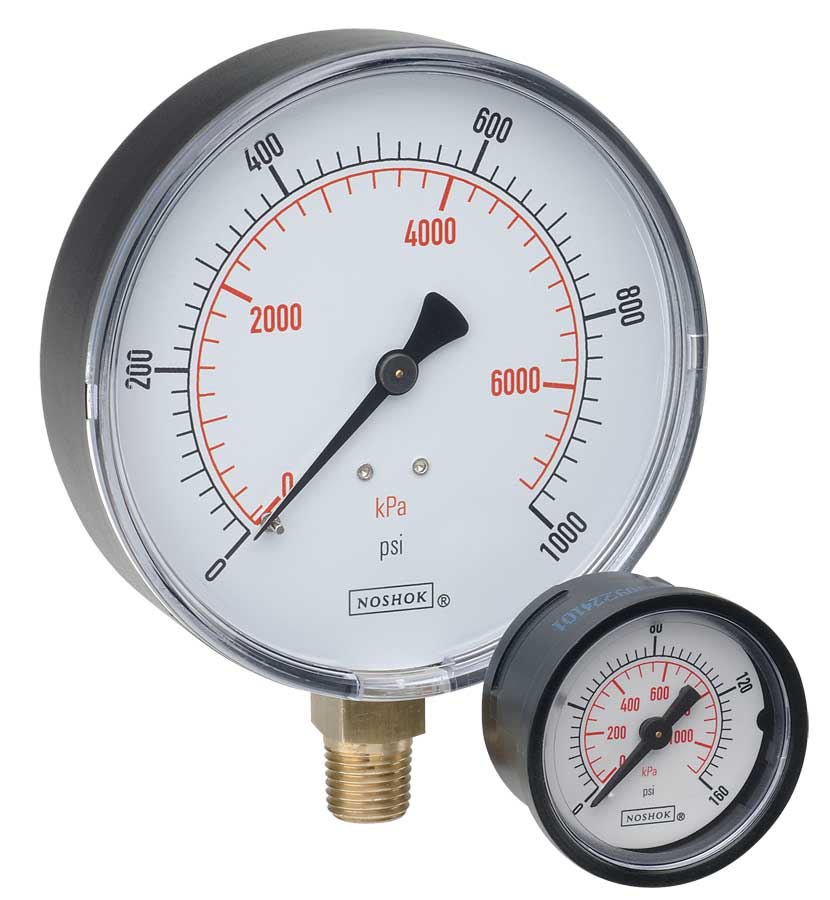 NOSHOK ABS & Steel Dry Pressure Gauges 100 series
 NOSHOK Low Pressure Dry Pressure Gauges-( 200 series)
 NOSHOK PT40 Series High Accuracy Transmitters-Replaces 100,200,615 series