



Pressure Gauge Bottom Mount Selection Guide From NOSHOK


A pressure gauge bottom mount configuration is usually the first detail that matters when the gauge has to thread directly into a vessel, manifold, regulator, pump skid, or fixed piping point. If the connection orientation is wrong, even a correctly ranged gauge becomes awkward to read, difficult to install, or vulnerable to vibration and damage. For industrial buyers, the question is not just whether a gauge measures pressure. It is whether the mounting style matches the mechanical layout, process media, and service conditions of the system.
What a pressure gauge bottom mount means
In a pressure gauge bottom mount design, the process connection enters through the bottom of the case, typically at the 6 o’clock position when viewing the dial face. This layout differs from a back mount gauge, where the connection extends from the rear of the case. Bottom mount gauges are commonly used when the instrument threads upward from a pipe tee, a tank port, a valve body, or a manifold block and the dial needs to face outward for direct visual reading.
This sounds straightforward, but mounting style affects more than orientation. It influences available panel hardware, clearance around the connection, stem support, and how the gauge reacts to vibration or operator contact. In many plants, a bottom mount gauge is the standard replacement because the existing system was built around that connection geometry.
Where bottom mount gauges are typically used
Bottom mount configurations are common across process and utility systems. You will see them on air compressors, hydraulic power units, water treatment skids, pump discharge lines, steam service points, gas distribution panels, and general OEM equipment. They are also common in maintenance environments where a gauge is mounted on a short nipple or isolation valve and needs to be read from the front.
For many MRO and replacement purchases, the preference is practical. A bottom mount gauge often gives the installer the simplest direct-thread installation with no need to reorient tubing or add adapters. If the process port is on top of the pipe or component and the dial must remain upright, bottom mount is usually the natural fit.
That said, it is not always the right answer. If the gauge needs to sit flush in a panel or if rear access is limited, a back mount style may be easier to integrate. The correct choice depends on the equipment layout, not just buyer habit.
How to specify a pressure gauge bottom mount correctly
A pressure gauge bottom mount should never be selected by mount style alone. Industrial buyers typically need to match five core variables at minimum: pressure range, dial size, wetted material, process connection size, and connection type.
Pressure range
The gauge range has to fit the normal operating pressure and expected spikes. A common rule is to place normal operating pressure in the middle portion of the scale rather than near the upper limit. That improves readability and helps reduce stress on the movement. If pulsation or surges are present, a dry utility gauge that looks adequate on paper may not hold up well in service.
Dial size and readability
A 1.5-inch or 2-inch dial may be acceptable on compact equipment, but larger dials are easier to read from a distance and often preferred on process skids or utility headers. The trade-off is space. Larger cases improve visibility but can create clearance issues around valves, tubing, and nearby components.
Process connection size and thread
Bottom mount gauges are commonly specified with 1/8 inch, 1/4 inch, or 1/2 inch NPT connections, but thread size has to match the port exactly. An assumed fit is a common source of ordering errors. Buyers replacing legacy gauges should verify both nominal size and thread standard before ordering.
Wetted parts and case construction
Material compatibility matters immediately in chemical service, corrosive atmospheres, washdown environments, and applications involving aggressive media. Brass internals may be suitable for many air, water, oil, and non-corrosive services. Stainless steel construction is often preferred for harsher environments, sanitary applications, chemical processing, or where longer service life is required.
Accuracy and service conditions
Not every application requires the same accuracy class. General industrial monitoring may allow a utility-grade gauge, while test systems, regulated process points, or OEM assemblies may need tighter accuracy. The service environment also matters. Vibration, pulsation, pressure cycling, overpressure risk, and ambient temperature all affect gauge selection.
Bottom mount versus back mount
The most frequent comparison is between bottom mount and back mount. Functionally, both can measure the same pressure range and use similar internal designs. The difference is installation geometry.
A bottom mount gauge is typically preferred for direct vertical installation into a piping connection or component port. It is simple, familiar, and widely used in field replacement work. A back mount gauge is usually chosen when the dial must be mounted through a panel or flush-mounted in an enclosure.
Neither style is inherently better. A bottom mount gauge on a panel can require awkward fittings or exposed tubing. A back mount gauge on a top-mounted pipe port may be difficult to orient cleanly. The right choice comes down to line entry, operator viewing angle, and available clearance.
When service conditions change the selection
The basic question may start with pressure gauge bottom mount, but the real buying decision often shifts once service conditions are reviewed. For example, a dry gauge in a smooth-running compressed air system can be perfectly adequate. The same gauge on a reciprocating pump discharge may fail early because of pulsation.
In those cases, a liquid-filled gauge can help damp pointer flutter and reduce wear on internal components. Stainless steel cases and wetted parts may also be needed where corrosion, washdown, or outdoor exposure is a factor. If clogging, crystallization, or diaphragm isolation is required, the buyer may need to step beyond a standard gauge and consider a diaphragm seal assembly or another engineered configuration.
This is where specification discipline matters. A gauge can match the connection and still be wrong for the application.
Common ordering mistakes with bottom mount gauges
Most replacement issues are not caused by the mount style itself. They come from missing one of the secondary details tied to the mounting arrangement.
One common mistake is assuming the existing gauge is standard brass when the process actually requires stainless steel wetted parts. Another is focusing on dial diameter while overlooking stem length, restricted clearance below the case, or the need for a lower mount that clears adjacent valves. Buyers also sometimes match the pressure range but miss the exact process thread, which leads to field adapters, leaks, or orientation problems.
There is also the issue of over-specifying. A heavier-duty gauge is not automatically the better purchase if the application is clean, stable, and non-corrosive. The right specification is the one that matches actual service conditions without introducing unnecessary cost or complexity.
Choosing by application instead of by appearance
Two bottom mount gauges can look similar and still belong to very different product families. Utility gauges, process gauges, all-stainless gauges, glycerin-filled gauges, sanitary gauges, and specialty low-pressure or high-pressure models all serve different roles. The correct selection depends on what the gauge is connected to, how often it cycles, what media it sees, and how critical the reading is.
For OEM builders and panel integrators, standardization is often the priority. A consistent bottom mount series across multiple assemblies can simplify stocking and replacement. For plant maintenance, exact interchangeability may matter more than anything else. If a legacy part number is being replaced, the buyer needs to confirm not only mount style but also case size, connection location, range, materials, and accuracy.
Authorized instrumentation sourcing becomes especially useful here. With NOSHOK-focused product selection, buyers can work from known series, exact part families, and crossover paths rather than generic gauge descriptions. That reduces the risk of ordering a gauge that appears close but does not actually match the application.
What to verify before purchasing
Before ordering a pressure gauge bottom mount unit, verify the application media, pressure range, normal operating pressure, connection size, thread type, dial size, required accuracy, and whether vibration or pulsation is present. Also check if the gauge will be mounted directly to the process or isolated through a valve, snubber, or seal.
If the gauge is replacing an installed unit, confirm the mounting orientation from the existing part rather than relying on memory or a purchasing record alone. A front photo of the dial is often not enough. The connection location must be verified physically.
In industrial instrumentation, small mismatches create unnecessary downtime. A bottom mount gauge is simple only when the specification is complete.
The best buying outcome is usually not the fastest one. It is the one where the gauge threads in correctly, faces the operator properly, holds up to the service, and does not have to be replaced again after the next maintenance cycle.
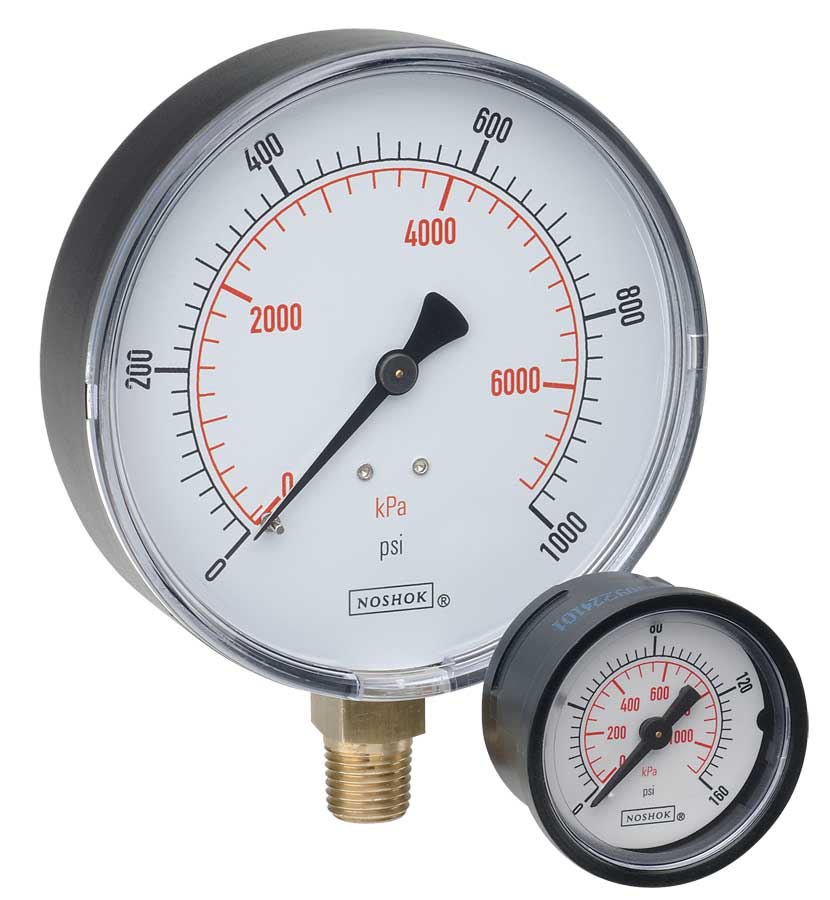 NOSHOK ABS & Steel Dry Pressure Gauges 100 series
 NOSHOK Low Pressure Dry Pressure Gauges-( 200 series)
 NOSHOK PT40 Series High Accuracy Transmitters-Replaces 100,200,615 series