



Digital Pressure Gauge FAQ for Industrial Use

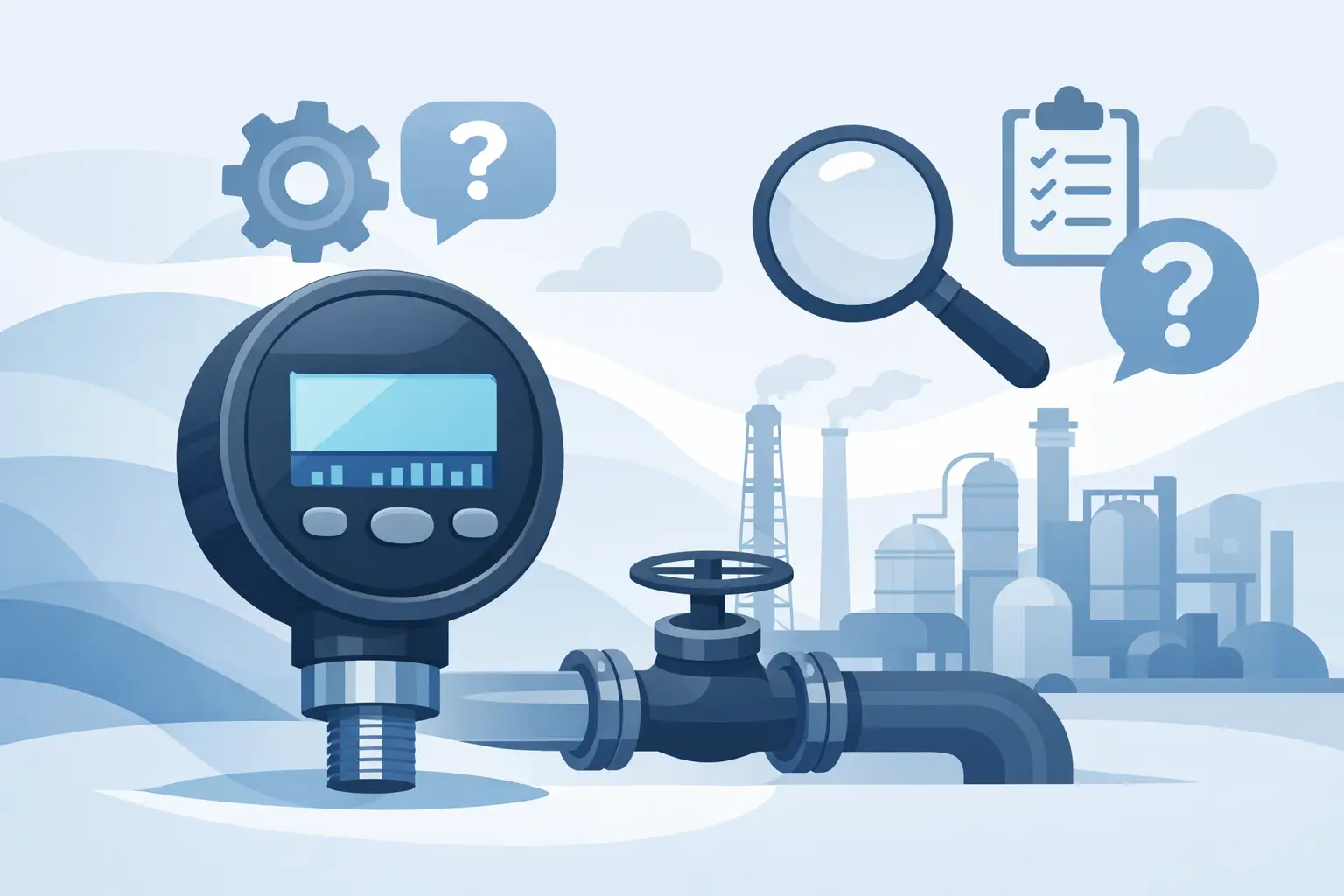
A digital pressure gauge that reads correctly on the bench can still be the wrong instrument for the line. In industrial service, the questions behind a digital pressure gauge FAQ usually come down to specification fit: accuracy under operating conditions, pressure range selection, process connection, wetted material compatibility, and whether the display and power setup make sense for the application.
For plant maintenance, OEM design, and replacement purchasing, those details matter more than the fact that the display is digital. A digital unit can improve readability and reduce interpretation errors, but it does not remove the need to match the gauge to media, environment, pressure spikes, and mounting constraints. The right selection starts with the same discipline used for any instrumentation component.
Digital pressure gauge FAQ: what buyers ask first
The first question is usually straightforward: when should you specify a digital pressure gauge instead of an analog gauge? The short answer is when the application benefits from higher display resolution, easier setpoint verification, better repeatability for routine checks, or features such as peak hold, min/max tracking, and engineering unit selection. In maintenance environments, digital gauges are often preferred where technicians need quick, unambiguous readings.
That said, analog gauges still have advantages in some services. If a location has no power tolerance for battery maintenance, extreme ambient conditions, or a strong preference for at-a-glance trend visibility from a distance, a mechanical gauge may remain the better fit. Digital is not automatically superior. It depends on how the instrument will be used, how often it will be observed, and what level of reading precision is actually required.
Another early question is whether digital pressure gauges are accurate enough for calibration-type tasks. Some are, some are not. Buyers should review the stated accuracy specification carefully, including whether it is expressed as a percentage of full scale, percentage of reading, or tied to a reference temperature range. For troubleshooting and process monitoring, a general-purpose digital gauge may be sufficient. For test, validation, or comparison work, a tighter specification is often required.
How should pressure range be selected?
A common mistake is choosing a range based only on normal operating pressure. A gauge should be selected so that the normal working pressure falls in a usable portion of the scale while still allowing for expected surges, pulsation, and upset conditions. If the range is too high, the display resolution can become less useful. If the range is too low, overpressure events can shorten instrument life or cause failure.
For many applications, buyers want normal operating pressure to land near the middle portion of the range, but this is not an absolute rule. Hydraulic systems, gas distribution, and process skids can each have different operating profiles. If pressure spikes are likely, overpressure protection and snubber considerations should be reviewed along with the nominal range.
Vacuum, compound, and absolute pressure requirements also need to be identified early. A digital gauge built for positive pressure only will not solve a vacuum measurement problem, even if the connection size is correct and the range appears close.
What accuracy specification matters most?
In any digital pressure gauge FAQ, accuracy tends to create the most confusion because not all published numbers mean the same thing. Industrial buyers should confirm the basis of accuracy, the compensated temperature range, and whether long-term stability is provided. A display with more digits does not mean the instrument is more accurate. It only means the readout is more granular.
For process monitoring, the practical question is whether the gauge supports the decision being made from that reading. If an operator only needs to know whether a line is near 100 psi or drifting toward a shutdown limit, a standard industrial digital gauge may be appropriate. If the gauge is being used to verify a pressure regulator, compare transmitter output, or support quality checks, tighter accuracy and documented calibration may be necessary.
Resolution and repeatability should also be considered. A gauge can look precise on screen but still not hold the consistency needed for diagnostic work.
Which wetted materials should be specified?
Material compatibility is a primary selection issue, especially in chemical processing, food and sanitary systems, oil and gas service, and utility applications. The buyer should confirm the wetted sensor material, process connection material, and any seal materials exposed to media. Stainless steel is common, but stainless is not a complete answer. Different media can require different alloys, seal materials, or isolation strategies.
If the process media is corrosive, viscous, prone to crystallization, or sanitary-sensitive, the gauge may need a diaphragm seal or another isolation method rather than direct exposure. In these cases, the digital gauge is only one part of the assembly. The instrument must be evaluated as a system, including capillary, fill fluid, seal face, and mounting orientation where relevant.
For steam, elevated temperature, or aggressive chemicals, temperature effects on the sensor must be reviewed alongside media compatibility. Even if the material is chemically acceptable, excessive process temperature can still push the gauge outside its design limits.
What process connection details are most important?
Connection size and thread type must match the application exactly. Buyers should verify NPT size, mounting orientation, and whether bottom or back connection is required for the installation. A gauge with the right range and accuracy can still be unusable if the connection geometry does not fit the manifold, panel cutout, or process tapping.
Connection location matters for visibility and vibration. A local skid-mounted readout may favor one orientation, while a panel builder may need another. If adapters are used to make a mismatch fit, that can introduce leak points, stack-up issues, and clearance problems. In instrumentation purchasing, exact fit is usually better than field improvisation.
Are digital pressure gauges suitable for vibration and pulsation?
They can be, but the application needs review. Mechanical vibration, hydraulic hammer, compressor pulsation, and rapid pressure cycling can all affect instrument performance and service life. Buyers should check whether the gauge is rated for vibration resistance and whether accessories such as snubbers, restrictors, or isolation devices are recommended.
Digital gauges are often selected because the display is easier to read than a moving pointer under vibration. That advantage is real, but it does not make the sensing element immune to the same process conditions that damage other instruments. If the system is known for pulsation, specifying damping or pressure protection is usually part of the solution.
How long does the battery last, and when does power matter?
Battery life depends on display type, backlight use, update rate, ambient conditions, and whether the gauge stays continuously active. For periodic inspection use, battery life may be more than adequate. For continuous duty in remote or hard-to-access areas, power management becomes more important.
Industrial buyers should ask whether the gauge has auto-off functions, low-battery indication, field-replaceable batteries, or external power options. In critical service, it is worth considering whether a battery-powered local indicator is the best choice at all. Sometimes a transmitter with a powered display is the more stable long-term solution.
Cold environments can also reduce battery performance. If the gauge will be used outdoors or in unheated utility spaces, ambient rating should be part of the review.
Can a digital pressure gauge replace a transmitter or switch?
Usually not directly. A digital pressure gauge is primarily a local indication device. Some models may include output or switching functions, but many do not. If the application requires signal transmission to a PLC, DCS, or remote monitor, a pressure transmitter is generally the correct product family. If the application needs alarm or control action at a defined threshold, a pressure switch may be required.
This distinction matters in replacement purchasing. A failed local gauge should be replaced with a gauge only if local indication is still the design intent. If the process requirement has changed and remote visibility is now needed, the instrument type may need to change as well.
What environmental ratings should be checked?
Ingress protection, enclosure material, ambient operating temperature, and display readability under lighting conditions should all be confirmed. Washdown areas, outdoor mounting, dusty plants, and corrosive atmospheres place different demands on the enclosure. A digital display that works well indoors may be difficult to read in direct sunlight or unreliable in temperature extremes.
Hazardous location requirements should also be reviewed where applicable. Not every digital gauge is suitable for classified areas. Approval markings, installation method, and site requirements must align before the instrument is specified.
How often should digital pressure gauges be calibrated?
The interval depends on application criticality, required accuracy, service severity, and site quality procedures. A gauge used for general process indication may follow a different interval than one used for verification, troubleshooting, or quality-sensitive operations. Drift, shock exposure, overpressure events, and harsh ambient conditions can all justify more frequent checks.
For buyers managing multiple assets, standardizing by series and specification can simplify calibration planning and replacement stocking. That is often where an authorized instrumentation distributor with strong series-level knowledge, such as Mass Measure, adds practical value.
A useful closing thought: the best digital pressure gauge is not the one with the most features. It is the one that matches the process, the installation, and the decision the reading is supposed to support.