



How to Choose Pressure Gauges


A pressure gauge that fits the port is not necessarily the right gauge for the job. In plant service, the wrong range, wetted material, accuracy level, or mounting style can shorten service life, distort readings, and create unnecessary replacement cycles. If you are evaluating how to choose pressure gauges for OEM equipment, MRO replacement, or process instrumentation, the selection should start with the application conditions – not the dial size alone.
How to Choose Pressure Gauges for Industrial Service
The first question is what the gauge actually needs to do. A general-purpose utility gauge used on air service has very different requirements from a gauge installed on a pulsating hydraulic circuit, a corrosive chemical line, or a sanitary process connection. Buyers often begin with pressure range and connection size, but reliable selection depends on a combination of pressure characteristics, media compatibility, ambient conditions, mounting requirements, and readability.
In practice, gauge selection is a specification exercise. The more closely the gauge matches the process, the more stable the indication and the longer the service interval. A low-cost mismatch can become expensive quickly if it leads to vibration damage, pointer flutter, bourdon tube fatigue, or process leakage.
Start with the pressure range
Pressure range is usually the first filter, and it is one of the most common sources of error. A gauge should not operate continuously at the top end of its scale. For steady pressure service, normal operating pressure is typically best kept in the middle portion of the range. For fluctuating or pulsating service, additional margin is needed to prevent premature wear.
If a system normally runs at 80 psi, selecting a 0-100 psi gauge may look acceptable on paper, but repeated cycling near the upper end of the scale can reduce life. A 0-160 psi range may be a better fit if the process experiences spikes. The trade-off is readability. As range increases, resolution decreases. That matters when operators need to distinguish small pressure changes.
Vacuum, compound, and low-pressure applications require the same discipline. A compound gauge should be selected only when both vacuum and positive pressure need to be observed. If the process is strictly low positive pressure, a dedicated low-pressure gauge usually provides better readability.
Match gauge accuracy to the task
Not every application requires the same accuracy class. On utility air, water service, or general equipment indication, a standard commercial accuracy may be sufficient. On test stands, regulated systems, calibration checks, or critical process control points, a higher accuracy gauge is often justified.
Higher accuracy generally comes with a different case construction, movement design, and price point. That does not mean better is always better. An expensive precision gauge installed on a harsh vibrating skid can be the wrong instrument if environmental protection is overlooked. Accuracy should be balanced with survivability.
How to Choose Pressure Gauges by Media and Materials
Wetted material compatibility is where many field failures begin. The process media must be compatible with the bourdon tube, socket, and any other wetted components. Brass internals may work well for air, water, oil, and other non-corrosive media, but they are not the default answer for aggressive chemicals or corrosive gas service. In those cases, stainless steel construction is often the correct starting point.
The case material also matters, especially in washdown, outdoor, or corrosive ambient environments. Stainless steel cases are commonly selected for durability and appearance in industrial settings, while lower-cost case materials may be fine in enclosed panels or protected indoor locations.
If the media is viscous, crystallizing, sanitary, or likely to clog a standard pressure port, a diaphragm seal may be needed between the process and the gauge. That changes the selection process because the seal assembly, fill fluid, and temperature effects all influence performance. In food, pharmaceutical, and certain chemical applications, the pressure gauge cannot be considered separately from the seal and connection geometry.
Consider pressure pulsation and vibration
A gauge that reads well on a bench can fail early in the field if the system pulses or the equipment vibrates. Reciprocating pumps, compressors, hydraulic systems, and mobile equipment often create pointer oscillation and internal wear. In those applications, a liquid-filled gauge is commonly preferred because the fill dampens pointer movement and protects internal components.
Dry gauges still have a place. They are often suitable in stable, non-vibrating environments and may be preferred where fill fluid expansion could affect indication under temperature swings. The right choice depends on actual service conditions, not a blanket rule.
Snubbers, restrictors, and needle valves can also help protect the gauge from spikes and surges. If pressure spikes are the real issue, adding protection upstream may improve life more effectively than simply changing the gauge series.
Check process connection details carefully
Thread size and mounting location need to match exactly. That includes NPT size, lower mount versus back mount orientation, and any clearance limits inside a panel or enclosure. A gauge with the wrong orientation can turn a simple replacement into a field modification.
Connection size should also make sense for the application. A smaller connection may fit the port, but if the process is dirty or the line is prone to blockage, a larger connection may be more reliable. On OEM builds, standardizing connection type across assemblies can reduce spare inventory complexity.
Dial size should be selected for actual viewing distance. A 2 inch gauge may be perfectly acceptable at arm’s length on a machine frame. It is not ideal for an operator trying to confirm pressure from several feet away. Larger dials improve readability, but they also require more space and can be more exposed to damage.
Environmental and Application Factors That Change the Answer
Temperature affects gauge performance more than many buyers expect. High ambient heat, cold outdoor conditions, and elevated media temperature can all shift accuracy and reduce component life. If the process is hot, a siphon, capillary, diaphragm seal, or other means of temperature isolation may be necessary depending on the service.
Location also matters. Outdoor exposure introduces moisture, UV, and corrosion concerns. Washdown environments may require stronger case sealing. Hazardous locations do not automatically require a different analog gauge, but they do require attention to the surrounding installation and any associated instrumentation.
For sanitary service, the connection standard is part of the specification, not an accessory detail. Clamp connections, polished wetted surfaces, and cleanability requirements can drive the selection toward purpose-built sanitary gauges or sealed assemblies.
Think about replacement versus new design
If you are replacing an existing gauge, confirm whether the old unit failed because it wore out normally or because it was misapplied. Matching the old part number without reviewing the service conditions can repeat the same problem. Verify range, accuracy, case style, connection orientation, material, and any accessories such as throttling devices or diaphragm seals.
For new design work, it is worth defining the gauge as part of the system rather than as a late-stage commodity item. Pressure spikes, installation geometry, service media, and visibility are easier to address during design than after startup.
Common selection mistakes
Most gauge issues trace back to a short list of errors. Buyers choose a range too close to normal operating pressure, assume brass works for any non-water service, ignore vibration, or overlook temperature effects. Another common mistake is focusing only on the gauge face and not the complete pressure instrument assembly.
Part-family selection is also important. Industrial buyers frequently need to align on exact series characteristics, not just generic descriptions like stainless gauge or utility gauge. That is especially true when sourcing replacements for installed equipment or standardizing around approved instrumentation.
A Practical Specification Checklist
When deciding how to choose pressure gauges, the cleanest approach is to document the application in a fixed order: pressure range including spikes, media type, wetted material requirement, required accuracy, ambient and media temperature, presence of pulsation or vibration, connection size and location, dial size, and any need for isolation devices or diaphragm seals. Once those points are clear, narrowing to the appropriate gauge series becomes much more straightforward.
For many industrial buyers, the challenge is not finding any gauge. It is finding the correct gauge series and configuration from an authorized instrumentation source that understands exact part-number requirements. That is where specialized distributors such as Mass Measure bring value, especially when the application calls for specific NOSHOK families, crossover support, or configuration-level matching.
Pressure gauges are simple instruments only when the application is simple. In most industrial environments, the right choice comes from matching the instrument to the service conditions with the same care used for valves, transmitters, and process connections. A few extra minutes spent on specification upfront usually prevents a much longer conversation at the maintenance bench later.
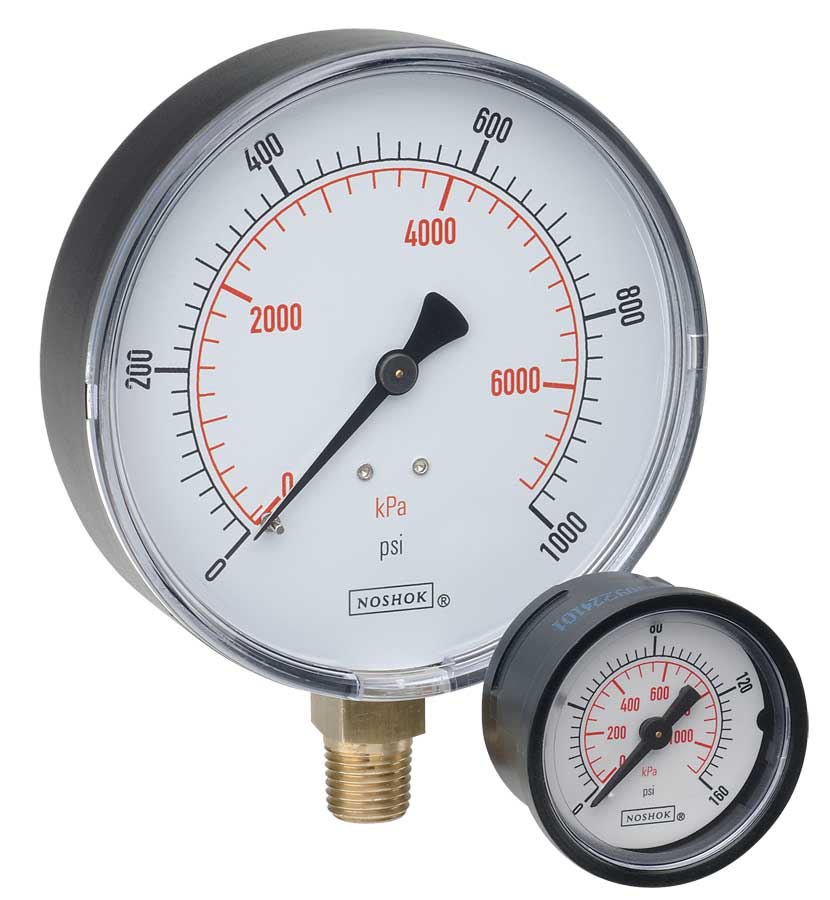 NOSHOK ABS & Steel Dry Pressure Gauges 100 series
 NOSHOK Low Pressure Dry Pressure Gauges-( 200 series)
 NOSHOK PT40 Series High Accuracy Transmitters-Replaces 100,200,615 series