



Process Connection Thread Standards Explained


A pressure gauge may have the correct range, accuracy, and wetted material, yet still be unusable if its process connection does not match the installation point. Process connection thread standards determine how gauges, transmitters, switches, diaphragm seals, manifolds, and valves physically join a process system. For replacement work and new system design, the thread callout is a mechanical and sealing requirement, not a minor catalog detail.
A connection described only as “1/4 inch” is incomplete. The nominal size must be evaluated with the thread form, taper or parallel geometry, pitch, sealing method, gender, and material. A 1/4 in. NPT male connection and a G 1/4 male connection may appear similar at a glance, but they are not interchangeable standards.
Why Process Connection Thread Standards Matter
Instrumentation connections must maintain pressure containment while placing the sensing element in proper communication with the process. When a thread is incorrectly specified, the result can range from an immediate assembly issue to a slow leak, damaged female port, inaccurate readings, or an unplanned shutdown.
This is especially relevant when replacing legacy gauges or sourcing components for imported equipment. United States installations commonly use NPT connections, while European and many international systems may use BSPP, BSPT, metric, or DIN-based connection conventions. Process equipment for sanitary production follows another set of connection practices built around cleanability and controlled sealing rather than conventional pipe threads.
The correct standard also depends on the instrument. A compact pressure gauge may use a 1/8 in. NPT lower mount connection, while a process transmitter may use 1/2 in. NPT male or M20 x 1.5 male. A diaphragm seal can introduce a flange, tri-clamp, or threaded process connection that is independent of the gauge-side or transmitter-side connection.
The Thread Standards Most Often Found in Instrumentation
NPT and NPTF
National Pipe Taper, or NPT, is the most common threaded process connection standard in North American industrial instrumentation. NPT threads are tapered. As the male and female threads engage, interference between the flanks creates the mechanical seal. Thread sealant, tape, or a compatible pipe compound is normally used to fill the spiral leak path and lubricate assembly.
Common instrument connection sizes include 1/8, 1/4, 3/8, 1/2, and 3/4 in. NPT. These nominal pipe sizes do not represent the outside diameter of the male thread. A buyer verifying a replacement by caliper measurement alone can therefore select the wrong size.
NPTF, sometimes called dryseal pipe thread, is a related taper-thread standard intended to form a seal through thread deformation when properly manufactured and assembled. It may be encountered in hydraulic and specialized service. However, do not assume NPT and NPTF are interchangeable in every application without reviewing the component manufacturer’s requirements, service pressure, and sealing practice.
BSPP and BSPT
British Standard Pipe threads are frequently found on equipment manufactured outside the United States. BSPP, also designated G thread or BSP parallel, has parallel threads. The thread itself generally does not create the pressure seal. Sealing is typically achieved with a bonded seal, gasket, O-ring, or machined sealing face.
BSPT, also called R thread in many specifications, is tapered. Its geometry and pitch are different from NPT even when the nominal size is similar. Forcing a BSPT fitting into an NPT port can damage both parts before an assembly even reaches full engagement.
The practical distinction is critical: a G 1/4 connection is not a 1/4 in. NPT connection. Both may be common on pressure instruments, but their thread angle, pitch, and sealing arrangement differ. If an existing component is marked only “1/4,” verify the manufacturer, country of origin, thread gauge results, or equipment documentation before ordering.
Metric Threads
Metric threads are identified by nominal major diameter and pitch, such as M12 x 1.5 or M20 x 1.5. They are common on pressure transmitters, temperature assemblies, and OEM equipment. Like BSPP connections, many metric process threads rely on an O-ring, gasket, or face seal rather than thread interference for sealing.
A metric thread designation must include pitch. M20 x 1.5 and M20 x 1.0 share the same nominal diameter but are different threads. This is a frequent source of mismatch when a component is measured but not checked against the original specification.
SAE Straight Thread and O-Ring Seals
SAE straight thread connections are common in hydraulic applications and are often paired with an O-ring boss sealing arrangement. The threads provide retention, while the O-ring seals against a prepared port surface. This design can offer repeatable sealing and easier orientation than a tapered pipe thread, but only when the mating port is designed for that standard.
Do not use thread tape to compensate for a missing or damaged O-ring seal. The O-ring, port geometry, material compatibility, and torque requirement are the controlling factors.
Sanitary Connections
Food, beverage, pharmaceutical, and other hygienic services commonly use sanitary clamp connections instead of threaded process ports. Tri-clamp style fittings use matching ferrules, a gasket, and a clamp to create a serviceable connection with a cleanable flow path. Threaded connections may still appear on instrument housings or adapter components, but the process-wetted joint is often a sanitary clamp, flange, or other hygienic fitting.
For sanitary instrumentation, verifying the ferrule size is only part of the requirement. The gasket material, surface finish, clamp rating, cleaning method, and wetted-material specification may be equally important.
Tapered Threads and Parallel Threads Seal Differently
Tapered and parallel threads should never be treated as interchangeable categories. Tapered pipe threads create increasing interference as they are tightened. Assembly depth, torque, and sealant selection affect both leak resistance and the risk of overstressing a port.
Parallel threads stop against a sealing surface or depend on a gasket or O-ring. Their orientation is often more predictable because the sealing load is not generated solely by thread interference. This can be useful for transmitters, diaphragm seals, and valve bodies where connector position matters.
The trade-off is that a parallel-thread installation requires all intended sealing components to be present and compatible. A correct G-thread instrument installed without its required sealing washer will leak even though the threads fit properly.
How to Identify an Existing Process Connection
Start with the original instrument part number and manufacturer data whenever possible. This is more reliable than field measurement, particularly on older equipment where threads may be worn, coated, or partially obscured by sealant.
When documentation is unavailable, inspect the connection for taper, measure the major diameter, determine the thread pitch with a thread gauge, and examine the sealing arrangement. A male connection with visible taper and pipe sealant may indicate NPT or BSPT, but the pitch and angle still require confirmation. A straight male thread with an O-ring at the shoulder points toward an O-ring-sealed standard, while a flat sealing face may indicate BSPP or a metric configuration.
Also verify gender and location. “1/2 in. NPT” does not state whether the instrument has a male or female port, whether it is lower mount or back mount, or whether an adapter is already installed. These details affect replacement fit and may change the installed stem length or instrument orientation.
Specifying Thread Connections for New Installations
For a new measurement point, select the process connection after establishing pressure range, temperature, media compatibility, required accuracy, and mounting conditions. The plant standard should usually guide the choice. Maintaining a consistent connection type simplifies spares management and reduces the chance of cross-threading during maintenance.
For corrosive, viscous, high-temperature, pulsating, or sanitary service, the process connection may need to be considered with a diaphragm seal, snubber, siphon, restrictor, or isolation valve. Each added component has its own inlet and outlet connection requirements. A correctly specified gauge connection does not resolve a mismatch at the manifold or seal interface.
Mass Measure supports industrial buyers who need instrumentation specified by exact connection, series, pressure range, and wetted material. When comparing a replacement or configuring a new assembly, use the complete connection designation from the product data, not the nominal size alone.
Before placing an order, confirm the thread standard, nominal size, gender, sealing method, material, and pressure rating as a complete set. That extra verification is usually faster than correcting a mismatched process connection after the system is open.
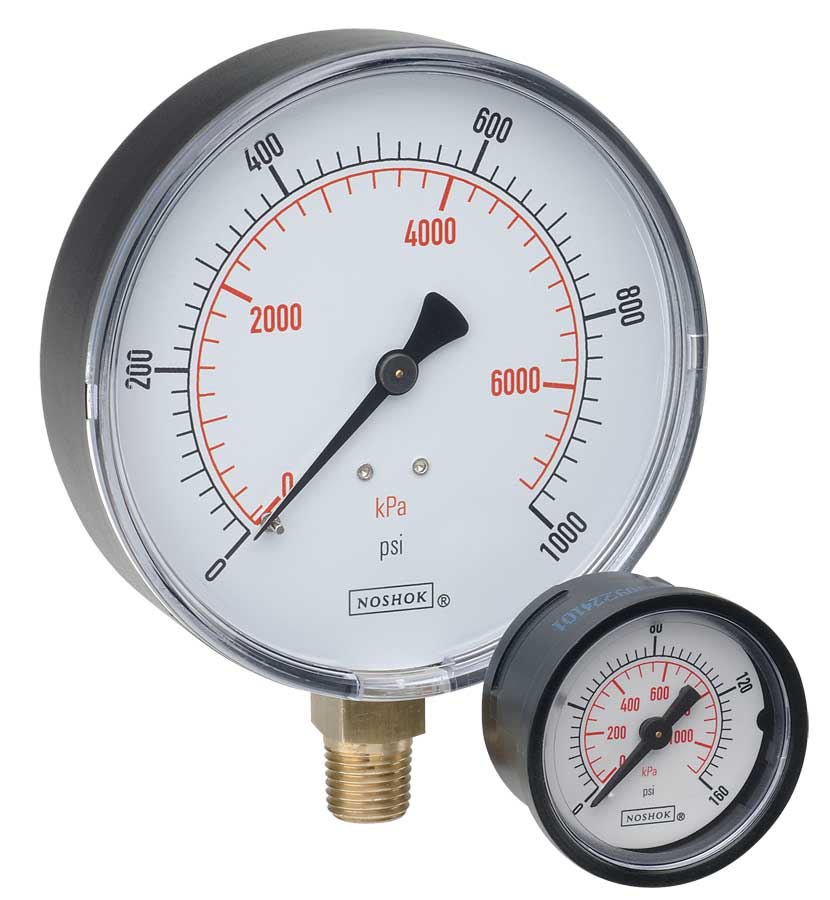 NOSHOK ABS & Steel Dry Pressure Gauges 100 series
 NOSHOK Low Pressure Dry Pressure Gauges-( 200 series)
 NOSHOK PT40 Series High Accuracy Transmitters-Replaces 100,200,615 series