



Pressure Switch vs Transmitter Selection

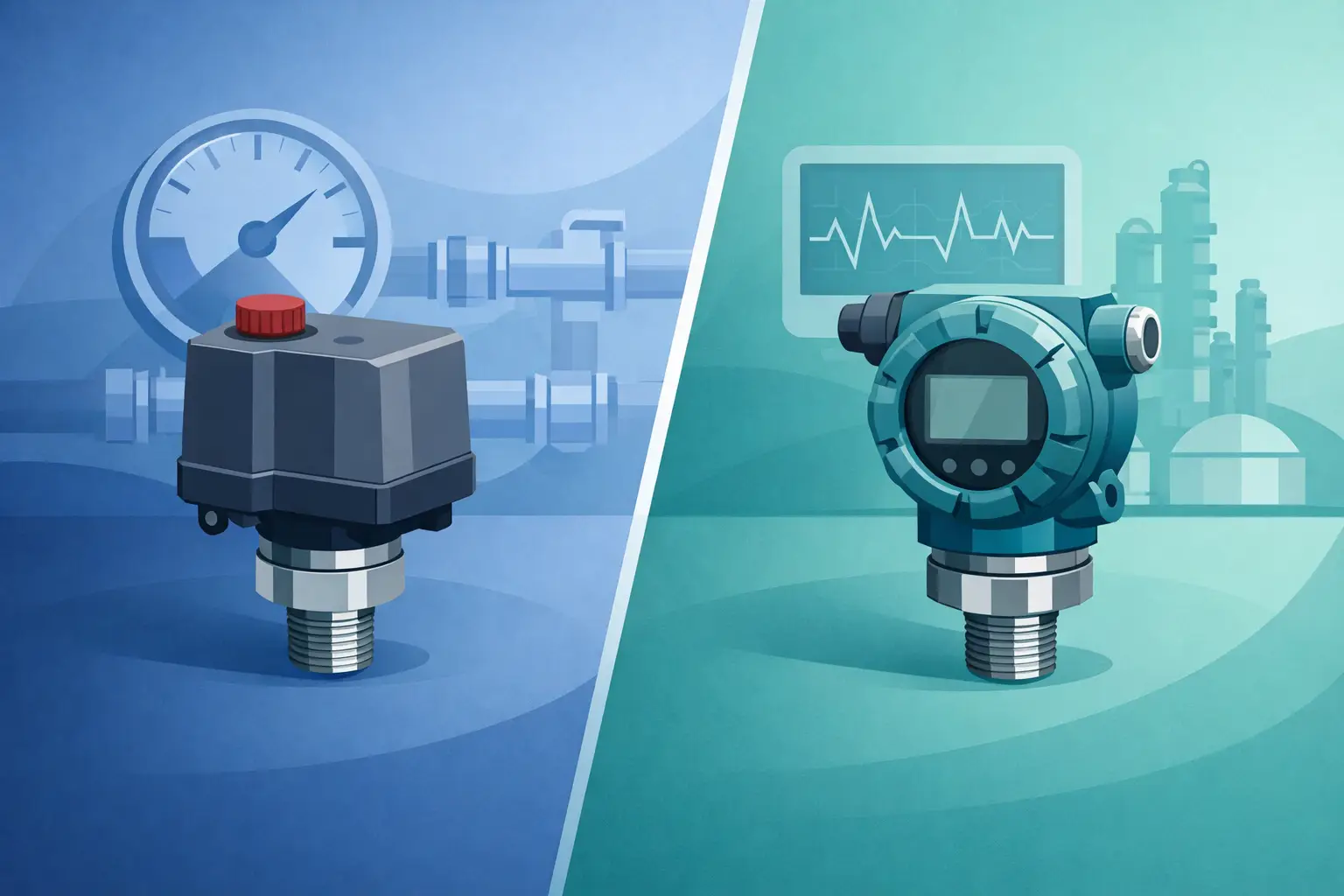
A pressure switch and a pressure transmitter may connect to the same process line, but they serve fundamentally different functions. In a pressure switch vs transmitter decision, the first question is not which device is better. It is whether the application needs a discrete action at one pressure point or a continuous measurement signal across an operating range.
That distinction affects the instrument type, electrical output, wiring, accuracy requirement, process connection, and control-system integration. Selecting the wrong device can leave a pump without a protective shutdown, a PLC without usable process data, or a maintenance team with a replacement part that will not match the existing circuit.
Pressure Switch vs Transmitter: The Functional Difference
A pressure switch is a discrete device. When process pressure reaches a specified set point, the switch changes state. Depending on the configuration, it may open or close a circuit, energize an alarm, stop a pump, start a compressor, or provide a permissive signal to another piece of equipment.
A pressure transmitter is an analog measurement device. It continuously senses pressure and converts that measurement into an electrical signal, commonly 4-20 mA, that represents pressure across its calibrated range. A control system, indicator, data logger, variable frequency drive, or PLC can use that signal to display, trend, alarm, or control the process.
Put simply, a switch answers whether pressure is above or below a defined threshold. A transmitter answers what the pressure is right now. Both may be installed on the same vessel, pump discharge, hydraulic circuit, or process line when the system requires both control data and an independent protective action.
When a Pressure Switch Is the Correct Device
Use a pressure switch when the required output is on or off. This is common where a process condition must trigger a direct, repeatable action without the need to continuously monitor pressure values.
For example, a low-pressure switch on a lubrication system can shut down equipment when oil pressure falls below a safe operating limit. A high-pressure switch on an air compressor can stop the motor at cutout pressure and restart it at cut-in pressure. A differential pressure switch can signal a dirty filter condition once the pressure drop reaches a defined limit.
The key specifications are more than the nominal pressure range. Buyers should confirm the adjustable or fixed set point, rising or falling pressure actuation, deadband or differential, electrical contact form, current and voltage rating, enclosure rating, and process-wetted materials. A switch rated for the system pressure may still be unsuitable if its contacts cannot handle the load or if its deadband does not support the required control sequence.
Mechanical pressure switches are often appropriate for straightforward local control and safety functions. Electronic pressure switches can add digital displays, adjustable parameters, switching outputs, and more precise repeatability. The best choice depends on the circuit design and the consequence of a missed or unstable trip point.
When a Pressure Transmitter Is the Correct Device
Choose a pressure transmitter when the system needs a continuously variable pressure signal. In most industrial installations, 4-20 mA transmitters are used because the signal can travel long distances, integrates with common control hardware, and provides a recognizable low-end diagnostic condition below the normal 4 mA value.
A transmitter is appropriate for applications such as monitoring pump discharge pressure at an HMI, controlling a steam or gas process, recording hydraulic pressure trends, calculating level from hydrostatic head, or generating high and low alarms in a PLC. Unlike a switch, it allows the operator or controller to see pressure movement before the process reaches an alarm threshold.
Pressure range selection matters. A transmitter should cover the highest expected operating and upset pressure without making normal operating changes too small to resolve. Selecting an excessively broad range can reduce the practical value of the measurement. Selecting a range too close to normal maximum pressure can expose the sensor to overload events and shorten service life.
Also verify output type, supply voltage, accuracy, response time, electrical connection, display requirement, and environmental rating. For a 4-20 mA loop, confirm that the receiving input is configured for current rather than voltage and that the available loop supply can support the transmitter and total wiring resistance.
Accuracy, Repeatability, and Deadband
Pressure switches and transmitters are specified differently because they do different jobs. A transmitter accuracy specification describes how closely its output represents actual pressure over its calibrated span. Accuracy may include nonlinearity, hysteresis, and repeatability, depending on the manufacturer specification.
A pressure switch is commonly evaluated by set point accuracy, repeatability, and deadband. Deadband is the difference between the pressure at which the switch changes state and the pressure at which it resets. This difference is intentional in many applications. It prevents rapid cycling when pressure fluctuates near the set point.
For compressor control, a usable deadband may be necessary to prevent frequent motor starts. For a high-pressure safety alarm, a narrow and predictable actuation tolerance may be more critical. Do not assume a transmitter can replace a mechanical safety switch simply because a PLC can create an alarm from its analog signal. The control system, power source, programming, and failure modes must all be considered before assigning a protective function to an analog loop.
Process Compatibility Still Drives the Selection
Whether selecting a switch or transmitter, process compatibility is not optional. Confirm the pressure media, operating temperature, pressure spikes, vibration, pulsation, ambient exposure, and cleaning requirements before matching a part number.
For corrosive media, wetted stainless steel or another compatible alloy may be required. For sanitary service, the process connection and surface requirements must fit the cleaning method and installation standard. For viscous, crystallizing, or high-temperature media, a diaphragm seal may be needed to protect the sensing element and maintain a usable pressure measurement.
Connection details also need to match the installation. Thread type, size, male or female configuration, and sealing method should be verified against the existing port or manifold. A nominally similar NPT, SAE, DIN, tri-clamp, or metric connection is not an interchangeable replacement.
Pressure pulsation and hydraulic shock deserve special attention. A transmitter may need a snubber, restrictor, or remote mounting arrangement where pump pulses are severe. A pressure switch may chatter or cycle prematurely if pulsation repeatedly crosses its actuation point. The corrective action is not always a different instrument range. It may be a change to the installation, damping, or impulse line arrangement.
Control-System and Electrical Considerations
A pressure switch usually connects to a discrete input, relay circuit, motor starter control circuit, or alarm circuit. Confirm whether the application requires normally open, normally closed, SPDT, PNP, NPN, or another switching configuration. In hazardous or wet locations, the enclosure classification and cable entry must also align with the site requirement.
A transmitter typically connects to an analog input and requires correct loop wiring, polarity, power supply, and signal scaling. A 4-20 mA transmitter calibrated for 0-300 psi must be scaled the same way in the receiving device. If the PLC is scaled for 0-500 psi, the displayed value and alarm logic will be wrong even though the transmitter itself is functioning correctly.
For replacement work, identify every marking from the existing device: pressure range, output, connection, electrical termination, accuracy, wetted material, approvals, and any customer-specific calibration or configuration. The pressure range alone is not a complete specification.
Can One Device Replace the Other?
Sometimes an electronic pressure switch with an analog output can combine local switching and continuous measurement in one device. This can reduce installation points and simplify some OEM assemblies. It is not automatically the best answer for every application.
Separate devices provide functional independence. A transmitter can feed process control and monitoring while a dedicated switch provides a hardwired high- or low-pressure trip. In higher-consequence service, that separation can be preferable to relying on one sensor, one power supply, and one control path.
Conversely, a simple packaged system may only need a cut-in and cutout function. Installing a transmitter, analog input card, PLC logic, and display would add cost and complexity without improving the required outcome. The correct device is the one that meets the operating requirement with appropriate reliability and maintainability.
When specifying NOSHOK pressure instrumentation, match the device family to the required output first, then verify the complete mechanical and electrical configuration. A pressure switch should be selected around actuation behavior and contact requirements. A transmitter should be selected around measurement range, signal type, and control-system compatibility.
Before issuing a purchase order or replacing a failed instrument, document the process conditions and the exact function the device must perform. That disciplined check is usually faster than correcting a mismatched pressure instrument after installation.