



Sanitary Diaphragm Seal Selection Guide

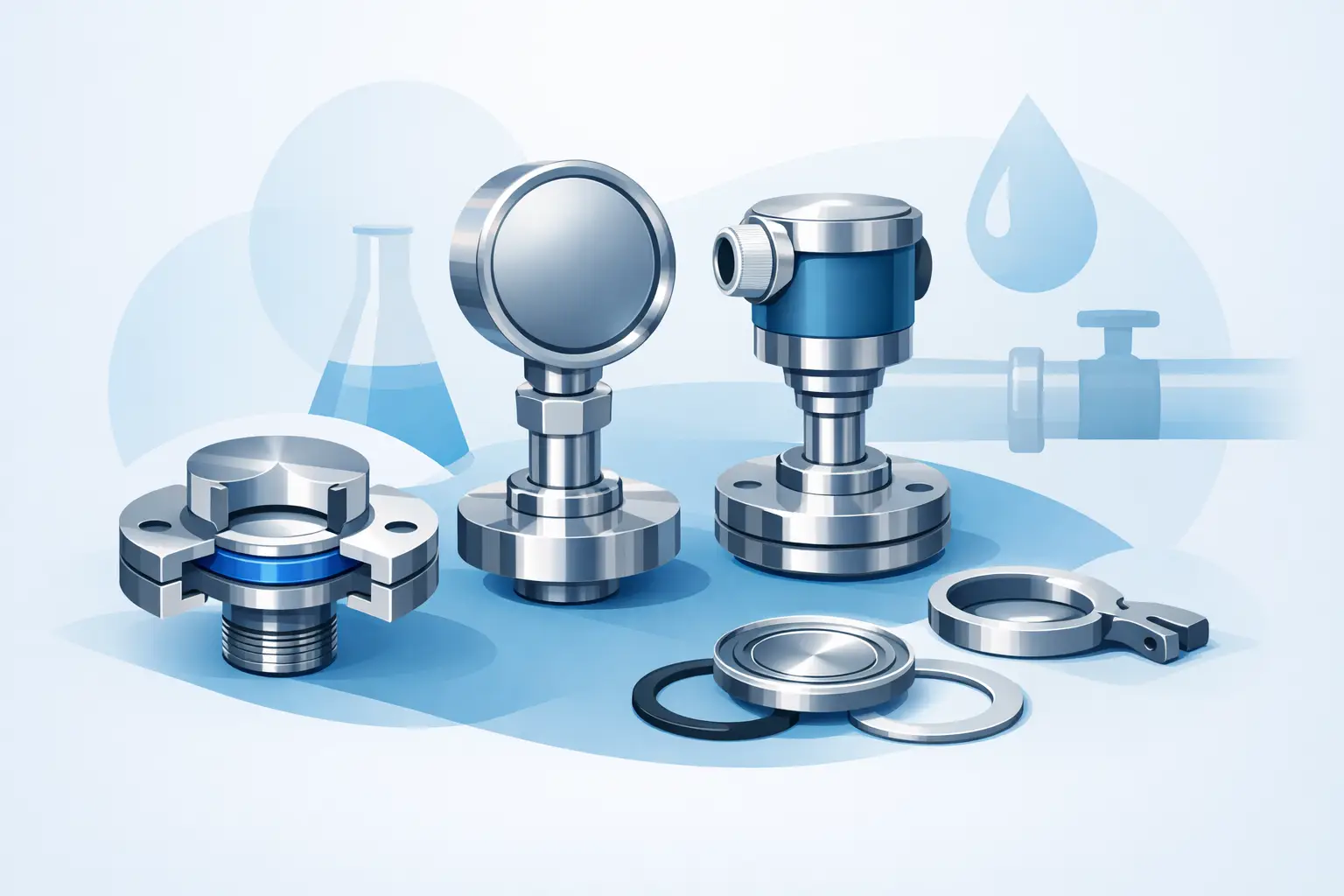
A pressure instrument that performs well on a utility line can fail quickly on a sanitary process connection. Product contact surfaces, cleanability, dead space, temperature cycling, and washdown exposure all change the selection criteria. That is why a sanitary diaphragm seal is not just an accessory. It is a process interface that protects the instrument while preserving hygienic design and measurement integrity.
In food, beverage, dairy, pharmaceutical, and biotech service, the wrong seal configuration can create more than a maintenance issue. It can introduce cleaning problems, trap residue, shorten instrument life, or produce unstable readings during thermal cycling. Buyers and specifiers usually need to balance instrument protection, sanitary compliance, process compatibility, and replacement simplicity against an existing plant standard.
What a sanitary diaphragm seal does
A sanitary diaphragm seal isolates the pressure instrument from the process media with a thin diaphragm and a fill fluid. Process pressure deflects the diaphragm, and that pressure is transmitted through the fill fluid to the gauge, switch, or transmitter. This lets the instrument measure pressure without direct contact with the process.
That basic function matters most when the process media is viscous, corrosive, particulate-laden, crystallizing, or subject to strict hygienic requirements. In sanitary service, the seal also helps support clean-in-place and, depending on the assembly design, steam-in-place conditions. The goal is not only to protect the instrument from the process. The goal is to maintain a flush, cleanable, product-contact boundary that fits the sanitary piping standard already in the system.
For many plants, the diaphragm seal is selected together with the pressure instrument as an assembled system. That approach reduces compatibility problems between the seal, capillary or direct mount arrangement, fill fluid, and instrument range. It also matters for response time and temperature performance.
Where sanitary diaphragm seal assemblies are used
Sanitary processes place unusual demands on pressure measurement because the process connection itself is part of the hygienic design. A threaded industrial connection may be acceptable on a non-product utility line, but not on a product-contact vessel, transfer line, or skid.
Typical applications include tank pressure measurement, filter housings, pump discharge monitoring, separator systems, batching skids, filling equipment, and transfer piping. In these settings, operators often need a flush process connection that will not create a pocket for product buildup. They also need materials that hold up to caustic washdown, acidic cleaning agents, thermal shock, and repeat sanitation cycles.
The instrument side of the assembly can vary. Some applications still use a gauge for local indication. Others require a pressure transmitter for PLC or DCS integration. The seal selection affects both.
Sanitary diaphragm seal connection options
The first specification point is usually the sanitary connection style. In US plants, tri-clamp connections are common because they support quick disassembly and standard sanitary ferrule interfaces. The nominal size must match the existing process connection, but size is only part of the decision.
The diaphragm face geometry matters just as much. A flush diaphragm helps reduce dead space and product retention. Some designs are better suited to smaller lines, while others are intended for tanks or larger diameter process points where a broader sensing area improves measurement stability.
Surface finish and material certification may also be part of the specification, especially in pharmaceutical or higher-purity processes. In more routine food and beverage service, the focus is often on practical compatibility with existing fittings, elastomers, and cleaning procedures. It depends on how the plant writes its hygienic standard and how tightly documented the validation process is.
Material selection for sanitary service
A sanitary diaphragm seal usually starts with stainless steel construction, but not every stainless option performs the same in every washdown or process environment. 316L stainless steel is common for product-contact components because of its corrosion resistance and sanitary suitability. Even then, actual compatibility must be checked against the product media and the cleaning chemicals.
If the process includes chlorides, aggressive acids, or unusually frequent sanitation cycles, buyers may need to consider alternate wetted materials or special diaphragm alloys. A seal that survives the product may still degrade from the cleaning regimen. That is a common spec gap in replacement purchases, especially when procurement only references the original pressure range and connection size.
The diaphragm itself deserves close attention because it is the thinnest wetted barrier in the assembly. Material choice affects corrosion resistance, fatigue life, and measurement sensitivity. In sanitary service, long-term durability often comes down to matching the diaphragm material to both the media and the full cleaning process, not just one or the other.
Fill fluid and temperature limits
The fill fluid is easy to overlook, but it directly affects performance. It transfers pressure from the diaphragm to the instrument, so its expansion characteristics influence accuracy as process or ambient temperature changes. In a washdown environment with frequent hot and cold cycling, poor fill fluid selection can lead to reading shift, slow response, or excessive temperature error.
Food-grade requirements may also apply, depending on plant policy and risk tolerance. While the diaphragm is intended to isolate the fill fluid from the process, sanitary applications often require additional scrutiny of any material within the pressure boundary.
Temperature range should be reviewed as a full system issue. Process temperature, ambient temperature, cleaning temperature, and temporary steam exposure all matter. A direct-mounted assembly may work well for compact installation, but it exposes the instrument to more heat. A capillary-mounted configuration can help protect the instrument from temperature, vibration, or access limitations, though it may introduce slower response and greater temperature sensitivity if poorly specified.
Instrument compatibility and range matching
A sanitary diaphragm seal is only as useful as the instrument it is paired with. Gauge, switch, and transmitter compatibility should be confirmed at the series level, not assumed from thread size or general pressure rating. The seal volume, diaphragm size, fill fluid, and mounting arrangement all influence how the connected instrument behaves.
Low-pressure applications need special care. If the pressure range is narrow, the seal assembly can have a larger effect on system accuracy and response. A configuration that is acceptable at higher pressure may produce disappointing performance at the low end. This is one reason experienced buyers often source the instrument and seal as a matched assembly rather than combining components after the fact.
Vacuum service, compound ranges, pulsation, and frequent pressure cycling also change the selection criteria. In some systems, adding a diaphragm seal improves reliability because it protects the sensing element from fouling. In others, a poor match between instrument range and seal design creates lag or zero shift that operators interpret as instrument failure.
Specifying a sanitary diaphragm seal correctly
The fastest way to avoid a mismatch is to define the application in a disciplined order. Start with the process media and cleaning chemicals. Then confirm process temperature, pressure range, sanitary connection type and size, wetted materials, instrument type, and mounting preference.
After that, review whether the installation is best served by direct mount or remote capillary. Direct mount is compact and usually offers better response. Remote mount can be the better choice when heat, vibration, access, or washdown exposure would shorten instrument life. Neither is automatically better. It depends on the physical conditions around the process connection.
Buyers replacing an existing assembly should also confirm whether the current part was selected for original design conditions that still apply. Plants change products, cleaning agents, and operating temperatures over time. A like-for-like replacement may not be the right replacement if the process has shifted.
Common mistakes in sanitary diaphragm seal selection
Most field problems come from a short list of specification errors. One is treating the sanitary diaphragm seal as a simple adapter rather than a calibrated process interface. Another is focusing on the ferrule size while ignoring diaphragm material, fill fluid, or instrument range interaction.
A third common issue is forgetting the cleaning cycle. The process media may be mild, but repeated caustic washdown or steam exposure can still damage the seal or affect accuracy over time. There is also the practical problem of ordering by a partial description instead of a complete configured part number. In instrumentation, close is not close enough.
For buyers working in branded instrumentation environments, it helps to source through an authorized specialist that understands exact series compatibility, assembly options, and crossover requirements. That is especially true when the job calls for a NOSHOK-matched configuration rather than a general industrial substitute.
A sanitary diaphragm seal should fit the process mechanically, chemically, and operationally. When those three align, the instrument lasts longer, readings stay more stable, and replacement cycles become more predictable. If the application details are clear before the order is placed, the installation usually goes the same way – clean, correct, and without surprises.