



Top Industrial Transmitter Features That Matter

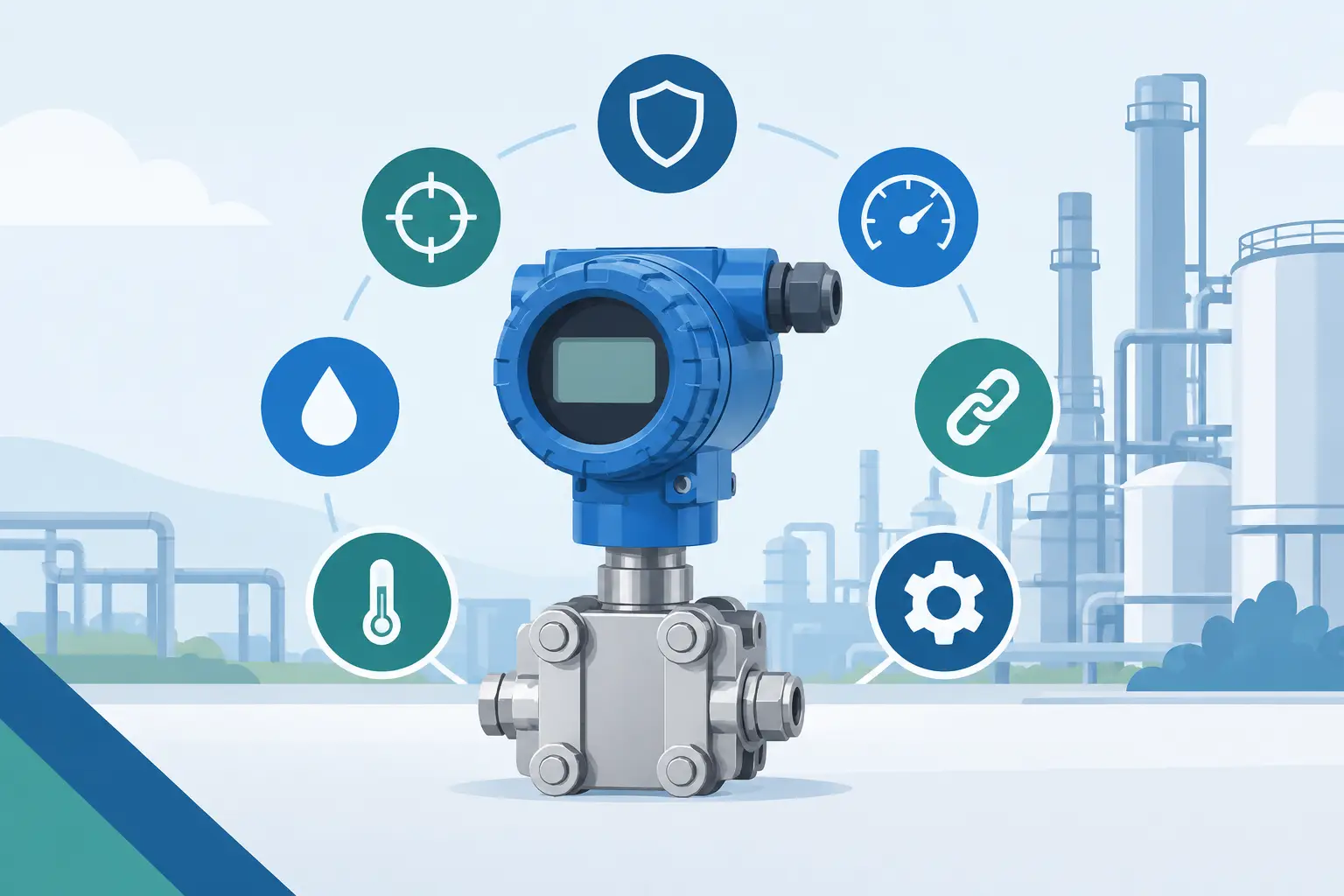
A transmitter that fits the process connection but cannot survive the media, communicate with the control system, or hold its stated accuracy creates a maintenance problem before startup. The top industrial transmitter features are not interchangeable checkboxes. They must be evaluated against the process conditions, control architecture, installation method, and required measurement confidence.
For plant maintenance teams and OEM builders, the right selection usually starts with the measurement variable: pressure, differential pressure, temperature, level, or flow. From there, the details determine whether the device provides dependable process data or becomes a recurring replacement item. Range, output, wetted materials, connection style, environmental protection, and approvals should be reviewed together rather than as isolated specifications.
Top Industrial Transmitter Features for Process Applications
Measurement range and turndown
The stated operating range is the first technical filter. A pressure transmitter should be selected so normal operating pressure falls within a useful portion of its calibrated span, not at the extreme low or high end. A 0-100 psi transmitter may withstand a 60 psi process, but it may not deliver the resolution needed if the meaningful operating change is only a few psi.
For adjustable or smart transmitters, turndown describes how far the calibrated span can be reduced from the sensor’s maximum range. Higher turndown can reduce inventory requirements because one transmitter family may cover several application spans. That flexibility has limits. Accuracy specifications often change with turndown, and an excessively broad sensor range may be less suitable than a properly ranged fixed-span unit.
Also separate working pressure from proof pressure, burst pressure, and overpressure limits. In pumping systems, compressor discharge lines, hydraulic circuits, and steam service, temporary spikes can exceed normal conditions. A transmitter must tolerate those events without permanent zero shift or sensor damage.
Accuracy, stability, and response time
Accuracy is often quoted as a percentage of full scale, calibrated span, or reading. Those bases are not equivalent. A buyer comparing instruments should confirm exactly how the manufacturer states accuracy, including linearity, hysteresis, repeatability, and thermal effects.
For a broad operating range, percent-of-reading accuracy can offer an advantage because error scales with the measured value. For a tightly controlled fixed range, a percent-of-span specification may be entirely appropriate. The required accuracy depends on the job. A general pump monitoring point may not need the same performance as a custody-related calculation, calibration standard, or high-value batch process.
Long-term stability matters just as much in installations with difficult access or mandated calibration intervals. A transmitter that holds calibration reduces field labor, production interruptions, and uncertainty between verification cycles. Response time should also match the process. Fast response is useful for dynamic hydraulic or pneumatic systems, while excessive damping can hide a rapidly developing condition. Conversely, some pulsating processes need damping or signal filtering to prevent nuisance alarms and unstable control loops.
Output signal and control-system compatibility
A transmitter is only useful when its output can be accepted and interpreted correctly by the receiving device. The 4-20 mA signal remains common across industrial facilities because it is familiar, suitable for long cable runs, and provides a live-zero indication. A reading below 4 mA can help identify an open circuit or selected fault condition.
Voltage outputs may suit short-run OEM equipment, while digital communications can provide configuration, diagnostics, and additional process variables. Depending on the application, buyers may need HART communication over 4-20 mA, a fieldbus protocol, a switch output, or a combination of analog and digital functions.
Do not assume a matching connector means a matching electrical interface. Verify supply voltage, loop resistance, load requirements, wiring method, display requirements, and the input type on the PLC, DCS, recorder, or local indicator. For hazardous locations, the signal method must also align with intrinsic safety barriers, isolators, or approved installation practices.
Wetted materials and media compatibility
The wetted diaphragm, pressure port, sensor seal, and any fill fluid must be compatible with the process media. Stainless steel is a common choice for many industrial pressure applications, but it is not a universal answer. Chlorides, acids, caustics, high-purity chemicals, sour gas, and sanitary media can require alternative alloys, specialized elastomers, or an isolation arrangement.
Material selection should account for concentration, temperature, cleaning chemicals, and the possibility of contamination. A seal material that performs well in ambient water service may fail in hot washdown, steam cleaning, or solvent exposure. In sanitary systems, the transmitter’s process contact materials, surface finish, and cleanability can be as important as its pressure range.
When direct media contact is unsuitable, a diaphragm seal can isolate the transmitter from corrosive, viscous, crystallizing, or high-temperature process fluids. This adds components and must be specified carefully. Seal fill fluid, capillary length, mounting elevation, process temperature, and response requirements can affect measurement performance.
Process connections and installation geometry
Connection type is a frequent source of ordering errors. NPT, SAE, JIC, flange, clamp, DIN-style, and sanitary connections have different sealing methods and dimensional requirements. A thread may appear to fit while still providing an improper seal, poor engagement, or an unsafe installation.
Confirm the connection size, gender, thread standard, and sealing surface before selecting a transmitter. For sanitary applications, verify clamp size, gasket compatibility, and whether the installation can be cleaned as required. For pressure measurement, mounting orientation and impulse-line design also affect the result. Trapped gas in a liquid line, condensed liquid in a gas line, plugged impulse tubing, or poor tapping location can produce misleading readings regardless of transmitter quality.
High-temperature service deserves particular attention. Some transmitters have specified process temperature limits that differ from their ambient temperature rating. Remote seals, cooling elements, or properly designed impulse lines may be necessary when the process connection is exposed to heat beyond the transmitter electronics or sensor limits.
Environmental protection and mechanical construction
Industrial transmitters operate in conditions that may include vibration, washdown, dust, UV exposure, salt air, outdoor temperature swings, and electrical noise. The enclosure rating should match the actual location, not the general facility description. An instrument mounted inside a dry electrical enclosure faces different demands than one installed on a washdown skid or outdoor piping rack.
Review the stated IP or NEMA rating, housing material, cable entry, connector style, and operating ambient temperature range. A stainless steel housing may be appropriate in corrosive or washdown areas, while a compact polymer housing can be suitable for protected machine installations. The decision depends on exposure, not appearance.
Mechanical vibration can shorten transmitter life and create unstable signals, especially near reciprocating pumps, compressors, and mobile equipment. Where vibration is expected, review the manufacturer’s vibration rating and use appropriate mounting practices. Avoid placing the transmitter where piping movement, unsupported cable weight, or direct mechanical impact loads are transferred into the process connection.
Hazardous-area and industry approvals
Approvals are not optional documentation when the area classification requires them. Select equipment with the correct hazardous-location marking for the installed environment, whether that involves explosionproof, intrinsically safe, nonincendive, or other approved protection methods. The transmitter approval, wiring method, cable gland, barrier, and control panel arrangement must function as a complete system.
Industry-specific requirements may also apply. Food and beverage installations may require sanitary materials and construction. Oil and gas service may involve sour-service considerations. Utility, marine, or OEM applications can require defined electrical, environmental, or agency standards. Approval requirements should be identified before a part number is released for purchase, particularly when replacement instruments must match an existing documented installation.
Features That Improve Field Service and Inventory Control
A local display, configurable engineering units, diagnostic indication, and accessible zero/span adjustment can reduce commissioning time. These features are useful, but they should not be treated as automatic upgrades. A display may add value at a remote skid and add little value inside a panel where the PLC already provides clear indication.
For multi-site maintenance programs, standardizing on compatible transmitter families can simplify spare inventory, training, and replacement procedures. That does not mean forcing one model into every application. Standardization works when it preserves the required range, materials, approvals, and connection details.
Authorized product sourcing also matters when a buyer needs exact series continuity, manufacturer documentation, or a dependable cross-reference for an existing installation. Mass Measure supports industrial buyers who need NOSHOK instrumentation specified by product family, process connection, pressure range, output, and material configuration.
Before issuing a purchase order, compare the transmitter data sheet to the process record one line at a time: measured variable, normal and maximum conditions, wetted materials, connection, output, power, environment, approvals, and installation constraints. That disciplined review is often the difference between a transmitter that merely fits the port and one that supports reliable measurement for its intended service life.
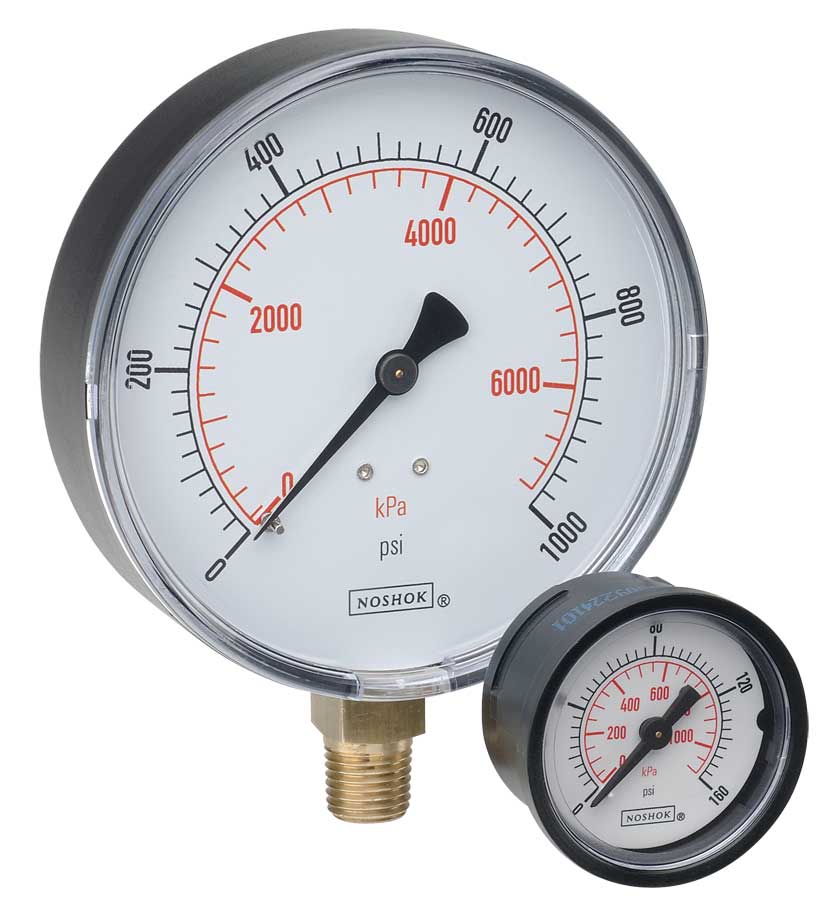 NOSHOK ABS & Steel Dry Pressure Gauges 100 series
 NOSHOK Low Pressure Dry Pressure Gauges-( 200 series)
 NOSHOK PT40 Series High Accuracy Transmitters-Replaces 100,200,615 series
