



Why Use Diaphragm Seals in Process Systems?

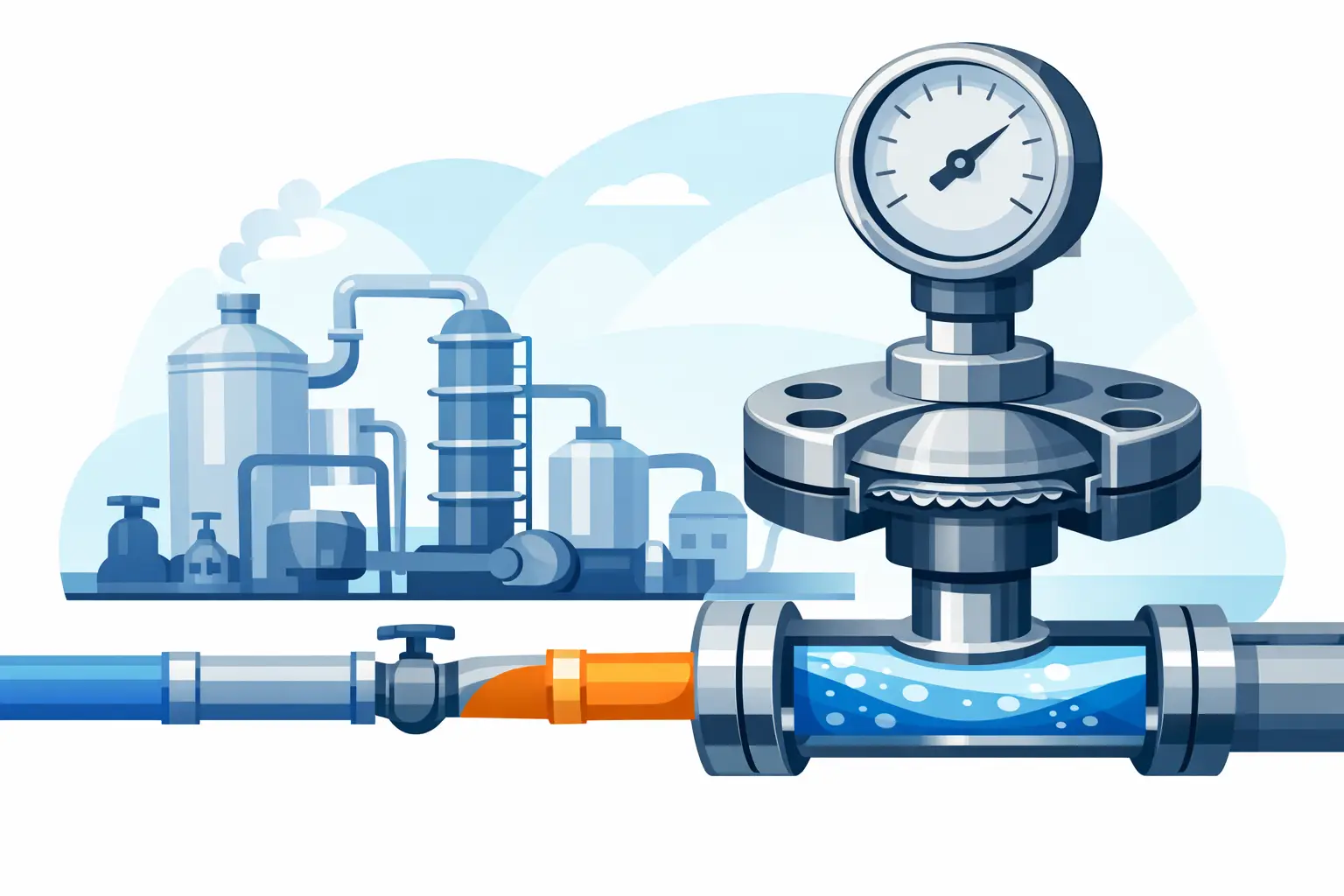
A pressure gauge can be correctly ranged, properly installed, and still fail early because the process media reaches its sensing element. That is the practical answer to why use diaphragm seals: they isolate the instrument from conditions it was not designed to contact directly while preserving a usable pressure signal. In many process systems, the seal is not an accessory. It is the component that makes reliable pressure measurement possible.
Why Use Diaphragm Seals for Pressure Instruments?
A diaphragm seal mounts between the process connection and a pressure gauge, pressure transmitter, pressure switch, or other pressure-sensing device. A thin, flexible diaphragm forms the process boundary. Process pressure deflects that diaphragm and transfers the force through a sealed fill fluid to the instrument.
The instrument does not contact the process media. Instead, it measures the pressure transmitted through the diaphragm seal assembly. This arrangement protects internal components such as Bourdon tubes, capsules, sensor diaphragms, and small pressure ports from plugging, corrosion, coating, or contamination.
Direct mounting is generally the best approach when the media is clean, compatible with the instrument’s wetted materials, and within the instrument’s temperature limits. Adding a seal introduces cost and system variables, including fill-fluid selection and temperature effects. But when direct contact creates a material, cleanliness, or serviceability problem, a properly selected diaphragm seal is usually more dependable than repeatedly replacing failed instruments.
Conditions That Justify a Diaphragm Seal
The strongest reason to specify a seal is process media that can damage, obstruct, or contaminate the pressure instrument. The application, not the gauge size or transmitter model alone, should drive the decision.
Corrosive or chemically aggressive media
Acids, caustics, chlorides, sour process streams, and other aggressive chemicals can attack standard stainless steel wetted parts. A diaphragm seal allows the buyer to specify process-contact materials appropriate for the chemical exposure while keeping the instrument isolated. Material selection still requires care. A seal with an unsuitable diaphragm, lower housing, gasket, or process connection will not solve a corrosion problem.
Verify the full wetted path, concentration, operating temperature, pressure, and potential cleaning chemicals. Compatibility charts are useful starting points, but they do not replace process-specific review where corrosion consequences are significant.
Viscous, crystallizing, or solids-bearing media
Heavy oils, asphalt, slurries, pulp stock, adhesives, resins, wastewater solids, and crystallizing fluids can enter a small instrument port and restrict it. Once a sensing passage plugs, the reading may lag, hold pressure, or fail to reflect actual process conditions.
Diaphragm seals provide a broad, flush process surface that reduces dead space and eliminates the narrow inlet path found on many direct-mounted instruments. Flanged, flush-mounted, and extended-diaphragm configurations are commonly considered where buildup is expected. The correct geometry matters as much as the seal itself. A recessed connection can still collect material if it is not matched to the vessel nozzle or pipe design.
High- or low-temperature process conditions
Process temperature can exceed the permissible temperature of a gauge, transmitter, or switch. A diaphragm seal can separate the instrument from the process and, when used with a capillary or cooling element, reduce the temperature reaching the sensing device.
This is not automatic thermal protection. Heat can travel through the seal body, fill fluid, mounting hardware, and capillary. Fill-fluid expansion can also cause temperature-related measurement shift. Specify the process temperature range, ambient temperature at the instrument, and required accuracy across those conditions. For high-temperature service, installation orientation and the distance between the process connection and instrument can materially affect performance.
Sanitary and contamination-sensitive applications
Food, beverage, pharmaceutical, biotechnology, and other hygienic processes often require a cleanable, crevice-minimized process connection. A sanitary diaphragm seal can provide a flush contact surface suited to sanitary fittings and cleaning practices while preventing product from entering the instrument.
For these applications, the connection standard, elastomer or gasket material, surface finish requirements, and clean-in-place or steam-in-place conditions must be reviewed together. The goal is not merely to protect the pressure device. It is to preserve cleanability and process integrity.
Pulsation, fouling, and difficult maintenance access
Diaphragm seals can also help in services where an instrument would otherwise require frequent removal for cleaning or replacement. They are often paired with other pressure-management components, such as snubbers, restrictors, or remote capillary systems, when pulsation and location constraints are present.
A seal alone does not eliminate pulsation. Rapid pressure cycling still reaches the instrument through the fill system. Where pressure fluctuations are severe, evaluate the complete assembly and expected response time rather than treating the seal as a universal damper.
What a Diaphragm Seal Protects Against
A diaphragm seal is primarily an isolation device. It can prevent process media from contacting sensitive instrument internals and can place the instrument at a more practical location. That protection can reduce unplanned maintenance, improve reading stability, and extend the usable life of pressure instrumentation.
The benefit is especially clear when failures recur in the same service. If a gauge repeatedly plugs on a slurry line, replacing it with another direct-mounted gauge addresses the symptom, not the installation condition. If a transmitter’s wetted diaphragm is exposed to incompatible media, a different transmitter range will not correct the material problem.
For maintenance teams, the value is often reduced troubleshooting. A well-specified seal assembly creates a defined process boundary and removes one common source of instrument failure. For OEMs and system designers, it supports repeatable pressure measurement across equipment built for demanding media.
Selecting the Right Diaphragm Seal Assembly
A diaphragm seal should be specified as part of the complete pressure measurement assembly. Pressure range is only one input. Start with the instrument type and measurement requirement, then match the process connection, wetted materials, diaphragm configuration, fill fluid, and mounting arrangement to the service.
The following details should be available before selecting a configuration:
- Process media, concentration, solids content, viscosity, and cleaning chemicals
- Normal operating pressure, maximum pressure, vacuum conditions, and pressure spikes
- Process and ambient temperature ranges
- Required accuracy, acceptable response time, and allowable temperature-related error
- Process connection type, size, mounting orientation, and available clearance
- Wetted-material requirements, including diaphragm, seal body, gasket, and connection materials
- Sanitary, hazardous-area, or facility-specific standards that apply to the installation
Pressure range deserves particular attention. The instrument must be ranged for normal operation and protected from foreseeable overpressure, while the diaphragm seal itself must be rated for the process. Vacuum service also needs explicit review because certain fill fluids, diaphragm designs, and operating temperatures can affect performance under vacuum.
Remote-mounted assemblies require further consideration. A capillary permits the instrument to be located away from heat, vibration, or inaccessible piping, but longer capillaries can increase response time and temperature influence. Select the shortest practical capillary length and avoid routing that exposes the line to unnecessary temperature swings or mechanical damage.
For buyers replacing an existing assembly, document every component of the installed configuration before ordering. That includes the gauge or transmitter connection, seal connection, process connection, material designation, pressure range, fill fluid where known, and capillary length. A similar-looking replacement may not provide equivalent performance.
Diaphragm Seal Trade-Offs to Evaluate
Diaphragm seals solve specific process problems, but they are not the default choice for every pressure point. They add initial cost, additional wetted components, and potential accuracy effects caused by fill-fluid temperature changes. Response can be slower than a direct-mounted instrument, especially with capillaries or large-volume seal designs.
They also require disciplined installation. Mechanical stress from misaligned piping, improper gasket selection, overtightening, or unsupported instrument weight can damage the seal or distort measurement. Do not disassemble a filled seal system in the field unless the procedure and equipment are appropriate for the assembly. Loss of fill fluid or trapped air can compromise accuracy.
The most effective approach is simple: use a diaphragm seal when the process demands isolation, and avoid adding one when a direct-mounted instrument is compatible with the service. A clear application review prevents both under-specification and unnecessary complexity.
For exact replacement and new-system work, Mass Measure can help buyers align NOSHOK pressure instruments and diaphragm seal configurations with the process connection, materials, and operating conditions already defined by the application. The right assembly protects more than the gauge or transmitter – it protects the reliability of the pressure measurement the operation depends on.