



Best Pressure Gauge Materials for Industrial Service


A pressure gauge may be a small component in a process line, but its material selection determines whether it provides dependable service or becomes a repeat maintenance item. The best pressure gauge materials are not selected by pressure range alone. Buyers must evaluate the process media, operating temperature, external atmosphere, connection material, and the gauge’s wetted construction.
A gauge can have a stainless steel case and still be unsuitable for a corrosive process if its bourdon tube or socket is brass. Conversely, specifying an exotic alloy for a clean, noncorrosive air system can add cost without improving service life. The correct choice begins by separating the materials exposed to the process from the materials that protect the instrument externally.
Start With the Gauge’s Wetted Materials
For most industrial pressure gauges, the primary wetted components are the socket and pressure element. In a bourdon tube gauge, the pressure element is the bourdon tube. In diaphragm, capsule, and other specialty designs, the sensing element changes, but the selection principle does not: every material in contact with the process must be compatible with that process.
The case, ring, window, movement, and pointer are also relevant to the application, particularly in washdown, marine, outdoor, or corrosive ambient conditions. They do not, however, substitute for compatible wetted materials. A procurement specification should identify both requirements separately.
Pressure rating is another filter. Material compatibility does not override the gauge’s published pressure range, overpressure capability, temperature limits, or accuracy class. A suitable alloy must be supplied in a gauge design rated for the actual operating conditions.
Best Pressure Gauge Materials by Application
Brass for air, water, and noncorrosive service
Brass sockets and bourdon tubes are widely used for compressed air, hydraulic oil, water, and other noncorrosive fluids. They are a practical selection for general industrial service where process temperatures and pressures remain within the gauge’s stated limits.
Brass offers good machinability and cost efficiency, making it common in utility systems, pneumatic equipment, pumps, compressors, and OEM assemblies. For a dry, clean compressed-air application, a brass internal gauge can be an appropriate and economical choice.
Its limitation is chemical resistance. Brass should not be assumed compatible with ammonia, many chemical solutions, sour environments, salt-laden atmospheres, or media that can cause dezincification or stress corrosion. When the process is uncertain, identify the exact fluid concentration and temperature rather than specifying brass as a default.
304 stainless steel for general corrosion resistance
304 stainless steel is commonly used for gauge cases and, in some designs, wetted components. It provides substantially better resistance to atmospheric corrosion than painted steel or brass and is well suited to many industrial environments.
A 304 stainless steel case is useful where gauges are exposed to moisture, dust, occasional washdown, or outdoor service. It is frequently selected for food equipment exteriors, general manufacturing areas, utility installations, and equipment exposed to routine plant cleaning.
For chloride-bearing environments, however, 304 stainless steel may not provide sufficient protection. Chloride exposure from coastal air, washdown chemicals, cooling water, or process fluids can lead to pitting and crevice corrosion. The material may be acceptable in a mild environment, but it should not be treated as a universal corrosion-resistant answer.
316 stainless steel for broader process compatibility
316 stainless steel is often the preferred standard for wetted gauge parts in chemical processing, oil and gas support systems, water treatment, sanitary equipment, and other applications requiring stronger corrosion resistance. Its molybdenum content improves resistance to pitting in many chloride-containing environments compared with 304 stainless steel.
When a specification calls for an all-stainless steel pressure gauge, confirm what that statement covers. It may refer to the case and ring, or it may include a 316 stainless steel socket and bourdon tube. For process compatibility, the latter distinction is the critical one.
316 stainless steel is not immune to corrosion. High chloride concentrations, elevated temperatures, strong acids, and certain reducing chemicals may require another material. It can also be unsuitable for some sulfur-bearing or highly caustic applications. A compatibility review should account for temperature because a material that performs well at ambient conditions may degrade rapidly at elevated process temperature.
Monel for selected chemical and marine environments
Monel alloys are nickel-copper materials commonly specified where brass and stainless steel do not offer adequate resistance. They are often considered for seawater, saltwater exposure, hydrofluoric acid service, and selected sour or corrosive process conditions, subject to the specific alloy and application limits.
Monel is not a general-purpose upgrade for every gauge. It is more expensive than brass or stainless steel, and its use should be driven by documented media compatibility. The required pressure gauge may also have limited configuration availability in Monel, particularly when connection size, pressure range, or mounting style is highly specific.
For a process involving aggressive chemicals, the gauge manufacturer or an authorized instrumentation supplier should review the full application before a material is selected. The process name alone is not enough. Concentration, contaminants, pressure cycling, temperature, and cleaning chemicals can change the recommendation.
Specialty alloys and diaphragm seals for severe media
Some applications exceed the practical limits of standard brass, 304 stainless steel, 316 stainless steel, or Monel gauge construction. Chlorine service, strong acids, high-purity chemical processes, hot caustics, and other severe duties may require specialty alloys such as Hastelloy or alloy 20, depending on the media.
In many cases, the most effective solution is not a specialty-alloy gauge alone. A diaphragm seal can isolate the gauge from the process using a diaphragm material selected for the fluid. The gauge is then connected through a filled system rather than directly exposing its sensing element to the media.
Diaphragm seals are particularly useful for viscous fluids, slurries, crystallizing media, sanitary processes, and applications where plugging or contamination is a concern. They add selection variables, including diaphragm alloy, fill fluid, temperature limits, connection style, and system response. The seal and gauge must be specified as a matched assembly.
Case Materials Still Matter
The external case material affects instrument life, safety, and readability. A painted steel case may be acceptable in a protected indoor utility area. A stainless steel case is generally better suited to wet, dusty, washdown, corrosive, or outdoor environments.
For liquid-filled gauges, case material should be evaluated with the fill fluid, window material, and venting arrangement. Glycerin or silicone filling can reduce pointer vibration and improve readability in pulsating systems, but it does not correct an incompatible wetted-material selection. It also does not eliminate the need for a snubber, restrictor, or pulsation dampener when pressure spikes exceed the gauge’s intended duty.
Window material is another practical consideration. Acrylic, polycarbonate, and safety glass offer different impact resistance, chemical resistance, and temperature capabilities. In applications with solvents, UV exposure, washdown chemicals, or high ambient temperatures, the window can become the first visible failure point even when the metal construction is correct.
Match Material Selection to the Actual Process
A useful gauge specification identifies more than the line pressure. It should include the process fluid and concentration, normal and maximum pressure, normal and maximum temperature, ambient conditions, required connection size and type, mounting arrangement, accuracy requirement, and whether the pressure is steady, pulsating, or subject to spikes.
For replacement work, verify the existing gauge rather than matching only its dial size and connection. A 2 1/2-inch gauge with a 1/4-inch NPT lower connection can be offered with different wetted materials, case materials, movement designs, and pressure ranges. Two visually similar gauges may have very different application limits.
If a gauge failed prematurely, treat that failure as selection data. Green deposits around a brass socket, pitting on stainless steel, a clouded window, a broken bourdon tube, or a stuck pointer each points to a different issue. Corrosion, vibration, overpressure, temperature, and process plugging require different corrective actions.
Specify the Complete Material Construction
The best purchase description states the material requirement directly: for example, a 316 stainless steel socket and bourdon tube with a stainless steel case, or a gauge with a compatible diaphragm seal and specified diaphragm alloy. Avoid vague descriptions such as “stainless gauge” when the process media demands verified wetted-part construction.
For NOSHOK gauge, seal, valve, and related instrumentation selections, exact series and configuration details help prevent a material mismatch before the component reaches the field. A correct part number should reflect the process connection, pressure range, mounting, gauge diameter, and material requirements as a complete specification.
The right gauge material is the one that matches the process, not the one with the most expensive alloy label. Confirm the wetted parts first, then match the case construction and accessory requirements to the surrounding environment and operating conditions.
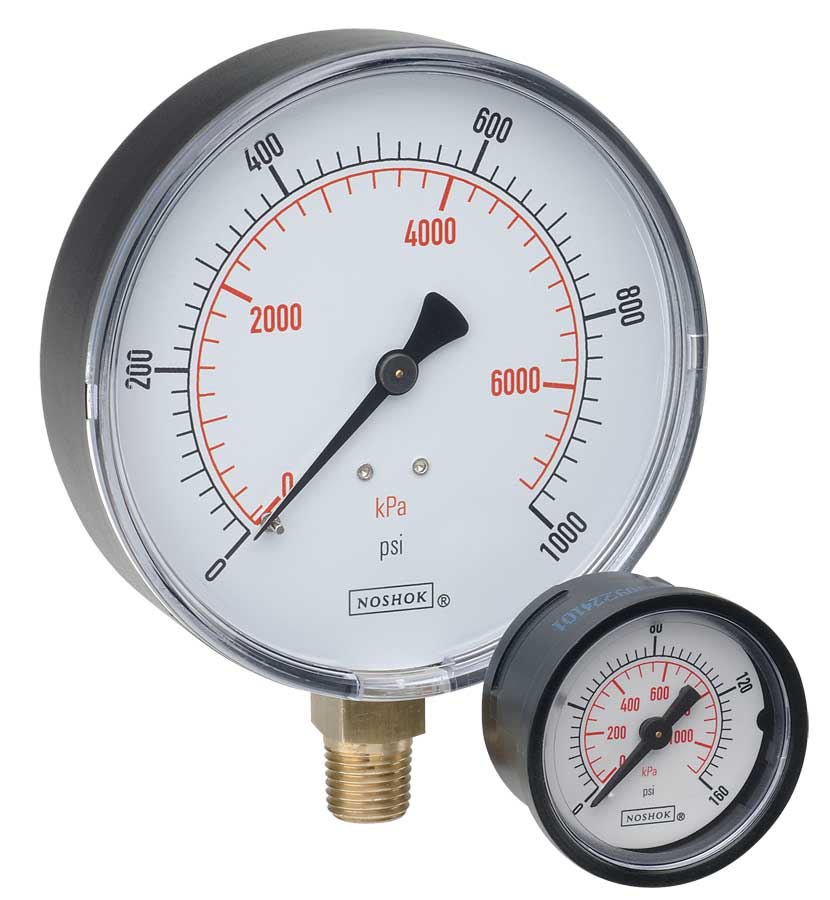 NOSHOK ABS & Steel Dry Pressure Gauges 100 series
 NOSHOK Low Pressure Dry Pressure Gauges-( 200 series)
 NOSHOK PT40 Series High Accuracy Transmitters-Replaces 100,200,615 series