



How to Identify Gauge Thread Size Correctly


A pressure gauge can have the correct pressure range, wetted material, and dial size yet still be unusable if its process connection is wrong. Knowing how to identify gauge thread size prevents cross-threading, leakage, unplanned adapter use, and delays when replacing a failed instrument. The task requires more than measuring the outside diameter of the connection. You must confirm the thread form, pitch, taper, sealing method, and whether the connection is male or female.
For plant maintenance and OEM work, treat the existing connection as a specification to verify, not an assumption based on appearance. Several common thread standards can look similar at a glance while remaining mechanically incompatible.
Start With the Connection Type
First, determine whether the gauge has a male threaded stem or a female threaded socket. Most pressure gauges use a male process connection extending from the lower, back, or center-back of the case. The mating piping component, manifold, valve, diaphragm seal, or adapter will normally have the corresponding female port.
Also identify the connection location before ordering a replacement. A lower mount gauge has the connection at the bottom of the case. A back connection exits through the rear center of the case, while a center-back connection is positioned at the rear but may be designed for panel mounting. Connection orientation does not define thread size, but it is part of the complete replacement specification.
Inspect the threads and sealing surfaces after isolating and depressurizing the process. Damage, corrosion, thread sealant buildup, or a previously installed adapter can conceal the original standard. If an adapter is present, measure both sides and document it separately. Do not assume the gauge connection matches the line connection simply because the assembly fits together.
How to Identify Gauge Thread Size With Measurements
Use a caliper and thread pitch gauge whenever possible. A steel rule can provide an initial estimate, but it is not precise enough to distinguish closely related pipe thread sizes. Record measurements in both inch and metric units if the equipment origin is unknown.
Measure the Major Diameter
For a male thread, measure the outside diameter across the crests of the threads. For a female port, measure the inside diameter at the opening, recognizing that this is less definitive because the female thread crest is not directly accessible. A thread plug gauge or known mating fitting provides a more reliable check for female ports.
The measured diameter will not necessarily equal the nominal pipe size. This is one of the most common sources of incorrect gauge orders. For example, a 1/4 in. NPT male connection has an outside diameter of approximately 0.540 in., not 0.250 in. Likewise, a 1/2 in. NPT thread measures roughly 0.840 in. across the major diameter.
Common pressure gauge connection sizes include 1/8 in., 1/4 in., 3/8 in., and 1/2 in. NPT. Metric applications may use M10 x 1.0, M12 x 1.5, M14 x 1.5, or M20 x 1.5 connections. BSPP and BSPT sizes such as G 1/4 or R 1/4 also appear on imported machinery and globally standardized equipment.
Check Threads Per Inch or Metric Pitch
For inch-based threads, use a thread pitch gauge to identify threads per inch, often abbreviated TPI. A 1/4 in. NPT connection has 18 TPI, while a 1/8 in. NPT connection has 27 TPI. Matching the diameter without confirming TPI can lead to a false identification.
Metric threads are identified by nominal diameter and pitch in millimeters. An M20 x 1.5 thread has a nominal major diameter near 20 mm and a 1.5 mm distance between thread crests. Use the metric side of the pitch gauge and check several threads, rather than relying on a single crest-to-crest measurement.
A practical field check is to place the pitch gauge leaf into the thread without forcing it. The leaf should seat cleanly across the thread profile. If it rocks, leaves gaps, or only matches part of the thread, the pitch is not correct.
Determine Whether the Thread Is Tapered or Straight
Taper is critical because it affects how the connection seals. NPT and BSPT threads are tapered. Their diameter gradually decreases toward the end of the male fitting. As the threads engage, the flanks create an interference fit, typically supplemented by an appropriate thread sealant.
BSPP and most metric threads are straight, also called parallel. These threads usually do not seal at the thread flanks. Instead, sealing occurs with a bonded seal, O-ring, gasket, washer, or a machined face. A straight-thread gauge installed into a port designed for a tapered thread may initially engage but will not provide a dependable pressure boundary.
To check for taper, measure the male thread near the first full thread and again near the last full thread. A tapered thread will show a measurable difference in diameter. Because NPT taper is subtle, this check should support – not replace – identification by pitch gauge, fitting markings, or equipment documentation.
Distinguish NPT, BSPP, BSPT, and Metric Threads
NPT is common in United States industrial pressure instrumentation. It has a 60-degree thread angle and a tapered profile. A 1/4 in. NPT male gauge connection is a frequent choice for general industrial pressure measurement, manifold assemblies, and valve-mounted gauges.
BSP threads use a 55-degree Whitworth thread angle. BSPP, designated with a G prefix, is parallel. BSPT, often designated with an R prefix for male threads, is tapered. Although a 1/4 in. BSP connection and a 1/4 in. NPT connection may appear close in diameter, they differ in thread angle, pitch, and sealing design. They are not interchangeable.
Metric threads are normally designated by the M prefix, nominal diameter, and pitch. An M20 x 1.5 fitting is clearly specified when both values are provided. Saying only “20 mm thread” is incomplete and creates unnecessary risk during procurement.
Thread markings on the gauge body, hex, product label, or original packaging are useful, but they should be verified against measurements. A gauge may have been replaced before, and the installed part may not match the equipment’s original connection standard.
Verify the Sealing Method Before Selecting a Replacement
A correct thread designation does not by itself confirm compatibility. Review how the installed connection seals. NPT and BSPT assemblies commonly use a thread sealant compatible with the process fluid and temperature. BSPP and metric straight-thread connections may require an O-ring, bonded seal, or gasket at a shoulder or port face.
Do not add thread tape or paste to compensate for a mismatched thread standard. Sealant may temporarily reduce a minor leak, but it cannot correct incompatible pitch, angle, or taper. It can also contaminate pressure ports, restrict small passages, and make later inspection more difficult.
For oxygen service, high-purity applications, food processing, chemical service, and elevated temperatures, sealing materials and lubricant selection require additional review. The pressure gauge connection must be considered with the entire wetted assembly, including the valve, adapter, diaphragm seal, and process medium.
Document the Full Gauge Connection Specification
Once the thread is identified, document more than the nominal size. A useful maintenance record includes connection size and standard, male or female gender, mounting location, material, pressure range, wetted materials, and any required adapter or seal. For example: “1/4 in. NPT male lower connection, 316 stainless steel wetted parts” is actionable. “Quarter-inch gauge fitting” is not.
If measurements remain uncertain, remove the gauge only after the system is properly isolated, vented, and verified at zero pressure. Compare it with a verified fitting or submit the measurements, clear photos, and equipment details to an instrumentation supplier. Mass Measure can help buyers align NOSHOK gauge configurations with the required process connection and application requirements.
Before installation, hand-thread the replacement connection. It should engage smoothly without binding or excessive side play. If it does not, stop and recheck the standard rather than applying more torque. The correct gauge thread size is a small detail with direct consequences for containment, reliability, and safe pressure measurement.
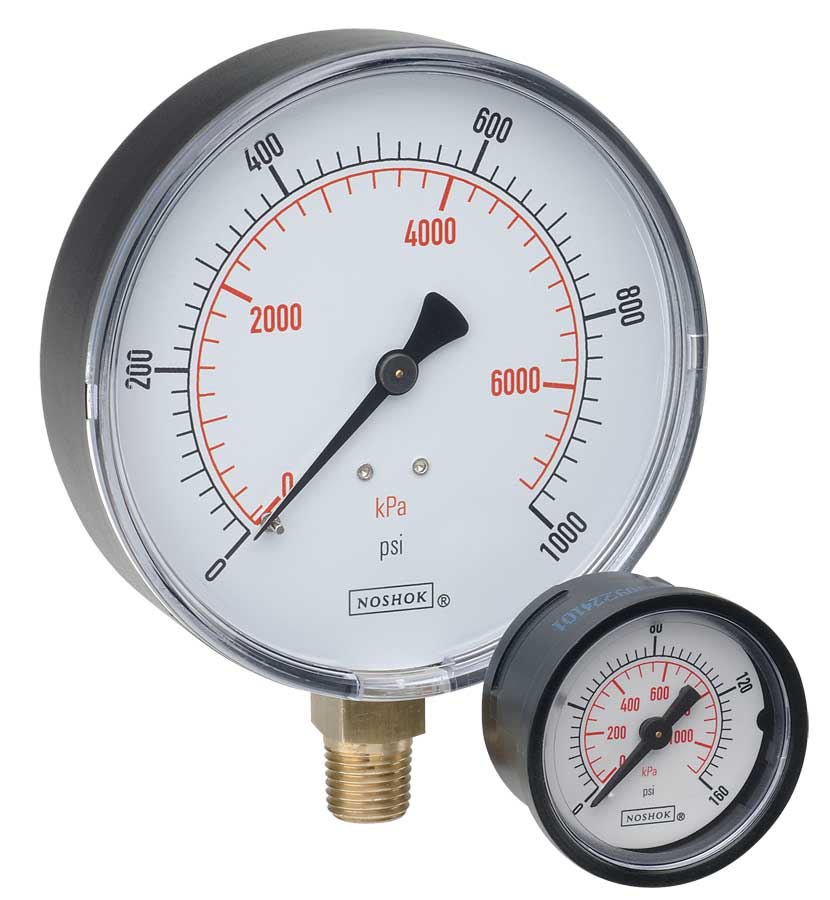 NOSHOK ABS & Steel Dry Pressure Gauges 100 series
 NOSHOK Low Pressure Dry Pressure Gauges-( 200 series)
 NOSHOK PT40 Series High Accuracy Transmitters-Replaces 100,200,615 series