



Pressure Gauge Syphon Selection for Steam Service

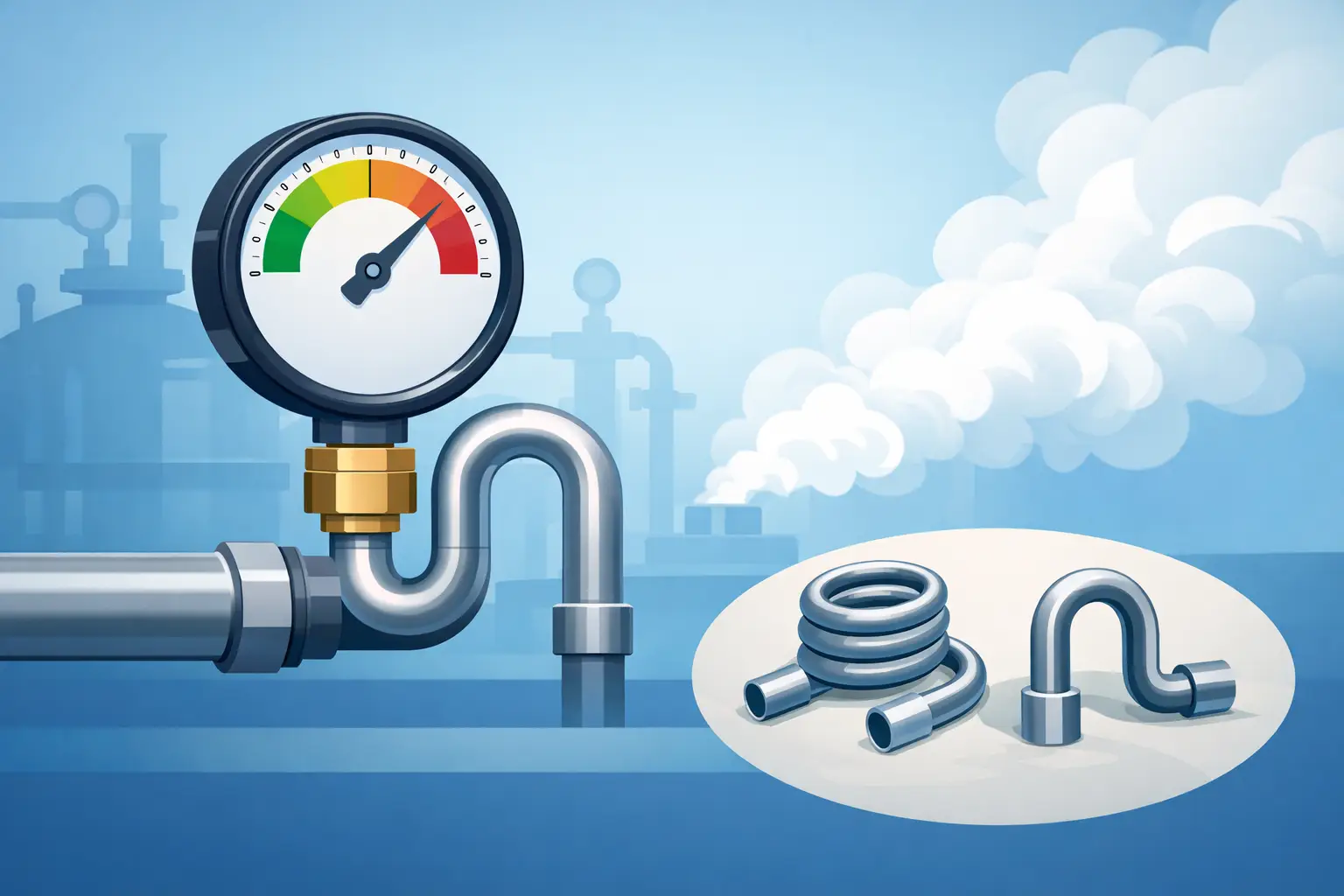
A pressure gauge syphon is a small component with a direct effect on gauge life, reading stability, and operator safety in steam and elevated-temperature pressure applications. Installed between the process connection and the gauge, it retains a condensate-filled water leg that limits the temperature reaching the gauge’s pressure element.
For a maintenance replacement, the syphon may appear straightforward: match the thread size and reinstall the gauge. For new construction or a recurring gauge-failure problem, that approach is not enough. The correct selection depends on process temperature, pressure, mounting geometry, material compatibility, connection orientation, and the gauge being protected.
What a Pressure Gauge Syphon Does
Steam can exceed the allowable operating temperature of many mechanical pressure gauges. Heat transferred directly into a Bourdon tube can affect accuracy, accelerate fatigue, harden or damage internal components, and shorten the service life of the case, window, and movement. A syphon creates a cooling section between the process and the instrument.
Once placed in service, the syphon’s loop or coil fills with condensate. This condensate acts as a thermal barrier. Process pressure is transmitted through the liquid column to the gauge, while the steam itself does not continuously contact the gauge’s sensing element at process temperature.
A syphon does not reduce system pressure. It is not a substitute for a pressure regulator, overpressure protection, a diaphragm seal, or a gauge selected with an appropriate full-scale range. It is a temperature-protection accessory designed primarily for steam service and other applications where a condensate leg can provide effective isolation from heat.
Pressure Gauge Syphon Styles and Mounting Orientation
The two most common configurations are pigtail syphons and coil syphons. Their intended mounting position matters. A syphon that is mechanically connected but oriented incorrectly may not retain the condensate needed to protect the gauge.
Pigtail Syphons for Vertical Connections
A pigtail syphon has a single loop that resembles a curled tail. It is commonly used where the gauge connection is positioned vertically above the process tapping point. The loop provides a compact condensate trap and is frequently specified for boiler, steam header, and general utility steam measurements.
The gauge should be installed so the syphon can fill and retain water before exposure to live steam. If the assembly is drained or removed during maintenance, it should be refilled before returning it to service. Starting a dry syphon against hot steam can expose the gauge to a damaging thermal surge.
Coil Syphons for Horizontal Connections
A coil syphon uses multiple turns of tubing and is generally selected for horizontal process connections. The added coil length increases the heat-transfer path and supports a suitable condensate seal when installed in the intended orientation.
Do not choose between pigtail and coil designs based only on available clearance. First establish the process connection orientation, then confirm the gauge location, access for calibration, vibration exposure, and clearance for wrenching. A compact installation is useful only if the gauge remains readable and the syphon can function as designed.
Match Materials to the Process, Not Just the Steam Line
Carbon steel and stainless steel are common syphon materials, but the correct choice is driven by the complete process environment. Carbon steel may be suitable for compatible utility steam service. Stainless steel is often preferred where corrosion resistance, wet conditions, condensate chemistry, or plant material standards require it.
The external environment deserves the same attention as the wetted path. Outdoor exposure, washdown areas, corrosive atmospheres, insulation practices, and nearby chemical vapors can affect the service life of a syphon and its threaded joints. A stainless syphon does not automatically make the complete assembly corrosion resistant if the gauge socket, valve, fittings, or process connection use dissimilar materials.
For chemical process service, contaminated steam, or applications where the medium may condense into a corrosive liquid, verify compatibility against the actual condensate composition and operating conditions. If the medium is not suitable for direct contact with the gauge, a diaphragm seal system may be more appropriate than a syphon alone.
Specify Connection Size, Type, and Gauge Compatibility
Thread mismatch is one of the most avoidable causes of installation delays and leakage. Confirm the process-side and gauge-side connection sizes, thread standards, and gender before ordering. Common industrial configurations use NPT threads, but nominal size alone does not establish compatibility. The assembly must also match the existing fitting arrangement and the installation orientation.
Gauge compatibility includes more than the lower connection. Confirm the gauge’s pressure range, wetted material, temperature rating, mounting style, and allowable overpressure. A syphon protects against process heat, but it does not correct an improperly ranged gauge. For normal operating pressure, many applications benefit from selecting a range that keeps the expected reading in the middle portion of the dial rather than continuously near zero or full scale.
Also account for the static head of the condensate column. In most industrial steam pressure applications, its effect is small relative to the gauge range. It can become more relevant in low-pressure service, where even modest elevation differences may affect the indicated value. When measuring very low steam pressure, installation geometry and calibration reference should be reviewed as part of the complete measurement arrangement.
Build the Assembly for Maintenance and Isolation
A pressure gauge syphon is usually one component in a gauge assembly. A gauge cock, needle valve, or instrument isolation valve between the syphon and gauge allows the instrument to be isolated for inspection or replacement. Depending on plant procedure, a blowdown or venting arrangement may also be used to clear the connection and verify that the process tap is open.
Isolation hardware should be rated for the maximum working pressure and temperature of the installation. Do not assume that a general-purpose valve is acceptable simply because it has the same thread size. The valve material, seat design, pressure-temperature rating, and service classification must fit the application.
For applications with pulsation, pressure spikes, or mechanical vibration, a syphon should not be expected to solve every instrument problem. A snubber, restrictor, liquid-filled gauge, remote mounting arrangement, or a pressure transmitter with the proper process interface may be needed. The trade-off is response time: adding restriction can stabilize a fluctuating needle, but excessive restriction can delay the gauge response and mask rapid pressure changes.
Installation Practices That Protect the Gauge
Install the gauge assembly so it is supported, accessible, and protected from unnecessary pipe strain. Do not use the gauge case as a handle to tighten the process connection. Apply wrench torque only to the designated flats on the syphon, valve, fitting, or gauge socket, following the component manufacturer’s instructions.
Before admitting steam, fill the syphon with clean water. Open the isolation valve gradually to reduce thermal shock and allow the assembly to reach operating condition. Check threaded joints for leakage under pressure, and confirm that the gauge returns to zero when pressure is removed if the process can be safely isolated.
Insulation requires judgment. Insulating steam piping is often necessary for energy control and personnel protection, but fully insulating the syphon can reduce its ability to reject heat. Follow the plant’s engineering standard and the instrument manufacturer’s temperature guidance. Where ambient conditions are unusually hot, a longer heat path, remote-mounted gauge, or another instrument arrangement may be necessary.
When a Syphon Is Not the Right Answer
A syphon is most effective when the process medium can form and retain a stable condensate barrier. It is not a universal solution for every high-temperature fluid. Hot oils, molten materials, corrosive chemicals, or processes that cannot tolerate water contamination may require a diaphragm seal, capillary system, cooling element, or remote pressure transmitter instead.
Likewise, a leaking, plugged, or repeatedly dry syphon points to an installation issue that should be corrected rather than treated as a routine replacement item. Review valve position, piping slope, process tapping condition, startup procedure, and whether the selected syphon orientation matches the connection geometry.
Mass Measure supports industrial buyers who need NOSHOK instrumentation components specified by series, material, connection, and service requirement. For replacement work, record the existing syphon configuration and gauge details before removing the assembly. For new work, treat the syphon, isolation device, gauge, and process connection as one engineered measurement point. That discipline helps keep a simple steam gauge installation accurate, serviceable, and ready for the next maintenance cycle.
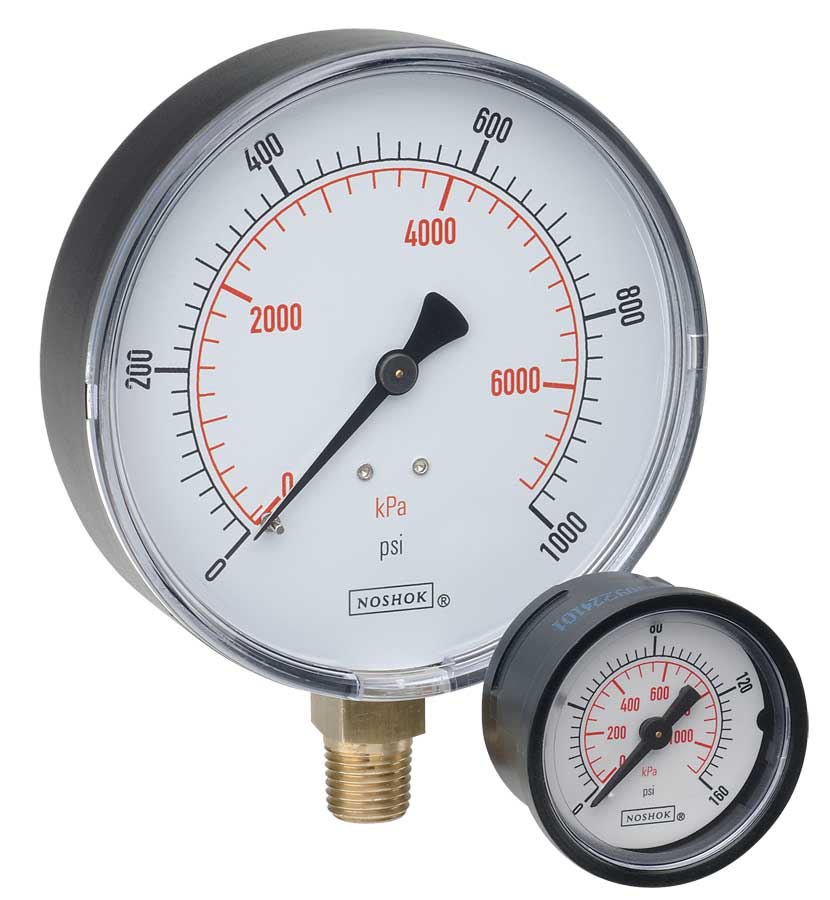 NOSHOK ABS & Steel Dry Pressure Gauges 100 series
 NOSHOK Low Pressure Dry Pressure Gauges-( 200 series)
 NOSHOK PT40 Series High Accuracy Transmitters-Replaces 100,200,615 series