



Bulk Pricing for Industrial Pressure Transmitters: 2026 Guide

Table of Contents
- What Bulk Pricing for Industrial Pressure Transmitters Really Includes
- Pressure Transmitter Specifications That Drive Your Per-Unit Price
- Pressure Transmitter Supplier Comparison: What Separates a Distributor From a Marketplace
- How to Build a Pressure Transmitter Quote Request That Gets Fast, Accurate Numbers
- Pressure Transmitter Calibration Cost and Total Cost of Ownership
- Hidden Costs, Tariffs, and Compliance Checks Before You Sign a Bulk Order
- Conclusion
- Frequently Asked Questions
Last Updated: October 21, 2026
What Bulk Pricing for Industrial Pressure Transmitters Really Includes
Bulk pricing for industrial pressure transmitters is a tiered per-unit rate that drops as order volume rises, and it bundles more than the sensor: calibration certificates, process connections, mounting brackets, and warranty coverage all shift the number.
Most first-time buyers assume volume alone moves the price. It does, but rarely as much as configuration.
That matters because industrial instrumentation procurement runs on repeatability: a distributor who stocks the line can commit to a lead time; a marketplace listing cannot.
Bulk pricing is a function of configuration consistency first, volume second. Standardize your spec before you negotiate.
Pressure Transmitter Specifications That Drive Your Per-Unit Price
Four specification families control most of the per-unit cost: accuracy class, output signal, wetted parts, and process connection. Get these right and the quote becomes predictable.

Accuracy Class, Output Signal, and Wetted Parts
Accuracy class is the maximum allowable error as a percentage of span.
Output signal is usually straightforward. A 4-20mA analog signal is the workhorse of industrial automation and prices lowest; HART or a digital fieldbus output adds cost at every unit.
Wetted parts are the surfaces that touch your media. Stainless steel housing and 316L wetted parts handle most chemical processing and water treatment duty.
Process Connection, IP Rating, and Hazardous Area Certification
The process connection (thread size and type) is where quotes quietly diverge. A standard 1/4 in NPT connection is a stock item.
Ingress protection matters more than buyers expect. An IP65 or NEMA 4 rating covers washdown and dusty plant environments. An IP67 or IP68 unit survives temporary submersion and costs more.
Hazardous area certification is the single largest price adder in this list.
| Specification | Cost Impact | When It Is Worth Paying |
|---|---|---|
| Accuracy class 0.1% vs 0.5% | High | Critical control loops, custody transfer |
| HART protocol output | Moderate | Remote diagnostics, re-ranging needed |
| Corrosion-resistant wetted parts | Moderate to high | Aggressive or corrosive media |
| Sanitary process connection | Moderate | Food, beverage, pharma duty |
| IP67/IP68 rating | Moderate | Washdown, outdoor, wet locations |
| Hazardous area certification | Highest | Classified locations only |
Pressure Transmitter Supplier Comparison: What Separates a Distributor From a Marketplace
A distributor owns the relationship, the stock position, and the warranty path. A marketplace owns none of them. That distinction decides what happens when a unit fails in month eight, and whether your bulk rate holds across reorders.
When you run a pressure transmitter supplier comparison, score the supplier on six verifiable items, not on the website’s design.
1. Authorization you can verify in writing
Ask for the manufacturer’s authorized-distributor letter and check the effective date. An expired letter is a red flag. A legitimate distributor sends it without hesitation; a broker sends a screenshot of a catalog page instead. Authorization matters because the manufacturer-backed warranty typically flows through the authorized channel, a gray-market unit may carry no enforceable warranty at all.
2. Stock position and allocation policy
Ask two questions: how many units of your exact configuration are on the shelf today, and how does the supplier allocate stock when demand exceeds supply? A distributor with a real stock position can commit to a ship date; a marketplace routes your order to whoever has inventory that week, so its lead times are estimates, not commitments. For a 50- to 200-unit order, ask whether the supplier will reserve allocation against a purchase order.
3. Response rate and technical review
A useful benchmark: a complete quote request (see the checklist below) should come back with a firm price and lead time within one business day from a stocking distributor. If the first response is a question about a field you already filled in, the supplier is not reading the spec. Ask whether a technical reviewer, not a sales rep, will flag mismatches such as an overkill accuracy class or a wetted-parts material that will not survive the media.
4. Lifecycle services after the sale
Confirm in writing whether the supplier performs repair and calibration in-house or subcontracts it. In-house service shortens turnaround and keeps the calibration traceability chain intact. Ask for the standard turnaround time on a bench calibration and whether loaner units are available for critical loops.
5. Commercial terms that affect landed cost
Ask for tariff treatment, freight terms, and payment terms in the same quote. A supplier who quotes a per-unit rate without tariff and freight is giving you a number that will change at invoice. Net-30 versus prepay, and whether the supplier will hold a volume tier across scheduled releases, are negotiable levers marketplaces never offer.
6. Volume-tier mechanics
Ask how the tier is calculated: per release or per annual commitment? A supplier who honors a volume tier across scheduled releases lets you take delivery in monthly batches without losing the discount, a real cash-flow advantage if you cannot warehouse a full year of units.
| Verification Item | What to Ask For | Red Flag |
|---|---|---|
| Authorization | Current distributor letter with effective date | Screenshot of a catalog page |
| Stock position | On-shelf count for your exact configuration | “Lead time is an estimate” |
| Response rate | Firm price and lead time in one business day | Follow-up questions on fields you already filled |
| Lifecycle services | In-house repair and calibration, turnaround time | Subcontracted service, no traceability chain |
| Commercial terms | Tariff, freight, payment terms in the same quote | Per-unit rate only |
| Volume-tier mechanics | Tier honored across scheduled releases | Tier resets on each shipment |
Ask for two references from buyers who placed a bulk order in the last twelve months, and ask those references specifically about the response time when a unit failed, not about the initial sale.
Mass Measure is a fully authorized distributor of the complete NOSHOK line, with over 50 years of field experience behind the counter. We stock for bulk orders, honor volume tiers across scheduled releases, and handle repair and calibration in-house, so a failed transmitter does not become a scavenger hunt.
The marketplaces that dominate search results for this category are transactional. They list a part number and a price and stop there.
How to Build a Pressure Transmitter Quote Request That Gets Fast, Accurate Numbers
A complete quote request cuts response time from days to hours. Suppliers quote what they can verify; missing fields trigger a round of questions.
Build your pressure transmitter quote request around this checklist:
- Manufacturer and series, or the legacy part number you are replacing
- Pressure range and whether it is gauge pressure or absolute pressure
- Accuracy class required
Send the legacy part number even if you have already picked a replacement. A distributor who knows the old series can confirm the new one is a true form-fit-function match before you commit to a bulk order.
The last two items are the ones buyers forget. A calibration certificate requirement changes the paperwork and lead time; a firm versus forecast quantity changes which volume tier the supplier will honor.
Pressure Transmitter Calibration Cost and Total Cost of Ownership
Total cost of ownership is where the cheap unit loses. Purchase price is one line; calibration, downtime, replacement frequency, and administrative load are the others. A bulk buyer who compares only per-unit rates is comparing the smallest number on the page.
The four cost buckets that belong in a TCO comparison
Build the comparison over a defined service life, five years is a common planning horizon for process instrumentation, and populate four buckets:
- Acquisition. Per-unit rate times quantity, plus tariff, freight, and any documentation or certification fees. This is the number on the quote.
- Calibration. Bench calibration at the manufacturer-recommended interval, plus certified traceable calibration where the process requires documentation. A tighter accuracy class often needs a more frequent interval to hold its specification, which raises this bucket.
- Downtime and replacement. A failed transmitter on a critical loop stops production. Even a short unplanned outage on a continuous process can dwarf the per-unit saving between a budget unit and a premium one. Replacement frequency compounds it: a unit that fails twice in five years costs more than one that lasts ten, even at a higher purchase price.
- Administrative load. Every purchase order, receipt, vendor record, and calibration work order carries labor cost. Consolidating a year of purchases into one blanket order with scheduled releases reduces this bucket without changing the per-unit rate.
How calibration cost actually scales
Pressure transmitter calibration cost depends on the unit, the range, and whether a certified traceable certificate is required. A bench calibration on a standard transmitter is routine; a certified calibration for a regulated process costs more because of the paperwork and reference standard required. Two levers move this bucket more than any other:
- Accuracy class versus interval. A 0.1% unit that drifts out of specification between intervals forces re-calibration or replacement. Match the class to the loop’s actual tolerance, a 0.5% unit on a non-critical loop often holds specification longer and costs less to maintain.
- Range selection. A transmitter sized so the operating pressure sits in the middle of its range typically holds accuracy better than one running near its upper limit. Specify the range around the process, not around the catalog’s nearest stock size.
Ask your supplier for the recommended calibration interval for your specific application and media, and budget for it annually rather than treating it as an unplanned expense.
A worked comparison framework
You do not need exact vendor numbers to run the comparison, you need the structure. For each candidate unit, list:
- Purchase price per unit and quantity
- Expected service life in years
- Recommended calibration interval and cost per calibration
Sum the buckets over the service life and divide by the number of units to get a per-unit lifecycle cost. The lowest purchase price frequently loses once downtime and replacement are included, which is why bulk buyers who plan for five years often standardize on a premium unit and negotiate the volume tier around it.
The most common bulk procurement mistake is optimizing the unit price and ignoring the calibration and replacement cycle. A lower per-unit rate that shortens service life or raises calibration frequency is a net loss over the planning horizon.
::: Refining these bulk procurement strategies requires a shift toward total cost of ownership models that align project requirements with long-term hardware reliability.
When you request a bulk quote, ask the supplier to include the recommended calibration interval and the cost of a certified calibration for the quoted configuration. A supplier who can answer both in the same response is telling you they support the full lifecycle, not just the sale.
Hidden Costs, Tariffs, and Compliance Checks Before You Sign a Bulk Order
Landing cost, not unit price, is the number that hits your budget. Tariffs, freight, and compliance documentation all land on the invoice.
Ask for a landed-cost breakdown in writing before you sign: the per-unit rate, tariff treatment, freight to your dock, and any certification or documentation fees, itemized. Mass Measure quotes bulk pricing with tariff charges included, so the number you approve is the number you pay, removing the most common dispute in industrial procurement.
On compliance, verify three things:
- Authorization. Confirm the supplier is an authorized distributor and that the manufacturer-backed warranty is legitimate and transferable to you.
- Certification currency. For hazardous area units, confirm the certification is current and matches your area classification.
- Calibration traceability. Confirm the calibration certificate traces to a recognized standard.
Request a sample unit from the bulk lot before the full order ships. One unit on your bench catches a specification mismatch while it is still a one-unit problem.
Conclusion
Bulk purchasing of industrial pressure transmitters rewards preparation: a standardized specification, a complete quote request, and a landed-cost number in writing. The supplier you choose determines whether that preparation pays off. Mass Measure is a fully authorized NOSHOK distributor with in-stock availability for bulk orders, bulk pricing that includes tariff charges, and in-house repair and calibration to support the full lifecycle of your instrumentation.
Frequently Asked Questions
How much does an industrial pressure transmitter cost?
Unit prices vary widely by specification. Bulk pricing for industrial pressure transmitters depends on quantity, accuracy class, wetted parts material, hazardous area certification, and lead time. Request a quote with your exact specifications so the supplier can price the correct configuration instead of a generic catalog number.
Do suppliers offer discounts for bulk pressure transmitter orders?
Most authorized distributors tier pricing by quantity, so a 50-unit order prices lower per unit than a 5-unit order. The discount depends on whether the models are standard stock items or custom configurations, and whether you commit to a scheduled release instead of one shipment. Ask for a volume discount schedule in writing and confirm what quantity break you need to hit. In-stock availability also matters, since expedited manufacturing can erase the bulk savings.
What factors affect the price of an industrial pressure transmitter?
The biggest drivers are accuracy class, output signal (4-20mA versus HART), wetted parts material, process connection type, IP rating, and hazardous area certification. A stainless steel housing and LCD display add cost. Supply voltage and sensor technology also factor in. Calibration certificates, mounting brackets, and configuration at the factory add line items. Confirm each of these in your quote request so you compare identical specifications across suppliers rather than headline prices.
What hidden costs should I check when buying industrial pressure transmitters?
Look for tariff surcharges, freight, expedite fees, calibration certificates billed separately, and restocking charges on returns. Confirm whether configuration and documentation are included or added at the end. Ask if prices are locked for the quote validity period, since steel and electronics costs move. A distributor that quotes tariff charges included removes the surprise at invoice. Also check warranty terms and who covers shipping on a warranty replacement.
Are calibration and configuration included in pressure transmitter pricing?
Not always. Factory calibration to a certificate is often a separate line item, and custom range configuration may carry a fee. Ask for a calibration certificate to be quoted explicitly, including whether it is a standard manufacturer certificate or a traceable one. If you need periodic recalibration, ask about turnaround time and cost per unit so you can budget the full lifecycle, not just the purchase.
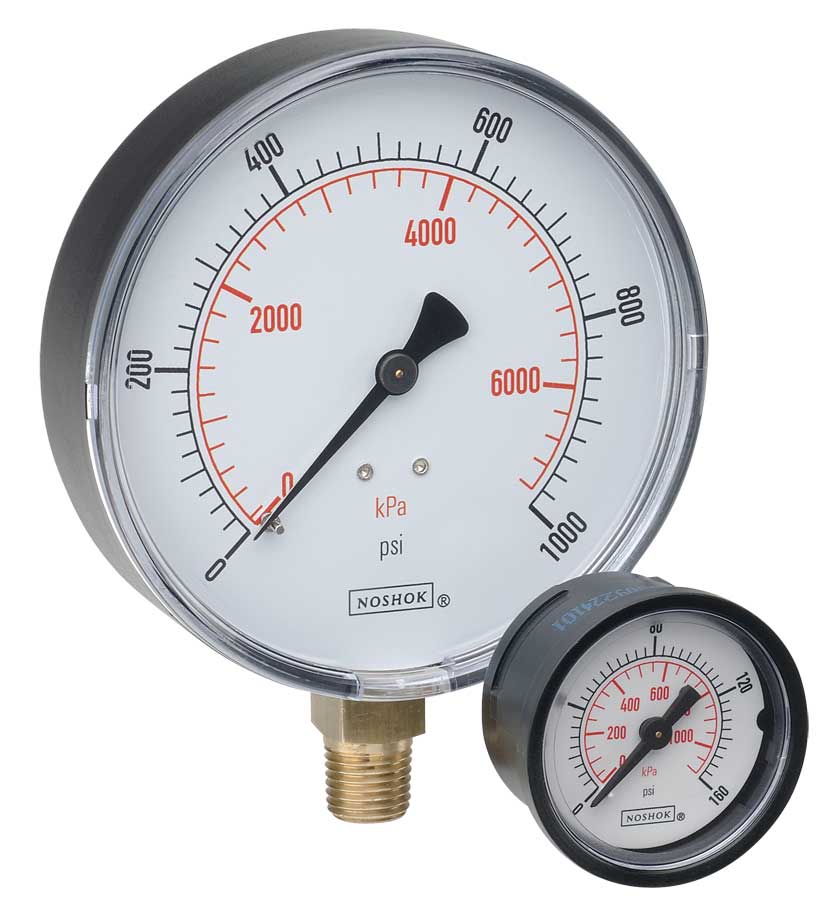 NOSHOK ABS & Steel Dry Pressure Gauges 100 series
 NOSHOK Low Pressure Dry Pressure Gauges-( 200 series)
 NOSHOK PT40 Series High Accuracy Transmitters-Replaces 100,200,615 series
