



Glycerin Versus Silicone Gauge Fill Compared

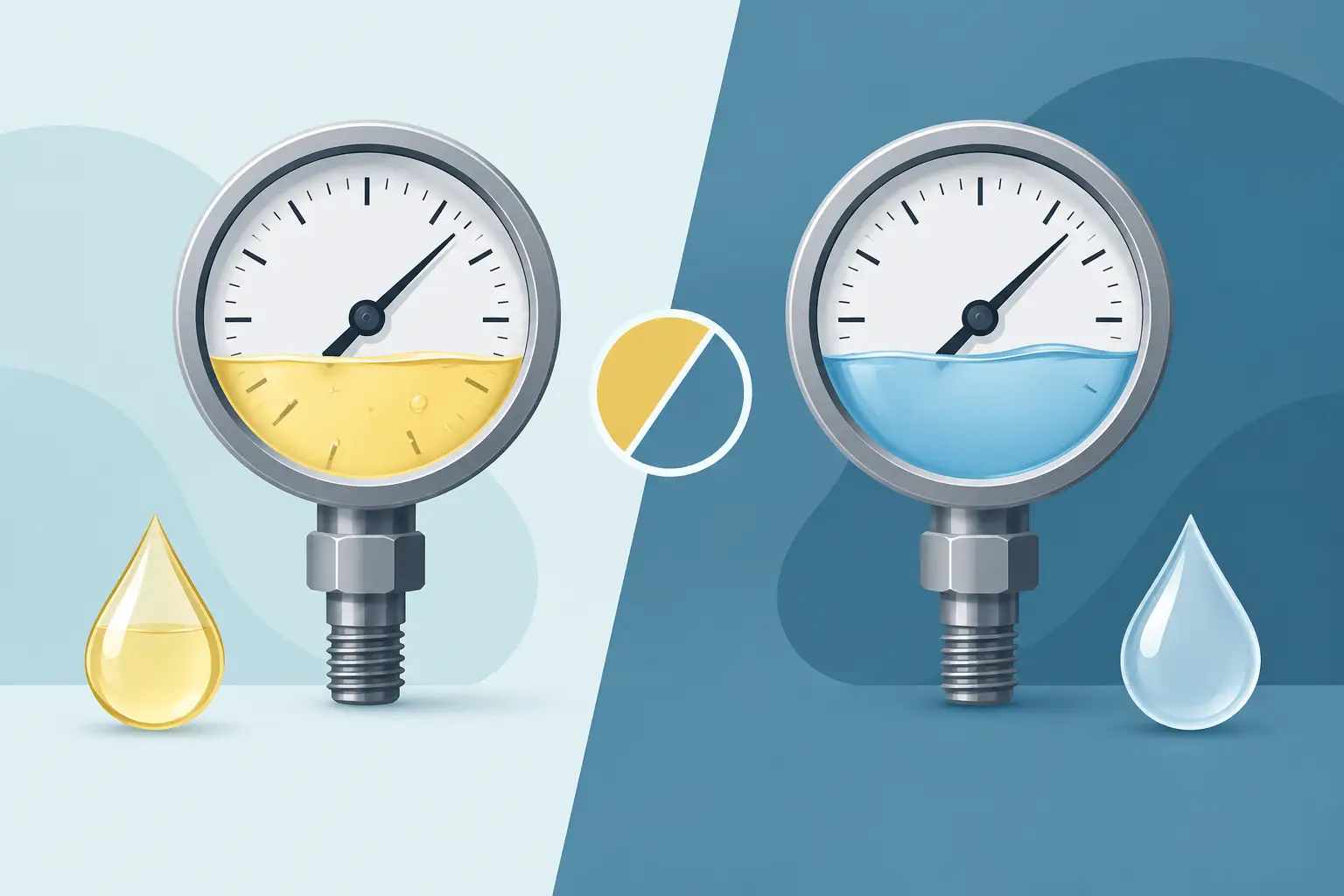
A pressure gauge that appears to have a failing movement may be responding to vibration, pulsation, or a process temperature outside its intended operating range. Before replacing it with the same dry gauge, specify the case fill. In the glycerin versus silicone gauge fill decision, the correct choice depends on the environment surrounding the gauge, not simply on which liquid is more common.
A liquid-filled gauge uses fluid inside the case to dampen movement of the internal mechanism. This stabilizes the pointer, reduces wear from continuous vibration, and makes the dial easier to read near pumps, compressors, hydraulic power units, and other rotating equipment. Glycerin is the standard selection for many industrial installations. Silicone fill becomes a stronger option when temperature conditions, fill-fluid behavior, or application requirements exceed what a glycerin-filled gauge can reliably accommodate.
What Case Fill Does for a Pressure Gauge
The Bourdon tube, link, sector gear, and pointer assembly in an analog pressure gauge are moving components. Rapid pressure cycling and equipment vibration can cause the pointer to oscillate, even when the gauge is correctly ranged and functioning normally. Fill fluid adds resistance to that motion. The resulting pointer response is steadier and the internal components receive less mechanical shock.
Case fill also helps protect the gauge mechanism from moisture and corrosive ambient conditions by reducing the air volume inside the case. It is not a substitute for selecting the correct wetted materials, process connection, or enclosure rating. A stainless steel case and wetted-part construction may still be necessary where washdown, outdoor exposure, chemical vapors, or corrosion are present.
Fill fluid does not correct an improperly specified gauge. If the pressure range is too close to normal operating pressure, if the gauge sees damaging overpressure, or if severe pulsation is transmitted directly from the process, the installation may require a pressure snubber, restrictor, diaphragm seal, pulsation dampener, or a different instrument design.
Glycerin Versus Silicone Gauge Fill
Glycerin-filled gauges
Glycerin is widely used because it provides effective damping for general industrial service and is commonly available across liquid-filled pressure gauge configurations. It performs well in applications with routine vibration and pulsation, including hydraulic systems, pneumatic equipment, pumps, compressors, and general manufacturing machinery.
For many indoor applications with moderate and relatively stable ambient temperatures, glycerin is the practical default. It offers clear damping characteristics and supports readable, stable pointer movement without adding unnecessary specification complexity. For maintenance replacement, a glycerin-filled gauge is often appropriate when it matches the original instrument’s materials, range, connection, and operating conditions.
Its limitation is temperature sensitivity. Glycerin becomes more viscous as temperatures decline, which can slow pointer response. At elevated temperatures, the fluid can expand and may affect case pressure if the gauge is not properly vented according to the manufacturer’s instructions. Long-term exposure to conditions beyond the gauge’s stated temperature limits can also affect fluid appearance and instrument performance.
Silicone-filled gauges
Silicone fluid is generally selected where a broader usable temperature range or more stable viscosity across changing temperatures is required. It is commonly considered for outdoor equipment, cold environments, high-temperature ambient exposure, and installations where operating conditions shift significantly between seasons, startup, and normal production.
Because silicone fluid maintains its flow characteristics more consistently over a wider temperature span, it can provide more dependable damping where glycerin would become excessively thick or where elevated ambient heat is a concern. The specific temperature capability still depends on the gauge series, case design, window material, seals, and manufacturer-rated limits. The fill fluid alone does not establish the instrument rating.
Silicone-filled gauges can cost more than comparable glycerin-filled models. That additional cost is justified when the operating environment calls for it, but it is not automatically an upgrade for every process. A gauge installed in a temperature-controlled plant on a standard hydraulic skid may gain little from silicone fill if glycerin is already within the published service limits.
Temperature Is Usually the Deciding Factor
When selecting a fill fluid, separate process temperature from ambient temperature. Process temperature is the temperature of the media at the pressure connection. Ambient temperature is the temperature around the gauge case. Both matter, but they affect the instrument differently.
A hot process can transfer heat through the socket and into the gauge movement. Even if the ambient air is moderate, that heat can exceed the gauge’s allowable operating temperature. A pigtail siphon, cooling element, capillary connection, or diaphragm seal may be required for steam or other high-temperature media. Changing from glycerin to silicone fill does not eliminate the need to control heat transfer from the process.
Cold outdoor service creates a different issue. A gauge may be exposed to low ambient temperatures for extended periods, and the fill fluid must remain suitable for the manufacturer-rated range. Silicone fill is often evaluated for this type of application, particularly where readable response during cold weather is required. Confirm the complete instrument specification rather than relying on a generic fluid comparison.
Consider the Process and the Installation
The case fill normally does not contact the process fluid in a standard direct-mounted pressure gauge. The process contacts the wetted components, typically the socket and Bourdon tube. Therefore, chemical compatibility with the process should first be addressed through the wetted material selection, such as brass, phosphor bronze, 316 stainless steel, Monel, or another suitable alloy.
However, fill selection still has application consequences. If a gauge is used around oxygen, strong oxidizers, food processing equipment, or sensitive clean-service areas, the entire gauge construction and cleaning requirements need review. Do not assume a standard liquid-filled gauge is suitable because its pressure range and connection match the line. Service-specific compatibility, cleaning, and manufacturer approval take precedence.
Mounting orientation and venting also deserve attention. Many liquid-filled gauges include a vent plug or pressure-relief feature that must remain in the specified position. During shipment, the plug may be closed to prevent leakage. Once installed, the manufacturer may require it to be opened or adjusted to equalize internal case pressure. Failure to follow that instruction can introduce reading error as ambient pressure or case pressure changes.
Select the Fill Fluid by Operating Conditions
Use the following questions when comparing glycerin versus silicone gauge fill:
- Is the gauge exposed to continuous vibration or pressure pulsation that makes a dry gauge difficult to read?
- What are the minimum and maximum ambient temperatures at the gauge case, including seasonal outdoor conditions?
- Is process heat conducted through the connection, and does the installation need a siphon, seal, or remote mounting arrangement?
- Does the service have special compatibility, cleaning, safety, or contamination-control requirements?
- Does the existing gauge series specify a particular fill fluid or temperature rating that must be maintained for an exact replacement?
For a conventional industrial installation, start with glycerin when vibration damping is needed and temperatures remain within the gauge manufacturer’s published limits. Move to silicone when temperature variation is the primary concern or when the selected gauge series identifies silicone as the proper fluid for the application.
Do Not Specify Fill Fluid in Isolation
A complete gauge specification includes more than the liquid in the case. Confirm the pressure range, dial size, accuracy class, process connection size and location, wetted materials, case material, window material, mounting style, and any safety or enclosure requirements. For pulsating service, verify whether the selected range is appropriate for normal operating pressure and whether additional protection is needed at the process connection.
For exact replacement work, record the full part number and all markings from the existing gauge before ordering. A similar-looking gauge can differ in connection orientation, pressure rating, internal material, or temperature capability. Industrial instrumentation is most reliable when the gauge, mounting method, and process conditions are treated as one system.
The best fill choice is the one that preserves stable indication over the actual conditions at the point of measurement. When those conditions are documented before purchase, glycerin or silicone becomes a controlled specification decision rather than a field assumption.
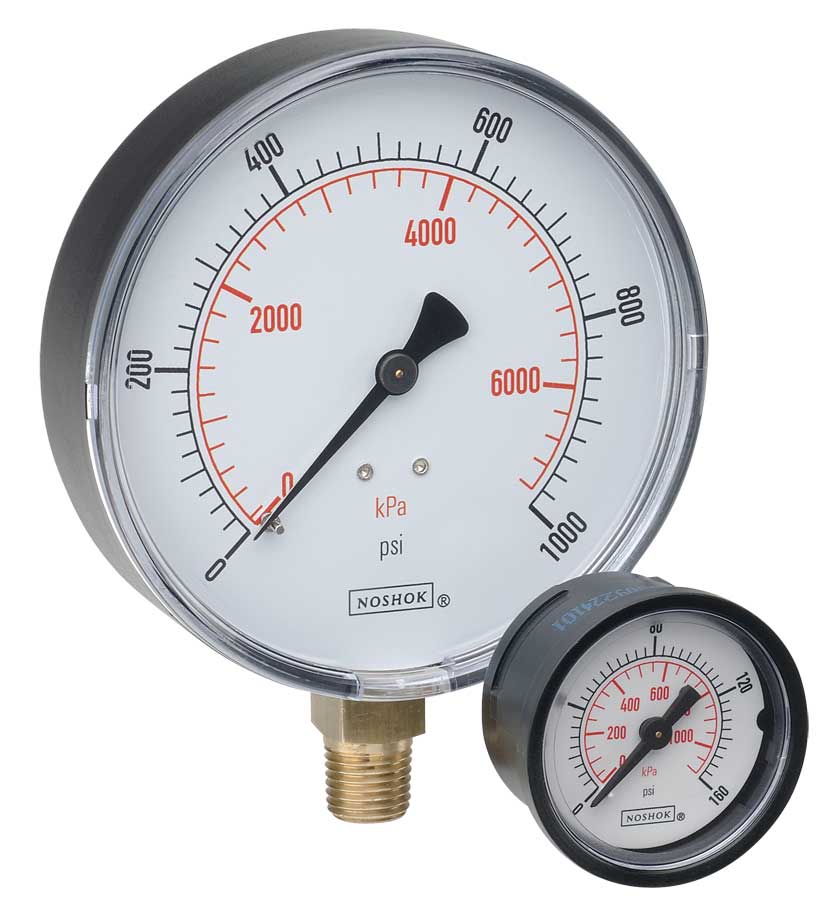 NOSHOK ABS & Steel Dry Pressure Gauges 100 series
 NOSHOK Low Pressure Dry Pressure Gauges-( 200 series)
 NOSHOK PT40 Series High Accuracy Transmitters-Replaces 100,200,615 series
