



How to Select Needle Valves for Process Service

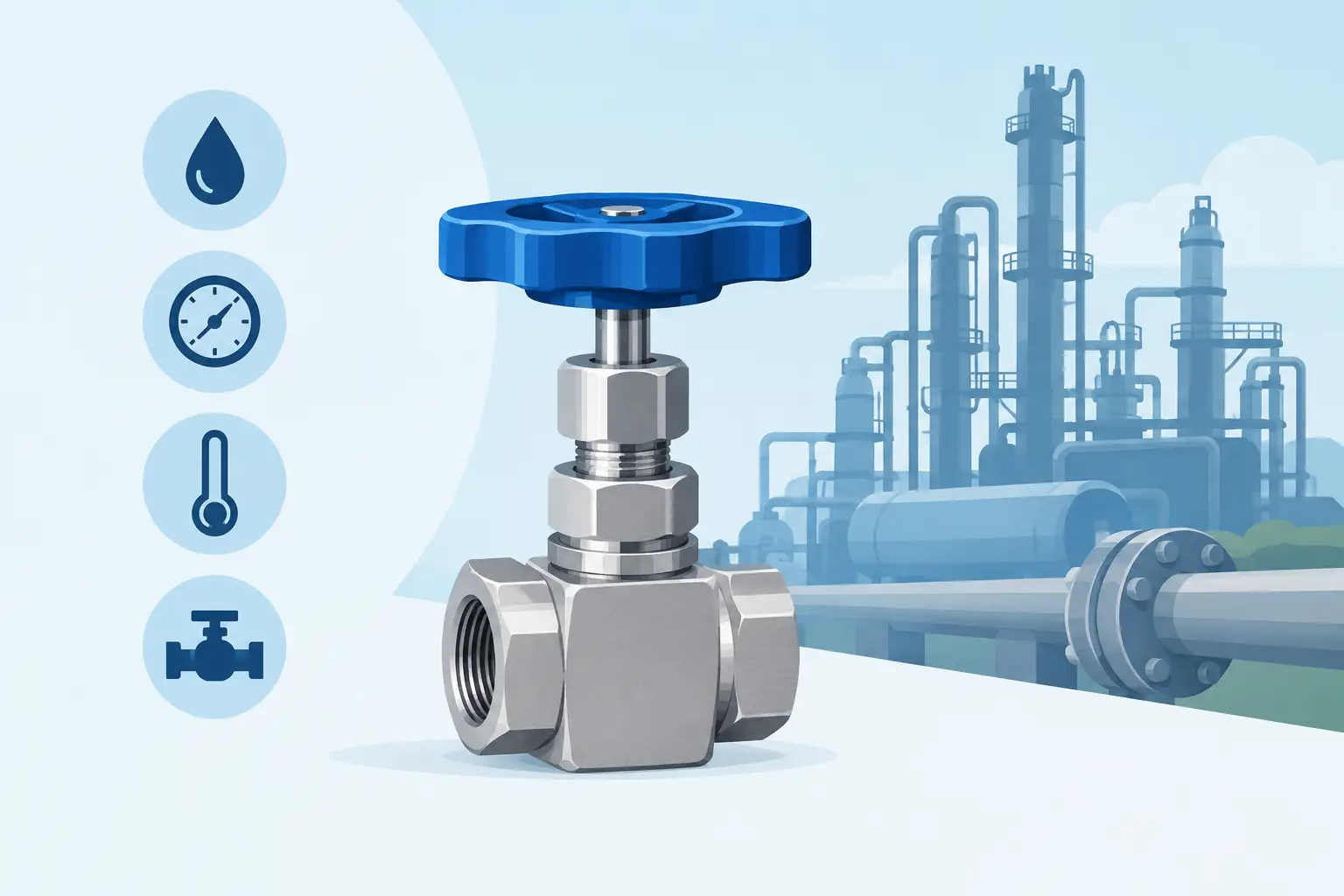
A needle valve that matches the line size can still be the wrong valve for the job. In instrumentation service, the decision often comes down to pressure rating, process media, connection geometry, sealing materials, and the degree of flow adjustment required. Knowing how to select needle valves from these specifications helps prevent leakage, poor adjustment, premature wear, and replacement-part mismatches during maintenance.
Needle valves are designed for controlled, gradual flow adjustment. Their tapered stem and small seat orifice allow an operator to make fine changes that would be difficult with a standard ball valve or gate valve. They are commonly installed on pressure gauge lines, impulse lines, analyzer systems, hydraulic circuits, lubrication systems, calibration setups, and other low-flow process connections. That does not mean every needle valve is suitable for every throttling or isolation duty.
Start With the Valve’s Actual Function
The first selection question is whether the valve will provide isolation, metering, or both. A needle valve can shut off flow, but its primary advantage is resolution at low flow. If the application only requires fast, full-bore on/off isolation, a ball valve may be more appropriate. If the process requires frequent, precise flow changes, a needle valve is generally the better fit.
Consider how the valve will be operated. A hand-operated valve is common for gauge isolation, venting, sampling, and calibration connections. Applications requiring repeated adjustment, remote operation, or automatic control may require an actuated valve or a purpose-designed control valve instead. Using a manual needle valve as a regulating valve in a continuously changing process can create excessive stem and seat wear.
Also establish whether the valve is expected to isolate pressure in one direction or either direction. Many instrumentation needle valves are suitable for bidirectional shutoff, but the manufacturer rating and flow-direction guidance should always control the selection. Directional configurations can affect seat loading, pressure-assisted sealing, and service life.
Define the Pressure and Temperature Envelope
A valve body may look substantial enough for the system, but visual comparison is not a pressure rating. Select the valve based on the maximum working pressure and temperature that can occur at the installation point, including startup, upset, pressure testing, and blocked-in conditions.
Pressure ratings are often reduced as temperature increases. This relationship depends on the body and wetted material, so a valve rated for a given pressure at ambient temperature may not carry the same rating in hot process service. The seat design matters as well. A soft seat can provide excellent shutoff at moderate temperatures, while a metal-to-metal seat may be necessary where temperatures, chemical exposure, or pressure would damage an elastomeric or polymeric seal.
Do not select against normal operating pressure alone. A gauge line connected to a high-pressure process can see the full process pressure even if the gauge range is lower. Similarly, a valve installed upstream of a regulator may be exposed to source pressure, not downstream set pressure.
Match Wetted Materials to the Process Media
Material compatibility is one of the most consequential parts of needle valve selection. The valve body, stem, seat, packing, and any O-rings exposed to the media must tolerate the chemical, temperature, and contamination conditions of the service.
Brass is frequently used for compatible air, water, oil, and noncorrosive hydraulic service. Carbon steel may be suitable for certain industrial systems but requires attention to corrosion exposure. Stainless steel is commonly specified where moisture, corrosive chemicals, outdoor exposure, high purity requirements, or more demanding process conditions are present.
The media itself is only part of the evaluation. Chlorides, hydrogen sulfide, oxygen, solvents, steam, abrasive particles, and cleaning agents can change the appropriate material choice. For example, a stainless steel body does not automatically make the entire valve suitable for a corrosive service if the packing or seat material is incompatible. For oxygen service, cleanliness and manufacturer-approved construction are as important as base material selection.
Where process fluid carries solids, crystallizes, polymerizes, or leaves deposits, a conventional fine-metering needle valve may plug or become difficult to operate. A larger-orifice valve, different valve style, filtration upstream, or a revised installation point may be required.
Select the Connection Type Before Choosing the Part Number
Connection errors are a common cause of installation delays. Identify the existing system connection standard, size, gender, and sealing method before selecting a valve. NPT threaded connections, tube fitting ends, socket weld ends, flange connections, and panel-mount configurations are not interchangeable.
NPT threads seal through thread interference and generally require an appropriate thread sealant. Tube fitting connections seal differently and must match the tubing outside diameter and fitting system requirements. Do not confuse nominal pipe size with tubing OD. A 1/4 inch NPT port and 1/4 inch tube fitting connection are different connection types, even when their stated size appears identical.
Thread engagement, installation clearance, and valve orientation also deserve review. A valve with the right port size may be impractical if the handle cannot be accessed, the body interferes with nearby tubing, or the installed assembly places excessive load on the connections. In compact instrument panels and manifolds, handle clearance can be as limiting as pressure rating.
Determine the Required Flow Capacity and Adjustment Range
Needle valves are not selected by pipe size alone. The required flow rate, pressure drop, fluid properties, and desired adjustment sensitivity determine whether the valve orifice and Cv are suitable. Cv is a flow coefficient that expresses valve capacity under defined conditions. A higher Cv generally means greater potential flow, but it also can mean less fine control at very low flow.
For a small purge line, calibration circuit, or instrument bleed application, a low-Cv valve with a fine-thread stem may offer more useful adjustment than a larger valve. For hydraulic flow or higher-volume gas service, an undersized orifice can cause unacceptable pressure drop, noise, or restricted system performance.
Gas and vapor applications require additional care because compressible flow behavior differs from liquid flow. High differential pressure can lead to choked flow, where further downstream pressure reduction does not increase flow through the valve. If the application involves high-pressure gas, flashing liquid, steam, or critical measurement control, use manufacturer flow data and engineering calculations rather than estimating capacity from connection size.
Evaluate Seat, Packing, Stem, and Handle Construction
The internal configuration determines how the valve performs over time. A non-rotating stem can reduce seat galling because the stem advances without turning directly against the seat. This is useful where precise repeatability and extended cycle life are required. A V-tip stem can improve fine metering, while a blunt or regulating tip may be selected for different flow characteristics.
Packing design affects both operability and external sealing. PTFE packing is widely used for chemical resistance and low friction, but it has temperature and pressure limits. Graphite packing can suit higher-temperature service, while other packing compounds may be specified for specialized media. Adjustable packing may allow field compensation for normal wear, but it is not a substitute for selecting compatible materials at the outset.
Handle style should fit the operating environment. A standard handwheel offers controlled adjustment. A T-handle can be useful where space is limited or where a compact profile is preferred. Locking handles, panel-mount options, and color-coded handles may be relevant when valve position control or identification is part of plant procedure.
How to Select Needle Valves for Instrumentation Lines
For pressure gauge, transmitter, and impulse-line service, the valve should be considered as part of the complete measurement assembly. The process connection, pressure range, temperature exposure, gauge or transmitter compatibility, and maintenance procedure all affect the correct configuration.
A needle valve used to isolate a pressure gauge should have a pressure rating at least equal to the maximum process pressure at its location. Its wetted materials should match the process, and its outlet connection must match the gauge, transmitter, manifold, tubing, or adapter without forcing improvised fittings into the assembly. When vibration is present, support the instrument and piping so the valve is not carrying the full mechanical load.
For differential pressure installations, a needle valve may be part of a more complete manifold arrangement. In that case, separate isolation, equalization, and vent functions should be evaluated together. Selecting individual valves without considering the manifold function can complicate commissioning and increase leak paths.
Verify Documentation, Ratings, and Replacement Requirements
Before releasing a purchase order, compare the valve data sheet against the installed-service requirements. At minimum, confirm the body material, seat and packing materials, end connections, pressure-temperature rating, Cv or orifice information, operating direction if applicable, and any required approvals or cleaning specifications.
For replacement work, verify the complete existing part number rather than ordering from a general description such as “1/4 inch stainless needle valve.” Two valves with the same nominal connection size may differ in pressure rating, thread type, stem design, packing, panel mounting, or handle configuration. Exact series and configuration matching reduces the risk of receiving a valve that fits the line but does not meet the original duty.
Mass Measure supports industrial buyers who need NOSHOK instrumentation components matched by series, connection, material, and service requirements. When the application details are available, a specification-based review is more reliable than selecting a valve from size alone.
The most useful purchase description is a complete service statement: process media, maximum and normal pressure, temperature, required connections, target flow or adjustment duty, and the installed part number when replacing an existing valve. That information gives maintenance and procurement teams a practical path to the correct needle valve before the line is opened.