



When to Use Pressure Snubbers on Pressure Gauges

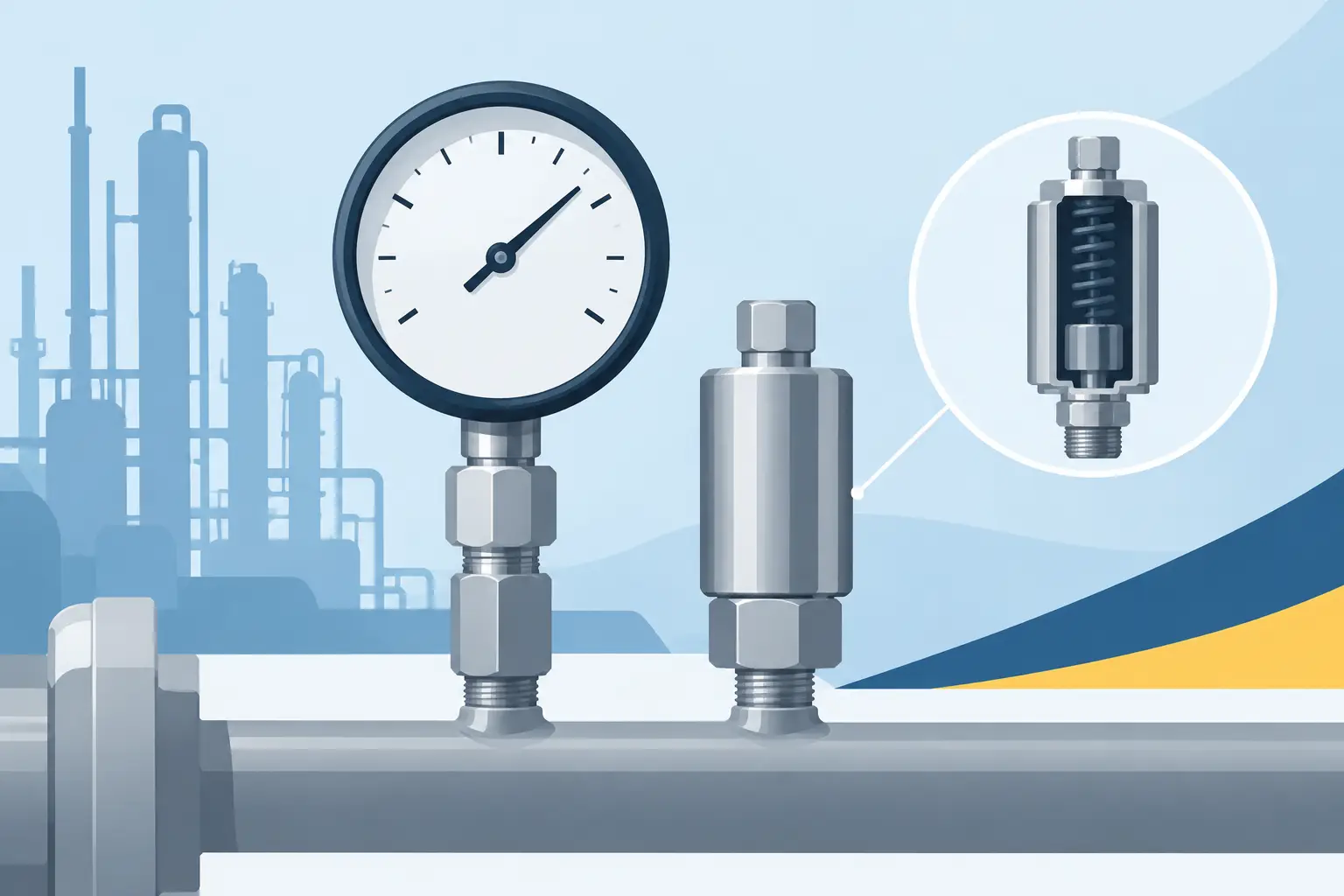
A pressure gauge that visibly oscillates is not providing a stable process reading. It is also operating under mechanical stress that can shorten movement life, fatigue internal components, and make routine operating decisions less certain. Knowing when to use pressure snubbers helps engineers and maintenance teams protect gauges and transmitters without unnecessarily slowing instrument response.
A snubber is a restriction installed ahead of a pressure instrument. It limits the rate at which pressure changes reach the sensing element, damping short-duration pulsations and spikes. The correct application depends on the pressure source, the process media, the required response time, and the instrument being protected.
What a Pressure Snubber Does
Pressure snubbers introduce a controlled flow restriction between the process connection and the gauge, pressure switch, or transmitter. Because pressure must pass through a small orifice or porous element, rapid fluctuations are attenuated before they reach the instrument.
This is especially useful where the average system pressure is stable but the pressure signal contains fast pulses. The snubber does not reduce actual system pressure or replace a properly sized relief device. It only conditions the pressure signal seen by the instrument.
For analog pressure gauges, the benefit is often immediately visible: the pointer settles enough for an operator to read it. For transmitters and switches, the objective is usually longer service life and fewer nuisance indications caused by rapid pressure cycling.
When to Use Pressure Snubbers in Industrial Service
Use a pressure snubber when an instrument is exposed to recurring pulsation, sharp transient pressure changes, or vibration-related pointer movement that cannot be resolved by improving the installation. Typical candidates include reciprocating pumps, piston compressors, hydraulic power units, high-cycle pneumatic systems, and certain diaphragm or metering pump applications.
Reciprocating Pumps and Compressors
Positive-displacement equipment produces pressure pulses as pistons, plungers, or diaphragms cycle. A gauge installed directly at the discharge can experience continuous pointer movement even when the process is operating normally. This makes the gauge difficult to read and accelerates wear on the bourdon tube movement.
A snubber can damp those individual pulses while allowing the gauge to display the operating pressure trend. The restriction must be selected carefully. If it is too restrictive, the gauge may lag significantly during startup, shutdown, or an actual pressure excursion.
Hydraulic Systems
Hydraulic circuits often see fast pressure changes from pump ripple, valve shifting, actuator stops, and load changes. Gauge damage in these systems can occur even when normal operating pressure is within the gauge range. Short pressure spikes may be much higher than the pressure a gauge displays during routine operation.
A snubber is useful at a gauge or transmitter connection where pressure pulsation is causing unreadable indication or repeated instrument failures. It should not be used as the only response to suspected hydraulic shock. Verify accumulator performance, relief valve condition, valve timing, line routing, and the actual pressure range before selecting the instrument assembly.
Pneumatic and Gas Applications
Pressure snubbers can also be effective on compressed-air systems and gas service with regulator chatter, compressor pulsation, or rapidly cycling controls. However, gas is compressible, so a restricted connection can cause more noticeable response delay than a similar installation in liquid service.
Where a pressure switch protects equipment from an unsafe condition, confirm that the added damping will not delay trip response beyond the application requirement. A snubber that improves switch stability may be inappropriate if the protective function depends on immediate detection of a rapid pressure change.
Applications With Pressure Spikes
A pressure spike is not always the same as pulsation. Pulsation is repetitive variation, while a spike may be a brief event caused by quick valve closure, pump startup, water hammer, or a sudden load change. A snubber can reduce the spike energy transmitted to an instrument, but it may not be adequate for severe surge conditions.
If transient pressure exceeds the instrument’s overpressure capability, first address the source of the surge and verify gauge range selection. A higher-range gauge, diaphragm seal arrangement, surge control device, or different instrument location may be required. Installing a snubber on an underspecified gauge is not a reliable corrective action.
Signs a Snubber Is Appropriate
The field symptoms are usually straightforward. Consider a pressure snubber when a gauge pointer swings rapidly, a transmitter output fluctuates at the frequency of a pump, or gauges repeatedly lose accuracy in an otherwise acceptable pressure range.
Other indicators include broken gauge movements, loose pointers, frequent recalibration, or a pressure switch that cycles excessively because of normal system pulsation. Before adding a snubber, inspect the installation for unsupported piping, external vibration, leaking fittings, and improper gauge range. Mechanical vibration can look like a process pressure problem, but it requires a different solution such as better mounting, a liquid-filled gauge, remote mounting, or both.
Snubbers Are Not the Right Choice for Every Instrument
Do not install a pressure snubber simply because a system has a pump. Some applications require the instrument to follow pressure changes quickly. Examples include dynamic test stands, control loops requiring fast transmitter response, and safety-related pressure monitoring where delay is unacceptable.
A snubber can also create maintenance issues in dirty, viscous, crystallizing, or particulate-laden media. Small orifices and porous elements can plug. Once restricted, the instrument may show a delayed or false indication, which can be more hazardous than a visibly pulsating gauge.
For corrosive, sanitary, high-temperature, or plugging process media, a diaphragm seal may be the better isolation method. In some installations, a diaphragm seal and snubber are both used, but the combined volume and restriction must be evaluated for response time. The right assembly is determined by the process connection, wetted materials, temperature, pressure range, and required instrument performance.
Selecting the Right Snubber Configuration
Snubbers are commonly available with fixed-orifice, adjustable-orifice, or porous-element designs. A fixed restriction offers consistency and fewer adjustment variables. It is often suitable where the pulsation pattern is known and the process is relatively clean.
An adjustable snubber allows commissioning personnel to tune damping in the field. This can be useful when pump speed, fluid viscosity, or process conditions vary. It also introduces a risk: an adjustment that appears satisfactory under one operating condition can be too restrictive under another. Document the final setting and confirm the instrument’s response during normal and abnormal operating conditions.
Material selection remains a primary specification. Wetted components must be compatible with the process media. Stainless steel is common for many industrial fluids and gases, while brass may be acceptable for compatible pneumatic, hydraulic, and general service applications. Match the pressure rating, process connection type, and thread standard to the existing instrument installation. Do not assume a visually similar fitting has the correct rating or connection geometry.
Installation Practices That Preserve Measurement Quality
Install the snubber as close to the instrument as practical so it protects the gauge, switch, or transmitter from the pressure fluctuations present in the impulse line. Use appropriate thread sealant and avoid introducing sealant into the restriction, where it can create partial blockage.
After installation, compare the instrument response with a known reference or with expected operating behavior. The goal is not a perfectly motionless pointer at all costs. The goal is a readable, representative indication that still responds promptly enough for the operating decision being made.
For transmitters, review damping settings in the transmitter configuration separately from the mechanical restriction. Electronic damping and a snubber can work together, but excessive combined damping can conceal process changes and complicate troubleshooting.
Specify the Instrument Assembly, Not Just the Snubber
A pressure snubber is one component in an instrument assembly. Its performance depends on the gauge or transmitter range, process connection, media compatibility, ambient conditions, mounting arrangement, and the character of the pressure signal.
For replacement work, identify the existing gauge or transmitter series, connection size, pressure range, wetted material, and source of pulsation before selecting a part. For new installations, specify the required response time alongside the pressure range. That allows the restriction to be selected as a measurement decision rather than a last-minute fitting addition.
When a gauge is hard to read or fails repeatedly, treat the snubber as a controlled way to manage the pressure signal, not as a substitute for diagnosing the system. A properly matched snubber can extend instrument life and improve readability while preserving the response the application actually requires.