


NOSHOK Valve and Gauge Repair Services: Complete Guide

Table of Contents
- Why NOSHOK Valve and Gauge Repair Services Matter
- Pressure Gauge Repair or Replacement: How to Decide
- Industrial Pressure Gauge Calibration and Verification
- Instrument Repair Turnaround Time and Service Scope
- Troubleshooting Gauge and Valve Problems On-Site
- Instrumentation Warranty Coverage and Protection
- Safety, Isolation, and Depressurization Before Repair
- How to Request NOSHOK Repair and Calibration Services
- Frequently Asked Questions
Last Updated: October 18, 2026
Why NOSHOK Valve and Gauge Repair Services Matter
Industrial pressure measurement systems fail when you can’t afford downtime. A stuck pointer, leaking valve stem, or gauge drifting out of calibration doesn’t just give bad data, it can halt production, compromise safety, and cost thousands. That’s where noshok valve and gauge repair services become critical infrastructure.
At Mass Measure, we know pressure gauges and valves are the eyes and hands of your process instrumentation. When they malfunction, your team is flying blind. The question isn’t whether you need repair and calibration services, it’s whether you can trust the provider to return instruments quickly, accurately, and ready for high-pressure environments.
This guide covers the full lifecycle of gauge and valve maintenance: when repair beats replacement, what calibration and verification involve, how to safely isolate and depressurize, on-site troubleshooting, and what to expect from professional turnaround.
Pressure Gauge Repair or Replacement: How to Decide
When a gauge fails, the first decision is simple but costly: fix it or buy new. The answer depends on the gauge’s age and service history, downtime cost, and what actually went wrong.
Signs Your Gauge Needs Repair
A gauge that’s worth repairing usually shows one of these specific failure modes: the pointer sticks or moves erratically, the dial reads consistently high or low (drift), the case is intact but the internals are sluggish, or the gauge holds pressure but leaks around the connection stem.
Drift is common in gauges exposed to vibration or temperature swings. A gauge reading 150 psi yesterday but 165 psi today under the same conditions hasn’t failed, it’s lost calibration. That’s a repair job: recalibrate the pointer and verify bourdon tube movement against a reference standard.
Slow seeps around the stem or case connection are fixable, a technician can replace the seal or tighten the connection without scrapping the gauge. On a NOSHOK model with stainless steel wetted materials, a seal replacement can extend service life by years.
When Replacement Makes More Sense
Replace the gauge if the bourdon tube is cracked, the case is shattered, or a pressure spike bent internal components. These failures are structural: a cracked bourdon tube can’t be welded reliably and will fail again under pressure. An overpressured gauge may have hidden damage, and repair cost approaches the cost of a new gauge, the risk isn’t worth it.
Age matters too. A gauge in service 15+ years with multiple wear signs, sluggish movement, minor leaks, calibration drift, is a replacement candidate. Repair might cost $200-$300, but you’re gambling on how long the fix holds.
Consider the gauge’s role. On a critical safety or high-vibration line, replace if repair leaves any doubt about reliability. On a backup or monitoring line, repair and return to service carries acceptable risk.
Industrial Pressure Gauge Calibration and Verification
Calibration checks whether a gauge reads accurately against a known standard and adjusts it if needed; verification proves the adjustment worked. Both are essential before a repaired gauge returns to service.
A technician applies known pressures with a precision reference gauge or deadweight tester and compares readings.
After calibration, the gauge is retested across its range, typically 0%, 25%, 50%, 75%, and 100% of full scale. A NOSHOK gauge with ±1.6% accuracy must hold that tolerance throughout. If it drifts outside spec at any point, the technician recalibrates and retests.
Documentation matters. You receive a calibration certificate recording the date, reference standard used, before-and-after readings, and technician sign-off.
Mass Measure includes calibration verification with every gauge repair. We use traceable reference standards and provide documentation that satisfies most industrial audit and compliance requirements.
Instrument Repair Turnaround Time and Service Scope
Turnaround time runs from drop-off to pickup, typically 3 to 7 business days for standard repair and calibration. Expedited service for critical instruments is often available within 24 to 48 hours at higher cost.
A standard repair includes disassembly, cleaning, inspection for internal damage, seal or linkage replacement if needed, calibration, verification testing, reassembly, and documentation.
For corroded gauges returning to a corrosive environment, the technician may recommend a case refinish or protective coating.
Valve repairs follow a similar timeline. A sticking or leaking needle valve is disassembled, the stem and seat cleaned or replaced, tested for leakage and flow, and reassembled. Worn diaphragm seals are replaced.
Mass Measure maintains in-stock repair components for common NOSHOK models, which reduces turnaround time. We also coordinate with NOSHOK directly for specialized parts, ensuring your repaired instruments meet original equipment specifications.
Troubleshooting Gauge and Valve Problems On-Site
Before shipping a gauge or valve for repair, on-site troubleshooting can reveal what’s wrong and whether repair is even necessary. A few simple checks save time and sometimes avoid a service trip altogether. Identifying these mechanical failures early prevents the kind of extended downtime often associated with hydraulic cylinder repair when systems are left to deteriorate beyond the point of simple maintenance.

Pressure Reading Errors and Drift
If a gauge reads high or low but the pointer moves smoothly, the problem is usually calibration drift, not mechanical failure. Connect a reference gauge or portable pressure tester to the same pressure point and compare readings. If they differ by more than the stated accuracy tolerance (typically ±1.6% to ±3%), the suspect gauge has drifted.
Drift can come from temperature changes, vibration, or age. Slow drift over months is normal aging; sudden drift suggests a mechanical shift, the pointer may have slipped on its pivot or the bourdon tube linkage loosened. Either way, the gauge needs recalibration or repair.
Check the reading itself: dial gauges should be read straight on, perpendicular to the face, since angle reading causes parallax error. Also confirm the pressure point is stable, fluctuating system pressure makes any pointer hunt, which looks like drift but is correct behavior.
Leaks, Corrosion, and Seal Failure
A slow weep around the gauge connection stem or valve outlet is a seal failure, the gauge or valve itself may be fine. Tighten the connection nut first; a loose fitting is often mistaken for a leak. If tightening stops the weep, you’re done. If not, the seal is compromised and the unit needs service.
Corrosion on the case or fittings is cosmetic unless severe. Surface rust on a carbon steel case doesn’t affect accuracy, but pitting or deep corrosion can weaken the case, especially under high vibration. A stainless steel NOSHOK gauge resists corrosion far better and suits corrosive environments.
If a gauge was exposed to corrosive gas or liquid, flush the connection lines with clean fluid before reattaching, residual material attacks seals and the bourdon tube. For oxygen-service gauges, flush with dry nitrogen and air-dry to prevent hydrocarbon contamination.
Valve Stiction and Needle Movement Issues
A valve that’s hard to open or closes sluggishly has stiction, the stem sticking in the packing, common in needle valves not exercised regularly. Open and close it slowly several times; light stiction often clears with use.
If it stays stiff, apply penetrating oil around the stem at the packing nut, let it soak 15 minutes, then work the valve gently. Don’t force it, you can damage the seat or stem.
If it still won’t move freely, the packing is likely hardened or the stem corroded. The valve needs disassembly and service: replace the packing, clean the stem, and verify the needle seat is undamaged. This standard repair usually takes 3-5 business days.
Instrumentation Warranty Coverage and Protection
Most NOSHOK gauges and valves carry a one-year manufacturer warranty covering defects in materials and workmanship, not damage from misuse, overpressure, or incompatible fluids. If a gauge fails within the period and the failure isn’t user-caused, NOSHOK repairs or replaces it at no cost.
To preserve coverage, register instruments with NOSHOK or your authorized distributor on receipt and keep purchase and service documentation. If a gauge fails, provide the serial number and a failure description so NOSHOK can assess coverage.
Mass Measure offers extended warranties covering repair and calibration costs beyond the manufacturer’s one-year period, valuable for gauges in critical applications where downtime is expensive.
Warranty doesn’t cover routine calibration, that’s maintenance, not defect repair. Budget for calibration every 12-24 months depending on environment and accuracy requirements.
Safety, Isolation, and Depressurization Before Repair
Never remove a gauge or valve from a pressurized system, fluid or gas can spray out with force, causing injury or contamination. Always isolate and depressurize first.
The isolation procedure has three steps:
Step 1: Close the isolation valve. Most gauge connections include a small ball or needle valve upstream. Close it to cut off pressure. If none exists, depressurize the entire system.
Step 2: Open a vent or drain. If a vent port sits downstream of the gauge, open it slowly to release residual pressure.
Step 3: Verify zero pressure. Before disconnecting, confirm pressure has dropped to zero by opening the gauge connection slightly, if nothing escapes, the line is depressurized.
For oxygen-service gauges, depressurization is critical, pressurized oxygen can ignite combustible materials. Never rush it; allow at least 30 seconds for pressure to bleed off completely before opening any connections.
After depressurization, disconnect the gauge by turning the connection nut counterclockwise. If stuck, apply penetrating oil and wait a few minutes. Don’t use excessive force, you can strip threads or damage the fitting.
How to Request NOSHOK Repair and Calibration Services
Requesting repair and calibration services from Mass Measure is straightforward. Contact our team with your gauge or valve serial number, a description of the problem, and your preferred turnaround timeline. We’ll provide a quote and a return shipping address.
Package the instrument securely in a padded box to prevent damage in transit. Include a note with your name, phone number, and a brief description of the issue.
Ship the package to Mass Measure using a carrier that provides tracking. We’ll inspect the instrument upon arrival, confirm the problem, and provide a detailed quote for repair and calibration. Most repairs proceed within 24 hours of approval.
The repaired instrument is shipped back to you with a tracking number. Typical turnaround is 5-7 business days from receipt to shipment, with expedited options available.
Frequently Asked Questions
Can NOSHOK pressure gauges be repaired, or do they need to be replaced?
Most NOSHOK pressure gauges can be repaired if the damage is confined to the case, dial, pointer, or seal. Common repairs include stem replacement, seal service, and pointer adjustment. However, if the bourdon tube is damaged, cracked, or has internal corrosion that affects measurement accuracy, replacement is usually the safer and more cost-effective choice. A qualified technician can assess the gauge and recommend repair or replacement based on your specific application and safety requirements.
How long does industrial pressure gauge calibration and repair typically take?
Instrument repair turnaround time depends on the scope of work and current service volume. Gauges requiring component sourcing, specialized testing, or complex repairs may take longer. Emergency expedited service is often available. Contact Mass Measure directly with your gauge details, pressure range, and application to receive an accurate turnaround estimate and schedule your repair.
What does NOSHOK warranty coverage include for repaired gauges?
Instrumentation warranty coverage for repaired NOSHOK gauges typically includes parts and labor for the repair performed, plus verification testing to confirm accuracy. Warranty terms depend on the repair scope and your original equipment warranty status. Repaired gauges are tested to manufacturer specifications and backed by Mass Measure’s service guarantee. Review your warranty documentation or contact our technical team to confirm coverage for your specific gauge model and repair type.
What information should I provide when requesting NOSHOK gauge or valve repair?
Provide your gauge or valve part number, pressure range and units of measure, case material (stainless steel, brass, etc.), connection type and size, current operating conditions, description of the failure or performance issue, and your application (oil and gas, chemical processing, water treatment, etc.). If available, include the installation date and maintenance history. Photos of the gauge or valve and any visible damage are helpful. This information allows our technicians to source the correct replacement parts and determine whether repair or replacement is appropriate.
Pressure gauges and valves are investments in process reliability. When they fail, repair and calibration services keep you running without the cost and lead time of replacement. Mass Measure offers fast, reliable repair and calibration for the complete line of NOSHOK products, backed by over 50 years of field experience and traceable documentation. Contact us today to discuss your repair needs and get a quote for your instruments.
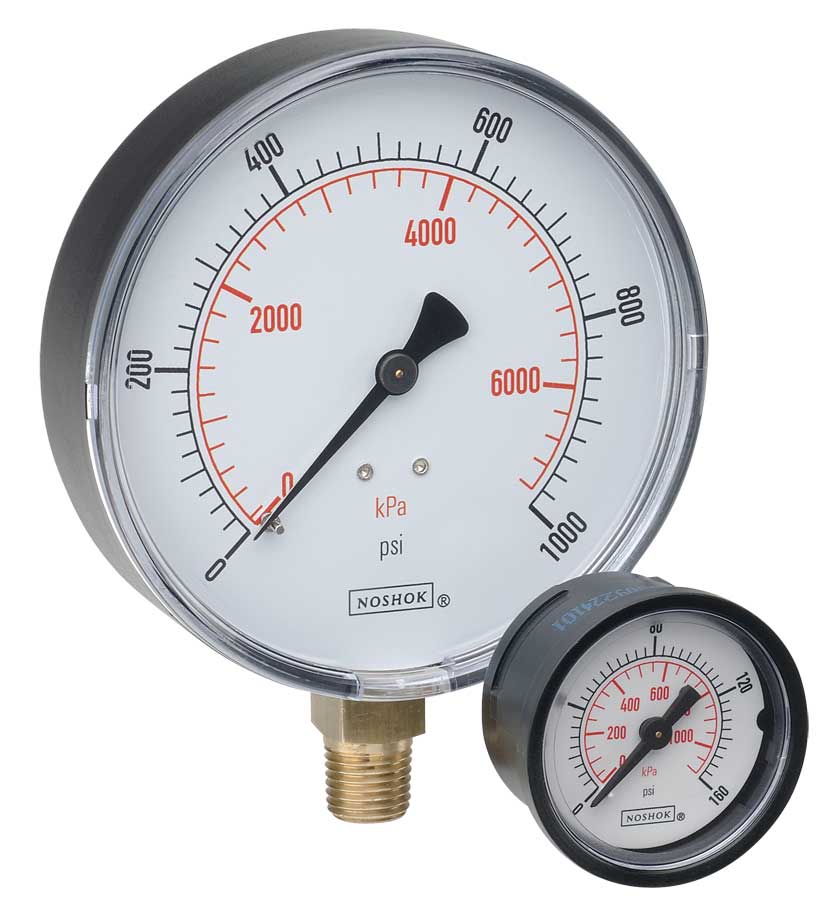 NOSHOK ABS & Steel Dry Pressure Gauges 100 series
 NOSHOK Low Pressure Dry Pressure Gauges-( 200 series)
 NOSHOK PT40 Series High Accuracy Transmitters-Replaces 100,200,615 series
