

Preventing Pressure Gauge Failure in Corrosive Environments

Last Updated: October 23, 2026
Quick Summary
Preventing pressure gauge failure in corrosive environments starts with matching wetted parts to the process fluid, since chemical attack on the Bourdon tube, socket, and movement is the leading cause. Add a diaphragm seal when no standard material passes, and inspect gauges monthly, quarterly, and annually.
- Corrosion thins, pits, or cracks the Bourdon tube from the inside until it leaks or bursts.
- Check compatibility at the concentration, temperature, and pressure present at the gauge tap, not the reactor.
- A diaphragm seal isolates wetted parts but adds response lag and a small accuracy penalty.
- Size the range so normal operating pressure reads mid-scale, and add a siphon for steam service.
- Replace gauges showing tube pitting, a compromised case, or drift that calibration cannot correct.
Table of Contents
- Why Pressure Gauges Fail in Corrosive Environments
- Pressure Gauge Failure Causes: Symptoms You Can Spot Early
- Pressure Gauge Material Compatibility Chart: Matching Wetted Parts to Process Fluid
- Pressure Gauge Diaphragm Seal for Corrosive Media: Selection and Installation
- Pressure Range, Overpressure Protection, and Gauge Type Selection
- Pressure Gauge Maintenance Checklist for Corrosive Service
- Troubleshooting Decision Tree: Diagnosing a Suspect Gauge
- Conclusion
- Frequently Asked Questions
Why Pressure Gauges Fail in Corrosive Environments
A pressure gauge failure in corrosive service rarely happens overnight. It builds slowly, starting the day the wrong wetted part meets the wrong chemical.
Pressure gauge failure is the loss of accurate pressure measurement caused by damage to the gauge’s internal components, most often from chemical attack, overpressure, or mechanical wear. In corrosive service, the process fluid attacks the Bourdon tube, socket, and movement from the inside out.
Corrosion is quiet. The gauge reads fine until the tube wall thins, cracks, and leaks. By then you have a safety incident, not a bad reading.
The Four Corrosion Mechanisms That Attack Gauges
- General corrosion thins the Bourdon tube evenly until it bursts under pressure.
- Pitting drills small holes that become leak paths through the tube wall.
- Stress corrosion cracking splits a stressed tube with no visible warning.
- Galvanic corrosion eats the joint where two dissimilar metals meet, usually at the socket.
Pressure Gauge Failure Causes: Symptoms You Can Spot Early
Most failing gauges tell you something is wrong before they quit. These are the pressure gauge failure causes we see most often in corrosive service, and the symptoms that give them away:
- Fogged or discolored window: moisture or chemical vapor inside the case
- Pointer stuck at zero or pegged high: tube rupture or blocked inlet
- Erratic needle movement: clogged port or worn movement
A gauge that reads zero when the line is pressurized is not “broken.” It may have a ruptured tube venting process fluid. Isolate the line before you touch it.
Pressure Gauge Material Compatibility Chart: Matching Wetted Parts to Process Fluid
Material selection is where most corrosion problems are won or lost. Wetted parts, the Bourdon tube, socket, and any seal diaphragm, protect the internals from the process; the case protects them from the outside.
| Process Fluid Type | Recommended Wetted Material | Avoid |
|---|---|---|
| Clean water, air, oil | Brass or 316 stainless steel | Nothing critical |
| Dilute acids, mild chemicals | 316 stainless steel | Brass, carbon steel |
| Chlorides, seawater | Monel or Hastelloy | 316 stainless steel |
| Strong acids, oxidizers | Hastelloy or PTFE-lined | Brass, 316 stainless steel |
| Food and sanitary service | 316L stainless, sanitary fittings | Brass, exposed threads |
| High-pressure hydraulic | 316 stainless steel | Brass at high pressure |

A Practical Chemical-Compatibility Selection Workflow
A material that passes at ambient temperature and dilute concentration can fail at 200 °F and full strength. Compatibility is a set of conditions, not a yes-or-no answer. Work through this sequence every time you specify a gauge for a new fluid:
- List every chemical in the process, including trace components, cleaning agents, and flush fluids. A trace chloride in an otherwise benign stream is enough to crack a 316 stainless tube.
- Record concentration and temperature at the gauge location, not at the reactor, a sample line or dead leg may see a different condition than the main process.
- Note the operating pressure and any upset pressure, because stress accelerates stress-corrosion cracking and pitting.
- Check the manufacturer’s compatibility data for each wetted material against each chemical at that concentration and temperature. Use corrosion tables as a screening tool, not a guarantee.
- Choose the least expensive material that passes every check. Over-specifying Hastelloy for a mild caustic stream adds cost and lead time without adding life.
- Add a diaphragm seal if no standard wetted material passes, or if the fluid is viscous, sanitary, or hazardous.
- Document the fluid, concentration, temperature, pressure, and chosen materials so the next engineer does not repeat the work.
How Concentration, Temperature, and Pressure Change the Answer
Three variables move a material from acceptable to unacceptable:
- Concentration: 316 stainless handles dilute sulfuric acid in some cold, low-concentration services but is attacked rapidly as concentration and temperature rise.
- Temperature: corrosion rates climb with temperature, and chlorides harmless at ambient can cause stress-corrosion cracking in hot 316 stainless. A gauge near a steam trap sees a harsher environment than the process fluid alone suggests.
- Pressure and stress: a Bourdon tube is a stressed part by design, and stress-corrosion cracking needs both a susceptible alloy and tensile stress, high-pressure chloride service is a classic failure combination for 316 stainless.
Selecting on the fluid name alone, then discovering the gauge fails at the temperature and concentration actually present at the tap, is a common pattern. Build the selection around the worst credible combination, not the nominal one.
For authoritative material guidance, the NACE International corrosion standards and OSHA process safety guidance are good starting references. When the fluid is hazardous or the consequence of failure is high, have a qualified engineer approve the material and installation choice rather than relying on a table alone.
Pressure Gauge Diaphragm Seal for Corrosive Media: Selection and Installation
A pressure gauge diaphragm seal for corrosive media is a barrier that isolates the gauge’s wetted parts from the process fluid, transmitting pressure through a fill fluid. It is the single most effective way to stop corrosion from reaching the Bourdon tube, but it is also a measurement system with its own trade-offs: a poorly selected or installed seal will protect the gauge and still give you a wrong reading.
Seal Selection: The Four Choices That Matter
Selection comes down to four choices, each affecting both protection and accuracy:
- Diaphragm material: match to the process fluid, same as wetted parts. Elastomer diaphragms (PTFE, PTFE-lined) suit aggressive chemicals and low pressures; metal diaphragms (316L, Hastelloy, Monel) suit higher pressures and temperatures. A thin elastomer diaphragm is more sensitive but less rugged; a metal diaphragm is tougher but needs more pressure to deflect.
- Fill fluid: silicone, glycerin, or halocarbon, chosen for temperature range and compatibility. Silicone is the common general-purpose fill; glycerin suits some food and pharmaceutical services but has a narrower temperature band; halocarbon fills suit low-temperature and some oxidizing services. The fill must stay liquid across the entire ambient and process temperature range, or the gauge will read wrong.
- Connection type: threaded, flanged, or sanitary clamp, matched to the process piping and cleaning regime. Sanitary clamps come apart for cleaning; threaded connections are simpler but harder to clean in place.
Fill Fluid, Capillary, and Accuracy Trade-offs
The seal plus fill plus capillary forms a closed hydraulic system, and every element adds lag and error:
- Fill fluid volume: more fill means more thermal expansion and more response lag. Keep it as small as the installation allows.
- Capillary length and diameter: a long, narrow capillary slows response and makes the reading sensitive to temperature changes along its run. Keep it short and route it away from hot surfaces and vibration.
- Temperature effects: a filled system reads the fill fluid’s expansion as pressure, so a seal exposed to a different temperature than the gauge will drift. Some installations use a cooling element or a longer capillary to move the seal away from heat.
A seal typically adds response lag measured in seconds and a small accuracy penalty versus a direct-mounted gauge. That is usually acceptable for corrosion protection, but not for fast pressure spikes or tight control loops, there, consider a direct-mounted gauge in a corrosion-resistant alloy, or a transmitter with a seal, rather than a gauge plus a long capillary. Maintaining precision in these demanding applications requires regular attention to the process of calibrating pressure sensors to ensure that the inherent offsets of the seal system do not drift beyond acceptable operational tolerances.
Installation Mistakes That Cause Seal Failures
Installation mistakes cause most seal failures. Mount the seal close to the tap, keep the capillary short, and support the gauge so the seal isn’t bearing weight. Fill the system completely; trapped air makes the gauge sluggish and inaccurate. Use the correct fill procedure for the fill fluid and the seal type, and do not mix fill fluids.
Mount the seal so the diaphragm sits below the gauge. Any trapped air rises to the gauge and causes a slow, drifting reading that looks like a bad gauge but is really a fill problem.
When a Seal Is the Wrong Answer
A diaphragm seal is not automatic. Skip it when the process fluid is compatible with a standard wetted material and the service needs fast response or tight accuracy. Add it when the fluid attacks the gauge, is viscous or contains solids that would clog a Bourdon tube, when the service is sanitary, or when the fluid is hazardous and a gauge leak would be a safety event.
Pressure Range, Overpressure Protection, and Gauge Type Selection
Pick the pressure range first. A gauge should read mid-scale at normal operating pressure, so a 100 psi line gets a 0-200 psi gauge, not a 0-1000 psi one.
Then add protection:
- Overpressure protector for lines that see pressure spikes
- Relief valve upstream to cap surges
- Siphon for steam service to protect against extreme temperatures
Gauge type follows the application. Liquid-filled gauges handle vibration. Process gauges with solid fronts suit high-pressure and hazardous service. Sanitary gauges with clamp fittings serve food and beverage lines.
For high-pressure oil and gas service, confirm the gauge’s pressure rating against the line’s maximum, not its normal, operating pressure.
Pressure Gauge Maintenance Checklist for Corrosive Service
Preventive maintenance is cheaper than a production stop. Run this checklist on every gauge in corrosive service:
- Check the reading against a known reference or calibrated transmitter
- Inspect the window for fogging, cracking, or discoloration
- Look for leaks at the socket and connection threads
Inspection Intervals and Replacement Criteria
Inspect gauges in corrosive service more often than standard gauges: a visual check monthly, a calibration check quarterly, and a full inspection annually, with frequency increased after any leak, process change, or near miss.
Replace the gauge when:
- The needle drifts beyond acceptable accuracy
- The Bourdon tube shows pitting or discoloration
- The case is cracked or the window is compromised
Mass Measure offers repair and calibration services, so a suspect gauge can be evaluated before you replace it outright. That often saves the cost of a new instrument.
Troubleshooting Decision Tree: Diagnosing a Suspect Gauge
When a gauge looks wrong, work through this sequence before you pull it:
- Is the line actually pressurized? Confirm with a second gauge or transmitter.
- Is the needle stuck at zero? Check for a blocked inlet or ruptured tube.
- Is the needle pegged high? Look for overpressure or a stuck movement.
- Is the reading erratic? Check for a clogged port, air in a seal, or vibration.
- Is there moisture in the case? The case seal has failed; replace the gauge.
- Is there a leak at the socket? Galvanic corrosion or a bad thread seal.
- Does it drift after calibration? The tube is degrading; plan replacement.
Most “bad gauges” are actually bad installations. Before you replace an instrument, check the tap, the seal fill, and the mounting. Fix the cause, not just the symptom.
If the fault traces back to material choice, revisit the compatibility workflow. If it traces back to the gauge itself, a NOSHOK replacement from Mass Measure arrives with a manufacturer-backed warranty and verified authenticity.
Conclusion
Corrosive service punishes shortcuts. The plants that avoid pressure gauge failure match wetted parts to the fluid, add a diaphragm seal when needed, and inspect on a real schedule, that discipline separates a reliable instrument from a recurring problem.
Mass Measure supplies the full NOSHOK line with in-stock availability and competitive bulk pricing, backed by over 50 years of field experience. We also handle repair and calibration, so your gauges stay accurate through their full lifecycle.
Frequently Asked Questions
What causes pressure gauges to fail in corrosive environments?
The most common pressure gauge failure causes in corrosive service are chemical attack on the Bourdon tube and socket, galvanic corrosion between dissimilar metals, chloride stress cracking of stainless steel, and abrasion from slurries that wears through thin tube walls. Each starts as a slow loss of wall thickness or a pinhole leak, then turns into a burst tube, fogged window, or a gauge that reads zero under pressure. Vibration and overpressure accelerate all four. Catching the symptoms early, such as discoloration, leakage at the socket, or a drifting needle, is what separates a planned swap from an unplanned shutdown.
How do you choose a pressure gauge for corrosive media?
Start with the wetted parts, not the dial. Identify the process fluid, its concentration, and its temperature, then check each wetted component (Bourdon tube, socket, movement, and any seal) against a pressure gauge material compatibility chart. Confirm the case material suits the surrounding atmosphere too, since washdowns and fumes attack the outside as readily as the inside. If no affordable wetted material holds up, isolate the gauge with a diaphragm seal instead of upgrading to an exotic alloy. Finally, set the pressure range so normal operation sits near mid-scale and add overpressure protection.
When should you use a diaphragm seal with a pressure gauge?
Use a pressure gauge diaphragm seal for corrosive media when the fluid would attack the Bourdon tube, when the fluid is viscous, slurried, or prone to clogging, or when extreme temperatures would distort the gauge reading. The seal puts a flexible diaphragm between the process and the instrument, and the cavity behind it is filled with a clean transfer fluid. Choose the diaphragm material for chemical compatibility, match the fill fluid to the temperature range, and mount the seal so the capillary stays free of air pockets. A correctly sized seal protects the gauge without sacrificing accuracy.
How often should pressure gauges in corrosive service be inspected?
A workable starting point is a visual check every month and a full calibration check every six to twelve months, tightened to quarterly for aggressive chemicals, high vibration, or gauges that have already failed once. Build a pressure gauge maintenance checklist that records the reading against a reference gauge, the condition of the case and window, leakage at the socket or seal, and any discoloration or pitting. Replace the gauge when the error exceeds its accuracy class, when the tube shows visible corrosion, or when the case has cracked. Calibration records make the replacement decision objective instead of a judgment call.

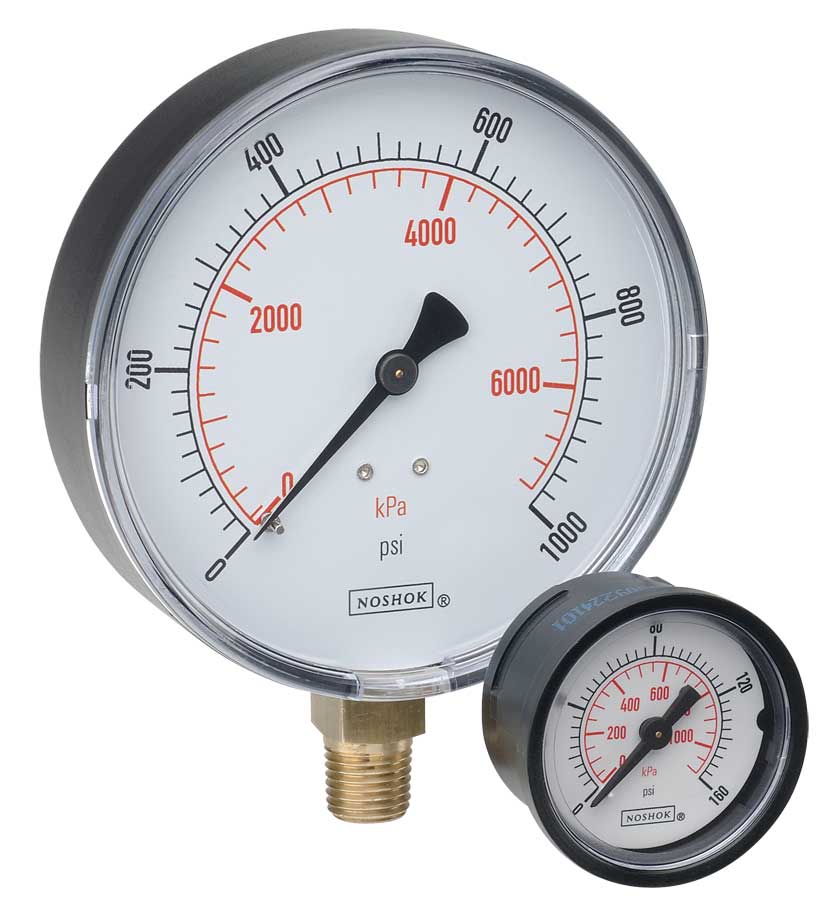 NOSHOK ABS & Steel Dry Pressure Gauges 100 series
 NOSHOK Low Pressure Dry Pressure Gauges-( 200 series)
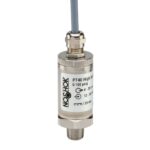 NOSHOK PT40 Series High Accuracy Transmitters-Replaces 100,200,615 series
